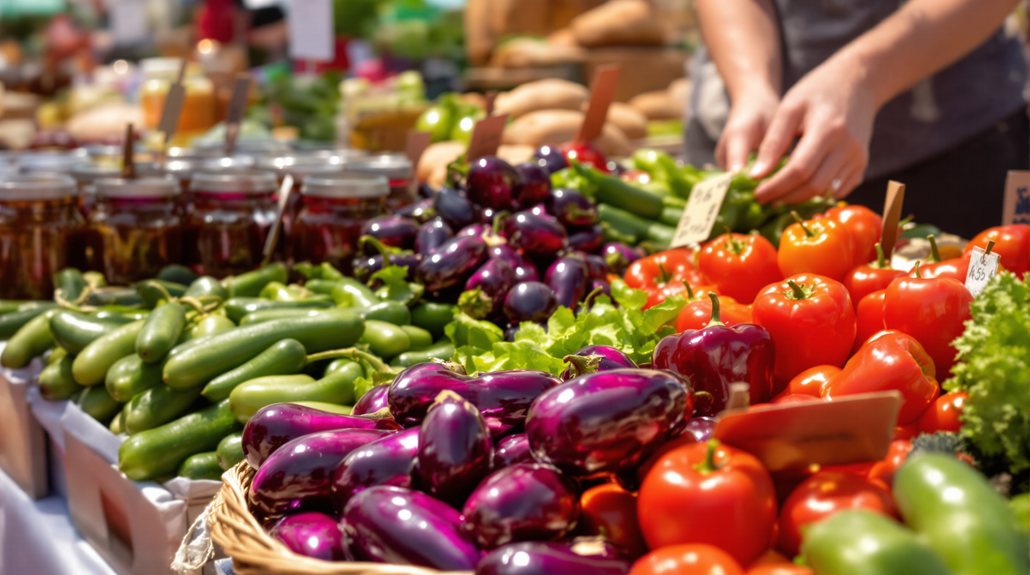
Jam and bread fill 75% to 80% of most markets, which kills your pricing power before you even set up. Microgreens appear in fewer than 40% of US markets, sell for $5 to $15 per unit, and carry margins of 65% to 80%. You’re not competing with three other vendors — you’re often the only one. That gap is where the profit is, and there’s a specific way to find it near you.
Key Takeaways
- Baked goods and jams appear in over 75% of markets, creating heavy competition that eliminates pricing power and shrinks margins significantly.
- Microgreens appear in fewer than 40% of US markets, meaning most vendors face zero direct competitors and retain strong price control.
- Microgreens sell for $5 to $15 per unit with margins typically running 65% to 80%, outperforming saturated commodity categories consistently.
- A 10×10 grow space produces sellable crops every 7 to 14 days, enabling faster turnover and higher revenue per square foot.
- Scouting markets for categories with zero vendors, particularly microgreens, reveals open opportunities to set prices without competitive pressure.
What actually sells best at a farmers market in terms of profit?
Most vendors answer the profit question wrong. They list baked goods, jams, and candles because those items are familiar.
That familiarity is exactly the problem.
Why baked goods and jams are the wrong answer to the most profitable question
Baked goods and jams feel like the obvious answer, but they’re the wrong one. Every market already has three jam vendors and two bread tables.
That saturation kills your price control.
Microgreens are the most profitable farmers market crop because they appear in fewer than 40% of US markets. Low competition means you set the price.
| Category | Market presence | Price control |
|---|---|---|
| Baked goods | High (80%+ of markets) | Low |
| Jams and preserves | High (75%+ of markets) | Low |
| Microgreens | Low (under 40% of markets) | High |
The gap in that table is your opening. You’re not fighting for shelf space. You’re filling a hole most vendors ignore.
What the data shows about which vendor categories have the least competition
When you look at vendor category data, the pattern is hard to ignore. Baked goods, jams, and crafts appear at more than 80% of US farmers markets.
Specialty produce, including microgreens, shows up in fewer than 40% of markets. That’s the finding from Lee and Miller 2026.
Fewer vendors in a category means less price pressure on you. Microgreens farmers market profit works because you’re not fighting five other tables selling the same thing.
Most markets have two to four jam vendors. Most have zero microgreens vendors.
That gap is real, and other growers in the know are already moving into it. The category is under-represented, customer interest is growing, and the margin data backs the move.
Why are specialty crops like microgreens more profitable than traditional farmers market products?
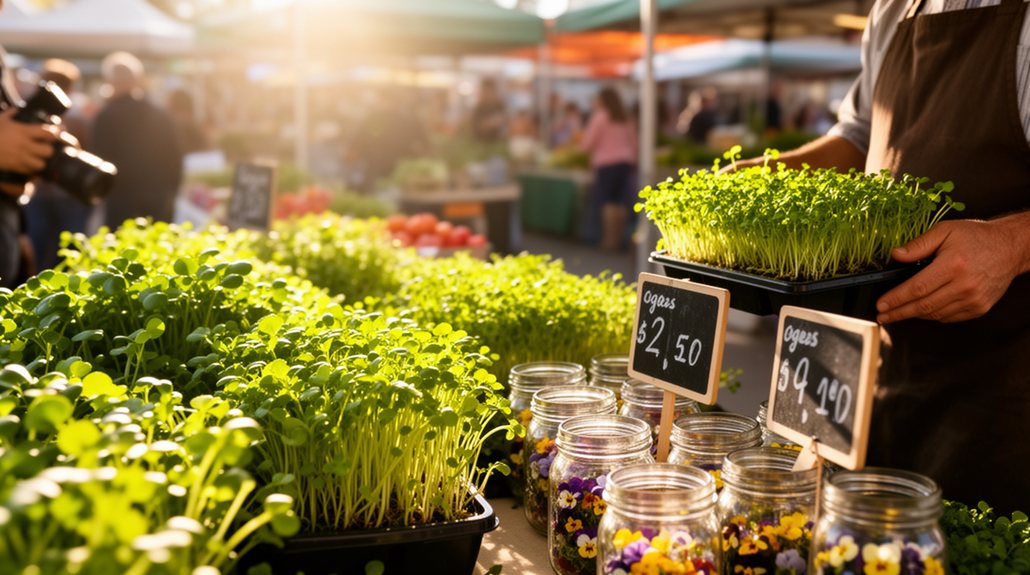
The supply gap at most farmers markets is real and measurable. Specialty produce like microgreens appears in fewer than 40% of US markets, according to Lee and Miller 2026.
That gap means less competition and more pricing power for you.
What the supply gap at most markets means for vendors willing to fill it
At most U.S. farmers markets, baked goods, jams, and honey fill 60% or more of vendor slots.
That’s where price competition kills your margin.
Lee and Miller (2026) found microgreens appear in fewer than 40% of U.S. markets. That gap is your opening.
When you’re the only microgreens vendor at a market, you set the price. You’re not matching anyone. Microgreens farmers market profit works because low supply meets real customer demand.
A 10×10 grow space produces sellable trays in 7 to 14 days. You’re turning inventory fast with little capital sitting idle.
Baked goods vendors at the same market waited years to see $5 to $15 per unit returns. You can start there on week one.
How lower competition at most markets supports higher pricing on specialty produce
Because most market vendors sell the same five things, specialty produce vendors don’t compete on price. You set the price. That’s the difference.
Baked goods and jams have five competitors at the same market. Microgreens often have zero.
When you’re the only microgreens vendor, customers can’t comparison shop. They buy from you or they don’t buy at all. That’s real price control.
Microgreens sell at $5 to $15 per unit at farmers markets. Margins run 65% to 80%. That’s what makes microgreens the most profitable thing to sell at a farmers market for vendors who understand the gap.
Low competition means you belong to a different category entirely. You’re not undercutting anyone. You’re defining the price floor yourself.
What does commercial expansion in microgreens tell farmers market vendors?
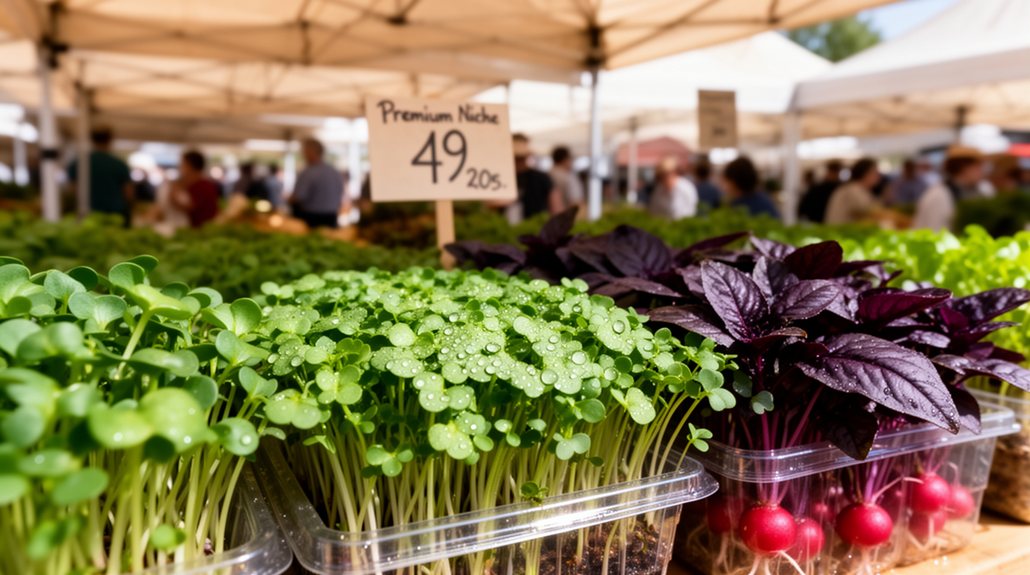
When big commercial players move into a category, they prove the demand is real.
Sunswell Greens expanded to 300+ Southeast retail stores in 2026.
BrightFarms presented microgreens as a premium value-added crop at West Coast Produce Expo 2026.
That’s your signal.
Why Sunswell Greens and BrightFarms expanding into retail proves the demand signal
Commercial expansion is a demand signal. Sunswell Greens moved into 300+ Southeast retail stores in 2026. BrightFarms presented microgreens as a premium crop at West Coast Produce Expo 2026.
These aren’t small operators testing ideas. They’re commercial players proving that buyers want microgreens at scale.
That matters for you. When big producers enter a category, they build awareness. Customers start recognizing the product. Your farmers market booth benefits from that awareness without competing at retail volume.
You’re selling fresh, local, and direct. That’s where you win.
Microgreens are consistently the most profitable farmers market product in under-supplied markets. Commercial growth proves the demand is real. Your job is to show up where the big players aren’t. Local markets are that place.
How commercial growth creates opportunity for local market vendors
Retail expansion by Sunswell Greens and BrightFarms tells you one thing: buyers already want this product.
Those companies sell to stores. You sell direct. That’s your edge.
A retail buyer gets microgreens that traveled days to reach the shelf. Your customer gets product cut that morning. Freshness is your competitive advantage, and no chain store can match it.
Commercial growth also does your marketing work. When Sunswell Greens lands 300 stores across the Southeast, more people learn what microgreens are. You show up at a farmers market and the education is already done.
Microgreens farmers market profit comes from that combination. Category demand is rising. Local supply is still thin. You’re not competing with BrightFarms. You’re filling the gap they can’t reach.
How does the revenue per square foot principle apply to farmers market products?
Space is your limiting factor at any farmers market booth.
A 10×10 grow area producing microgreens generates more revenue per square foot per week than most traditional vegetable crops.
A 7 to 14 day grow cycle means you’re restocking inventory every one to two weeks instead of waiting months.
Why short-cycle crops produce more per unit of space than traditional vegetables
Measuring revenue per square foot changes how you think about what to grow.
A tomato plant takes 60 to 80 days to produce. A short cycle crop farmers market growers count on, like microgreens, turns in 7 to 14 days.
That means you can run four to eight harvests in the same time one tomato plant matures once.
A 10×10 grow area producing microgreens generates more weekly revenue per square foot than almost any traditional vegetable crop. You’re not waiting on weather or long root development.
Other vendors are locked into slow cycles. You’re not. That gap in turnover speed is where your margin lives.
What 7 to 14 day crop cycles mean for weekly market inventory
That fast turnover isn’t just a growing advantage. It’s a weekly inventory reset that most vendors never get.
Baked goods and jams sit until they sell. Microgreens are planted, grown, and harvested in 7 to 14 days. You can time each tray to hit your market date.
Microgreens typically sell at $5 to $15 per unit at farmers markets. A 10×10 grow area can cycle multiple trays per week. That’s consistent product on your table every Saturday.
Other vendors wait on seasons. You wait on days.
That cycle also means low capital tied up at any one time. You’re not holding inventory for months. You grow what you need, when you need it, and sell it fresh.
How do you find markets with the biggest specialty produce gap near you?
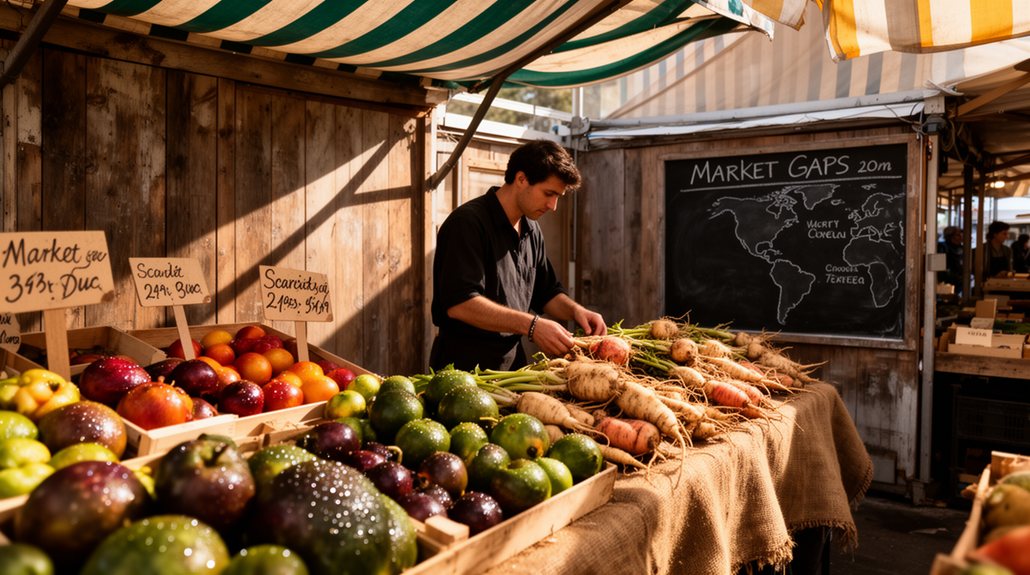
You don’t pick a market because it’s close. You pick it because the specialty produce gap is real there and nobody’s filled it yet.
The MGW Market Finder lets you search 7,842 USDA-verified markets by zip code, city, or state to check vendor categories before you apply.
How to identify under-served markets before the competition does
Scout the market before you apply. Walk the vendor rows and count every specialty crop booth. If you see fewer than two, the specialty crop farmers market profit opportunity is real.
| What to look for | What it signals |
|---|---|
| No microgreens vendor | Open category |
| One herb seller only | Low competition |
| Three jam booths | Saturated |
| No living greens at all | Strong entry point |
| Repeat customers asking vendors | Proven demand |
Talk to the market manager directly. Ask what categories they’re trying to fill.
The MGW Farmers Market Finder has 7,842 USDA-verified markets searchable by zip code, city, or state. Use it to find and compare markets near you before you apply – markets.microgreensworld.com.
The Microgreens Growth Path Tool maps your first move using local market data – growthpath.microgreensworld.com.
How to use the MGW Market Finder to search by market type and location
Walking a market gives you a snapshot. The MGW Farmers Market Finder gives you the full picture before you even leave your house.
Go to markets.microgreensworld.com. Search by zip code, city, or state. Filter results by market type to compare indoor, outdoor, and year-round options.
Look at vendor category data for each result. Markets showing low specialty produce representation are your targets. That’s where what sells best at farmers market shifts from crowded to open.
The MGW Farmers Market Finder has 7,842 USDA-verified markets searchable by zip code, city, or state. Use it to find and compare markets near you before you apply – markets.microgreensworld.com.
The Microgreens Growth Path Tool maps your first move using local market data – growthpath.microgreensworld.com.
Frequently Asked Questions
How Much Space Do You Need to Start Selling Microgreens at Markets?
You don’t need much. A 10×10 grow area can produce enough to stock a farmers market booth. Most growers start with even less and scale up after their first few sales.
Do You Need a License to Sell Microgreens at a Farmers Market?
You’ll likely need a cottage food permit or produce handler’s license, depending on your state. Check with your state’s department of agriculture before your first market day.
How Do You Price Microgreens When You Are a New Vendor?
You start at $6 to $10 per clamshell. Watch what sells fastest. If you sell out before noon, raise your price next week by $1.
What Microgreens Varieties Sell Fastest at Farmers Markets?
Sunflower, pea shoots, and radish move fastest. Spicy mix and broccoli are close behind. These five varieties hit the widest range of buyers and repeat the most consistently across markets.
How Many Trays per Week Do You Need to Run a Profitable Booth?
You’ll need 15 to 20 trays per week to cover booth costs and turn a real profit. Most growers who stick with it start at 10 trays and scale up within 60 days.