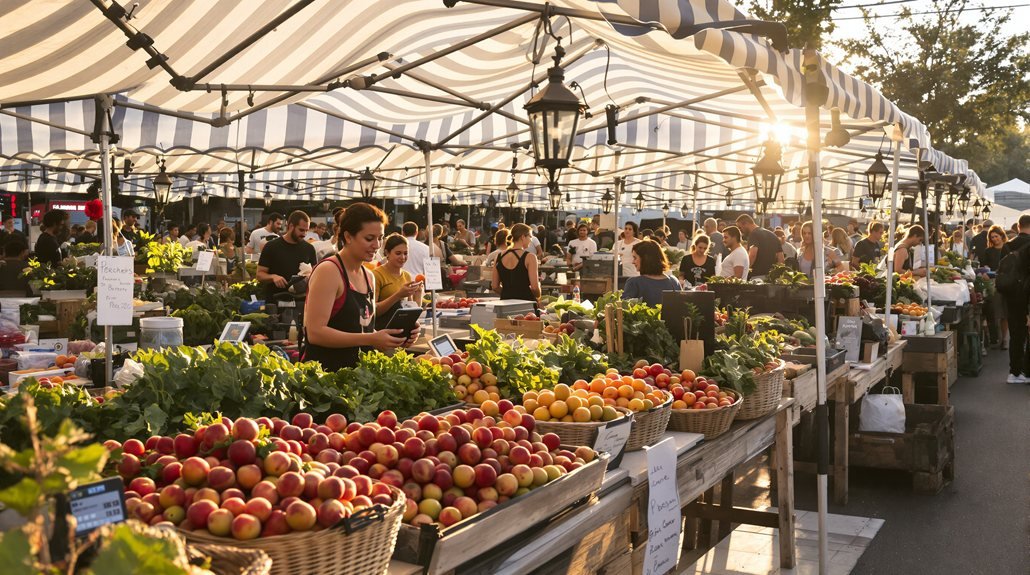
You can find farmers markets that accept SNAP and EBT near you using the MGW Market Finder at markets.microgreensworld.com — it filters by location and pulls from USDA data. Once you’re there, the market either swipes your card at a central booth and gives you tokens or runs a wireless terminal directly at the vendor’s booth. Both work like cash. Vendors benefit too — SNAP-accepting markets bring steadier foot traffic and more repeat customers. There’s more worth knowing before you go.
Key Takeaways
- Use the MGW Market Finder at markets.microgreensworld.com to locate nearby SNAP/EBT-accepting farmers markets using a built-in USDA-sourced filter.
- Confirm market hours, SNAP acceptance, and whether a token system or wireless terminal is used before visiting.
- SNAP covers fresh produce and food-producing plants like microgreens, but not hot foods, alcohol, or non-food items.
- Vendors must obtain USDA SNAP retailer authorization through fns.usda.gov before accepting EBT at their market stall.
- SNAP-accepting markets attract broader, mixed-income customer bases, generating higher foot traffic and more repeat buyers for vendors.
Farmers Markets That Accept SNAP and EBT Near You (And Why It Matters for Vendors Too)
Whether you’re shopping on a tight budget or trying to sell at a farmers market, SNAP acceptance changes the equation for both sides of the table.
Since 2014, the number of SNAP-authorized farmers markets in the U.S. has grown from under 2,000 to more than 8,000, which means more buyers with purchasing power and more competition for vendor spots at those markets.
That’s not a small shift — it’s reshaped who shows up, who buys, and what sells.
How SNAP Changed the Customer Mix at Farmers Markets
SNAP acceptance at farmers markets quietly drew in a whole new wave of shoppers who weren’t showing up before. SNAP benefits farmers market access opened the door for families who relied on grocery stores simply because that’s where their card worked. Now those same families shop alongside longtime regulars.
| Before SNAP acceptance | After SNAP acceptance |
|---|---|
| Mostly higher-income shoppers | Mixed income customer base |
| Smaller weekly foot traffic | Increased consistent attendance |
| Narrower community connection | Broader neighborhood participation |
That shift changes the whole feel of a market. You’re not selling to one type of person anymore. You’re part of something the whole community uses. For vendors, that’s not just good optics. That’s real, recurring foot traffic from people who come back weekly.
Why This Is a Different Conversation for Buyers and Sellers
Buying with SNAP at a farmers market and accepting SNAP as a vendor are two completely different problems to solve. If you’re a buyer, your question is simple: which EBT farmers market is near me and what can I get there? If you’re a vendor, the question goes deeper. You need federal authorization, the right equipment, and a clear understanding of what your customers actually need from you.
Neither perspective is more crucial than the other. But mixing them up creates confusion fast.
This article speaks to both of you directly. When the advice is for buyers, it’s for buyers. When it shifts to vendors, you’ll know. You belong in this conversation either way.
How Do You Find Farmers Markets That Accept SNAP Near You?
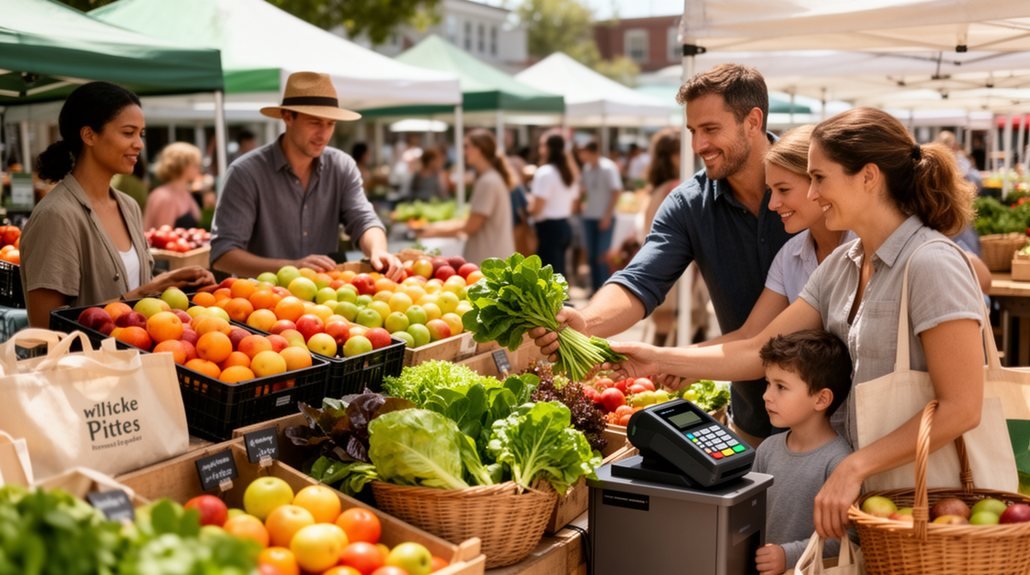
Finding a SNAP-accepting farmers market used to mean calling around or just hoping for the best. The MGW Market Finder at markets.microgreensworld.com has a built-in SNAP/EBT filter that pulls from USDA data, so you can search by location and filter results to show only markets that accept EBT.
Before you go, confirm the market’s current hours and check whether they employ a token system or a wireless terminal, since both are valid but work differently at the booth.
Using the MGW Market Finder SNAP Filter
If you’ve ever tried searching “farmers market SNAP near me” and gotten a wall of outdated Yelp results, you’re not alone. Most search results don’t tell you whether a market currently accepts EBT or not.
That’s exactly what the MGW Farmers Market Finder addresses. Head to markets.microgreensworld.com and utilize the built-in SNAP/EBT filter. It pulls live data from the USDA, so you’re not guessing. Just set your location, flip the filter on, and you’ll see farmers market SNAP EBT options near you.
No more calling ahead. No more showing up and finding out the hard way.
Whether you’re shopping or selling, this tool puts you in the right place with the right community around you.
What to Check Before You Go
The SNAP/EBT filter at markets.microgreensworld.com gets you a solid list, but there’s a short checklist worth running through before you load up your bags and head out. Understanding SNAP at farmers market how it works saves you a wasted trip.
| What to check | Why it matters | Where to confirm |
|---|---|---|
| SNAP acceptance is current | Listings change seasonally | Call the market directly |
| EBT terminal or token system | Some markets use wooden tokens instead of cards | Market website or social page |
| Operating hours and dates | Many markets run spring through fall only | USDA market directory |
| Vendors selling produce | Not every booth takes SNAP | Ask the market manager |
How Does SNAP Work at a Farmers Market Booth?

If you’ve never utilized an EBT card at a farmers market before, the process is simpler than it sounds.
Most SNAP-accepting markets utilize a token system — you bring your EBT card to a central market booth, swipe it for a dollar amount, and receive wooden or plastic tokens you spend at any participating vendor table.
Your card covers the same eligible foods it covers at a grocery store: fruits, vegetables, and other staple food items, which means microgreens qualify.
What EBT Cards Can Buy at a Vendor Table
Most EBT cards work the same way at a farmers market booth as they do at a grocery store — you’re spending SNAP benefits on eligible food items. That means fresh produce, seeds, and plants that grow food all qualify.
| Eligible with EBT | Not eligible with EBT |
|---|---|
| Fresh microgreens | Hot prepared foods |
| Vegetables and fruit | Alcohol or tobacco |
| Food-producing seeds | Non-food items |
Using your ebt card farmers market visit means you buy the same things you’d grab at any store. Raw, edible, and unheated. That’s the rule. Microgreens sold fresh at a booth clear that bar easily. If something’s cooked on-site and served warm, SNAP won’t cover it.
How the Token or Card Transaction Works at Market
Paying with EBT at a farmers market booth operates a little differently than swiping your card at a grocery store, but it’s not complicated once you see it once.
Most markets run a central cashier station. You bring your EBT card there, tell them how much you want to spend, and they process the transaction. In return, you get wooden or plastic tokens worth the same dollar amount. Then you spend those tokens directly at any vendor who agreed to accept SNAP at farmers market booths.
Some markets skip the token system entirely and make use of a wireless EBT terminal right at the booth. Either way, the tokens or the terminal act like cash. Nothing marks you as different from any other shopper.
What Is the WIC Farmers Market Nutrition Program?

WIC and SNAP are two completely different programs, and mixing them up at a market booth can cost you a sale.
WIC stands for Women, Infants, and Children — it’s a federal nutrition program that issues paper vouchers or checks specifically for fresh fruits and vegetables at approved farmers markets, not a general-purpose EBT card.
Some states run much stronger WIC Farmers Market Nutrition Program (FMNP) operations than others, with California, New York, and Pennsylvania consistently distributing the highest volume of FMNP benefits to market vendors.
How WIC Benefits Differ From SNAP at Markets
Although both programs help low-income families buy food, SNAP and WIC work very differently at the farmers market. SNAP loads onto an EBT card like a debit card. You swipe it and buy what you need. WIC is more specific. It gives you vouchers or checks tied to particular foods — think fruits, vegetables, dairy, and grains. You can’t just buy anything.
At a farmers market, WIC vouchers are accepted only at authorized vendors. Not every SNAP booth qualifies for WIC automatically. That’s a separate authorization process.
If you’re searching for markets using a snap farmers market locator, confirm which programs each market accepts. The two lists don’t always overlap. Knowing the difference saves you a wasted trip.
Which States Have the Strongest WIC Market Programs
The WIC Farmers Market Nutrition Program — known as FMNP — is a federal benefit that gives WIC participants extra money specifically to spend at farmers markets. It runs separately from regular WIC benefits.
Not every state participates. Currently, around 25 states run active FMNP programs. States with the strongest programs include California, New York, Pennsylvania, and Michigan. These states fund higher voucher amounts and partner with more markets.
If you’re a vendor in one of these states, getting into a WIC FMNP market opens your booth to a dedicated group of shoppers who’ve money set aside specifically for fresh produce. Microgreens qualify.
Check your state’s WIC agency directly to confirm current participation and voucher values in your area.
Why Should Vendors Care Which Markets Accept SNAP?

Choosing a SNAP-accepting market directly influences who shows up to buy from you. Markets that accept SNAP tend to draw a wider mix of shoppers, including buyers who prioritize fresh produce and visit consistently.
Vendors at these markets report steadier foot traffic and repeat customers, which matters more than a single high-sales day.
How SNAP Acceptance Changes the Customer Mix at a Market
Vendors often overlook market selection as a competitive decision, but it directly shapes who walks past your booth.
A farmers market with EBT accepted draws a wider slice of the community. That includes working families, seniors on fixed incomes, and people who genuinely want fresh food but are watching every dollar.
That customer isn’t just a transaction. They’re often a loyal, repeat buyer once they find a vendor they trust.
Markets without SNAP pull from a narrower pool. You’re competing for the same weekend shoppers everyone else wants.
SNAP-enabled markets shift that dynamic. You’re not adding charity to your business model. You’re adding people. And people who feel welcomed at a market tend to come back.
What Vendors Report About Sales at SNAP-Friendly Markets
Sales numbers tell the real story here. Vendors at SNAP-accepting markets consistently report higher foot traffic and more repeat customers than at markets without EBT access. That’s not a coincidence. When you search “farmers market SNAP near me” and show up at one of those locations, you’re walking into a market that’s already built trust with a wider community.
Microgreens vendors specifically note that SNAP customers often buy weekly once they uncover a product they like. That kind of loyalty adds up fast. You’re not chasing new faces every weekend. You’re building regulars.
The market itself matters as much as your booth. Picking the right location means you’re already positioned where consistent, returning buyers are showing up.
How Do You Apply to Accept SNAP at Your Booth?

Accepting SNAP at your booth starts with two things: a USDA SNAP retailer authorization and a way to process EBT payments on-site. You apply for that authorization directly through the USDA Food and Nutrition Service website, and the process is free.
Once you’re approved, you’ll need a wireless EBT terminal or you can work through your market’s token system if they’ve one set up.
The Authorization and Equipment You Need
To sell with SNAP at your booth, you need two things: a USDA retailer authorization and a way to process EBT transactions. The authorization comes first — apply at fns.usda.gov. Equipment comes second. Most vendors use a wireless EBT terminal or a snap token system farmers market programs often run through the market itself.
| Item | What it is | Where to get it |
|---|---|---|
| USDA retailer authorization | Federal approval to accept EBT | fns.usda.gov |
| Wireless EBT terminal | Swipes cards on-site | Terminal provider or market |
| SNAP token system | Physical tokens exchanged for EBT value | Market coordinator |
| Market agreement | Confirms shared equipment access | Your market manager |
| Backup plan | Manual token log if terminal fails | Create your own |
How the Application Process Works for Farmers Market Vendors
Applying for SNAP retailer authorization is more straightforward than it sounds. You go to fns.usda.gov and submit an online application through the USDA Food and Nutrition Service portal. You’ll need your business name, address, and tax ID. For a farmers market booth, your market stall location counts as your business address.
The USDA reviews your application and may ask follow-up questions. Approval typically takes a few weeks. Once you’re approved, you get your retailer authorization number. That number is what lets you legally accept farmers market SNAP EBT transactions at your booth.
The process feels like a lot at first. It’s not. Most vendors get through it in one sitting.
Frequently Asked Questions
Can You Use SNAP Benefits to Buy Microgreens at Farmers Markets?
You can utilize your SNAP benefits to buy microgreens at farmers markets. They qualify as fresh produce, so bring your EBT card and shop at any SNAP-authorized market booth near you.
Do All Vendors at a Snap-Accepting Market Automatically Accept EBT?
Not all vendors accept EBT, even when the market does. Each vendor gets authorized separately, so you’ll want to ask individual sellers before you shop.
Is There a Spending Limit When Using SNAP at Farmers Markets?
Your monthly SNAP benefit balance is your only spending limit. There’s no cap on how much you can spend at a farmers market — you just can’t exceed what’s loaded on your EBT card.
Can Farmers Markets Lose Their SNAP Authorization, and How Often?
Yes, they can lose it. The USDA can revoke a market’s SNAP authorization for violations like fraud or expired paperwork. Reauthorization isn’t guaranteed, so check markets.microgreensworld.com before your next visit.
Does Double up Food Bucks Work the Same Way as SNAP?
Double Up Food Bucks doesn’t work the same way as SNAP. It’s a matching program — you spend SNAP dollars, and you get extra funds specifically for fruits and vegetables. Participation varies by market.
Wrap-up
Whether you’re shopping or selling, SNAP access changes what’s possible at a farmers market. Shoppers get real food with their benefits. Vendors get more customers. It’s a straightforward win for both sides. Utilize the MGW Farmers Market Finder at markets.microgreensworld.com to find SNAP-accepting markets near you. Filter by location, show up, and see what’s available. The tool does the hard part. You just have to go.