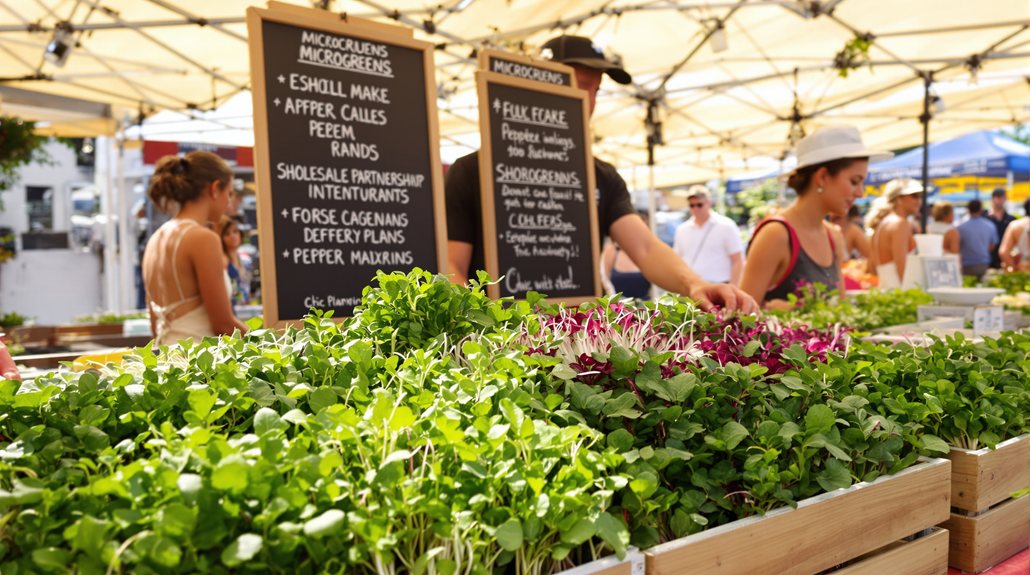
BrightFarms executives pitched microgreens and edible flowers at West Coast Produce Expo 2026, targeting restaurants and retail chains, not your Saturday morning shoppers. That’s a different customer entirely. When commercial operators build awareness around a category, local vendors benefit without sharing the channel. You keep full retail price, skip distributor cuts of 20% to 40%, and sell product harvested that same morning. The gap between their supply chain and your booth is your advantage, and there’s more to it.
Key Takeaways
- Commercial operators like BrightFarms target restaurants and retail chains, not Saturday morning farmers market shoppers, so direct competition is minimal.
- Large commercial investment in microgreens signals genuine category demand, validating what local vendors already sell.
- Commercial expansion builds consumer awareness and familiarity with microgreens, warming up potential farmers market buyers.
- Local vendors retain a freshness advantage commercial distribution cannot match, with same-day harvests versus two-to-four-day transit times.
- Farmers market vendors keep full retail margins without distributor cuts, unlike commercial operators accepting volume-based price-taker economics.
What did commercial microgreens growers say at West Coast Produce Expo 2026?
At West Coast Produce Expo 2026, BrightFarms executives Laurie Altenbern, Greg Cyr, and Marc Oshima presented microgreens and edible flowers as growing premium foodservice trends. BrightFarms, based in San Marcos, California and operating as Fresh Origins and BrightFresh, serves commercial foodservice accounts nationally. That presentation tells you commercial operators are putting real money behind microgreens category demand.
The BrightFarms presentation and what it signals about category demand
When commercial players talk publicly about microgreens, pay attention. At West Coast Produce Expo 2026, BrightFarms executives Laurie Altenbern, Greg Cyr, and Marc Oshima presented microgreens and edible flowers as evolving premium foodservice trends. The Packer covered it on June 3, 2026.
BrightFarms microgreens are sold under the Fresh Origins and BrightFresh brands. They operate out of San Marcos, California, and serve commercial foodservice accounts nationally.
That presentation wasn’t aimed at you. It was aimed at restaurant buyers and distribution networks.
But here is what it tells you. When a company that size puts microgreens on a stage, the category is no longer a niche conversation. Demand is real. Buyers already exist. You’re just reaching a different one.
Why commercial operators are betting on microgreens in foodservice
BrightFarms didn’t put microgreens on a stage at West Coast Produce Expo 2026 without a reason. Laurie Altenbern, Greg Cyr, and Marc Oshima presented microgreens and edible flowers as evolving premium foodservice trends. That presentation came from San Marcos, California, and reached a national audience.
Commercial players don’t build a microgreens restaurant supply chain around a fad. Restaurants are paying for consistency, plating appeal, and a product that moves check averages up. BrightFarms saw that demand and built infrastructure around it.
Sunswell Greens expanded into 300+ retail stores in the Southeast. That’s the same pattern. Big operations prove a category works, then scale it.
The demand is real. The category is proven. You’re just selling it differently.
What does commercial expansion mean for farmers market microgreens vendors?
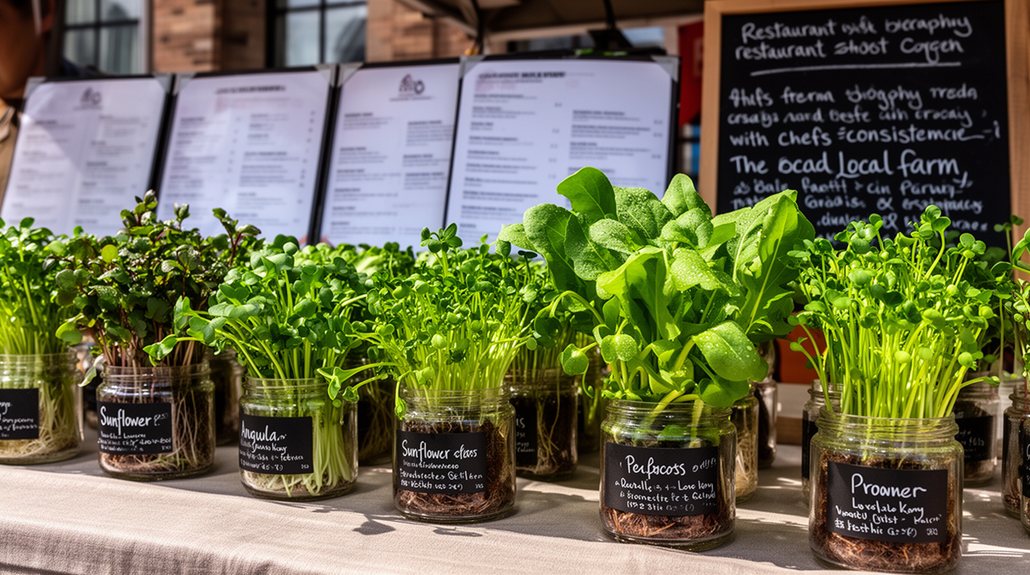
Most vendors see BrightFarms and Sunswell Greens expanding and assume it’s bad news. It’s not.
Commercial growth proves buyers want microgreens. It doesn’t prove those buyers want them from a grocery shelf.
Why most vendors read this news wrong
If you saw the BrightFarms presentation at West Coast Produce Expo 2026 and thought “competition,” you read it wrong.
BrightFarms is targeting restaurants and retail chains. You’re targeting the Saturday morning buyer at your local market. Those are different people with different needs.
The farmers market microgreens vendor advantage is real. You have same-day harvest. You have face-to-face trust. You have a price you control.
BrightFarms, Fresh Origins, and Sunswell Greens compete on volume, shelf life, and distribution. You don’t play that game. You don’t have to.
What their commercial push actually does is build awareness. Buyers see microgreens at restaurants and then look for them locally. That search ends at your table, not at a warehouse loading dock.
How retail and foodservice growth proves the market without owning it
Commercial players prove a category works before small growers have to. BrightFarms presented microgreens at West Coast Produce Expo 2026. That presentation cost you nothing and built buyer awareness you inherit.
Commercial microgreens expansion trains consumers to recognize the product. When someone sees microgreens at a restaurant in San Marcos or a retail chain in the Southeast, they become a primed buyer. You meet them at the farmers market already knowing what they want.
Sunswell Greens pushed into 300+ retail stores. BrightFarms is pitching national foodservice accounts. Neither of them is coming to your Saturday booth.
That’s your market. You already belong there. They proved the demand. You collect it.
What can a farmers market vendor offer that commercial growers cannot?
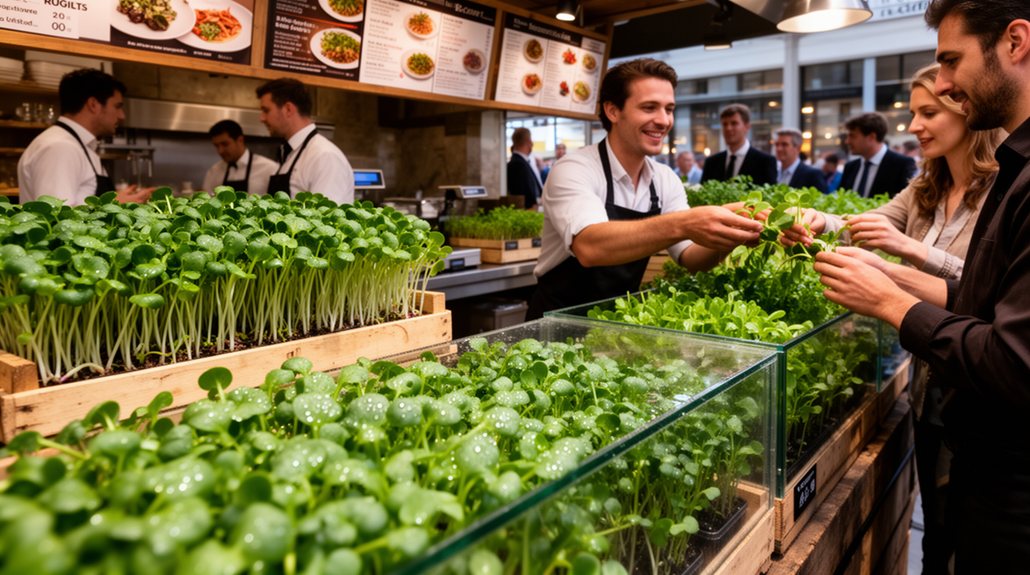
BrightFarms and Fresh Origins ship product days old by the time it hits a restaurant plate.
You harvest the morning of market day.
That gap in freshness is something no distribution chain can close.
Same-day harvest freshness and the distribution chain problem
The distribution chain cuts into freshness before a restaurant ever opens the box. BrightFarms ships from San Marcos, California to accounts across the country. Transit alone adds two to four days.
Your farmers market microgreens freshness advantage starts at harvest time. You cut Saturday morning and sell Saturday morning. That’s a same-day product no distributor can match.
Buyers at your booth know you grew it. They’ve seen your setup. That shared experience is something a commercial label can’t replicate.
The freshness gap is real and measurable. Sunflower shoots lose texture within 48 hours of harvest. Radish microgreens show yellowing by day three. You’re selling on day zero. That matters to the people standing in front of your table.
The grower relationship that retail will never replicate
Retail packaging hides the grower. The buyer sees a logo, not a face.
Your microgreens vendor competitive advantage is that you’re the product. Buyers at your booth know your name, your farm, and your process.
Dr. Booker T. Whatley built his framework on this exact point. Know your customer before you choose your market. Your repeat buyers are your critical mass. Ten loyal customers who return weekly beat fifty one-time shoppers.
BrightFarms serves restaurants in bulk. You serve Sarah who comes back every Saturday for sunflower shoots.
That relationship isn’t scalable for commercial growers. It belongs to you. Protect it by showing up consistently and knowing your regulars by name.
Why does price control matter more than market size?
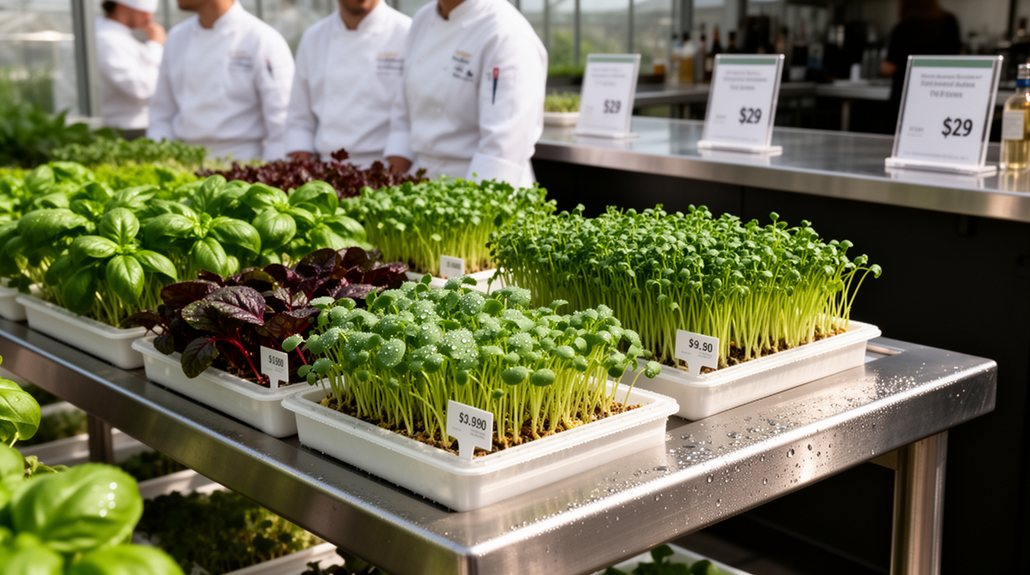
At a farmers market, you set the price. No distributor takes a cut, and no buyer negotiates you down to break-even margins.
The moment a middleman enters the chain, your margin shrinks before the product ever reaches the customer.
The price maker versus price taker distinction for farmers market vendors
When BrightFarms sets a price, restaurants accept it or find another supplier. BrightFarms is a price taker’s nightmare and a price maker’s model.
You’re on the other side of that equation at your booth. No distributor controls your margin. No contract locks your rate to last quarter’s produce index.
You set $18 per tray of sunflower microgreens. A customer pays it or doesn’t. You adjust based on what your buyers tell you directly, not what a procurement manager in another state decides.
That’s the microgreens price maker advantage. Retail vendors chase volume at thin margins. You chase relationship buyers willing to pay for freshness they can’t find at Kroger.
What happens to your margin when a distributor gets involved
Setting your own price is one thing. Keeping that margin is another problem entirely.
When a distributor enters the chain, they take 20% to 40% off the top. That’s before your packaging, labor, or delivery costs.
Commercial vs local microgreens operate on completely different math. BrightFarms and Fresh Origins absorb that distributor cut because they’re moving volume at scale. You’re not.
At your booth, no distributor touches your transaction. You collect the full price directly from the buyer standing in front of you.
That direct margin is what makes your farmers market business structurally different. Protect it by never letting a middleman between you and your customer.
How do you use this moment to your advantage at a farmers market booth?
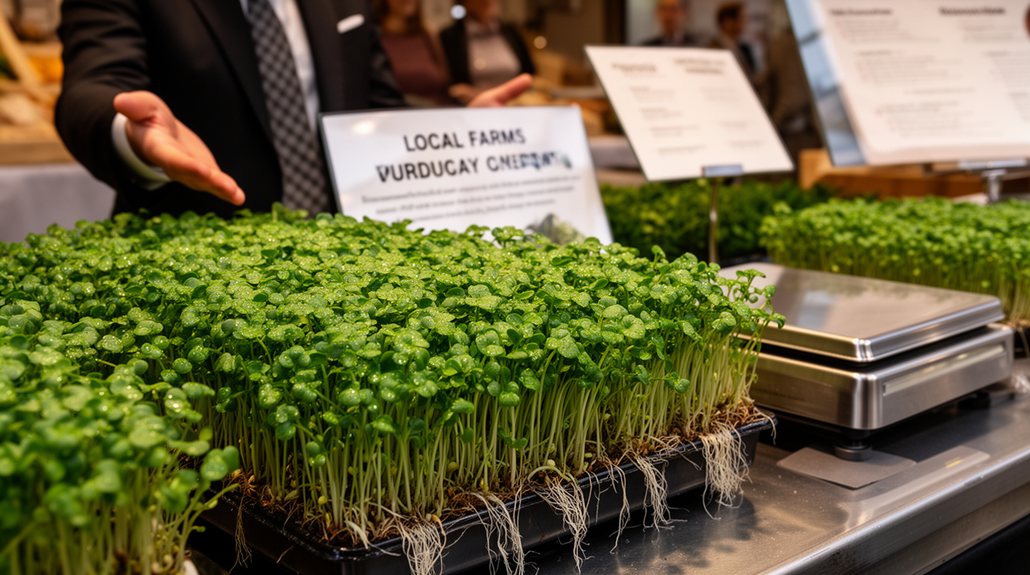
Customers will mention BrightFarms or something they saw at Whole Foods. That’s your opening, not a problem.
Here’s what to say and how to find the markets where buyers like that are already shopping.
What to say when customers mention store-bought microgreens
Don’t get defensive. Get specific.
Tell them yours were cut this morning. Tell them the store pack shipped from a facility in San Marcos, California, days before it hit the shelf. That’s your microgreens direct to consumer advantage. Freshness is the product.
Then name your farm. Say something like, “I’m the grower. These came off my trays at 6 a.m.”
That answer closes the gap between your booth and any retail shelf. The store can’t say that. You can.
How to find markets where the right customers are already shopping
Knowing what to say at the booth is one part. Finding the right market is the other.
Not every farmers market draws buyers who care about retail microgreens vs farmers market differences. Some markets attract deal-seekers. Others pull in food-curious regulars who ask questions and come back.
Dr. Booker T. Whatley said it plainly: know your customer before you choose your market. Build enough repeat buyers to sustain revenue. Specialty produce is under-represented at most markets. That gap is your entry point.
The MGW Farmers Market Finder has 7,842 USDA-verified markets searchable by zip code, city, or state. Employ it to find and compare markets near you before you apply – markets.microgreensworld.com.
The Microgreens Growth Path Tool maps your first move using local market data – growthpath.microgreensworld.com.
Frequently Asked Questions
How Many Trays Should a New Vendor Bring to Their First Market?
Bring 10 to 15 trays your first market day. That’s enough to look established without overcommitting. You’ll learn your sell-through rate fast, and that number tells you exactly what to bring next time.
Which Microgreens Varieties Sell Fastest at Outdoor Farmers Markets?
Sunflower, pea shoots, and radish move fastest. They’re bold, familiar, and easy to sample. Bring those three first. You’ll build repeat buyers quickly when shoppers recognize what they’re tasting.
How Do You Store Cut Microgreens Overnight Before a Saturday Market?
Cut them Friday evening. Layer them loosely in a lidded container lined with dry paper towels. Set your fridge between 34°F and 38°F. They’ll hold overnight without wilting if they’re dry going in.
Do You Need a Cottage Food License to Sell Microgreens at Markets?
Cottage food laws rarely cover microgreens. You’ll likely need a commercial kitchen license or a produce grower’s exemption. Check your state’s department of agriculture directly. Rules vary significantly by state.
How Do You Price Microgreens When a Nearby Vendor Is Selling Cheaper?
You don’t match their price. You hold yours and sell the difference. Tell buyers your greens were cut this morning. That story is what the cheaper vendor can’t offer.