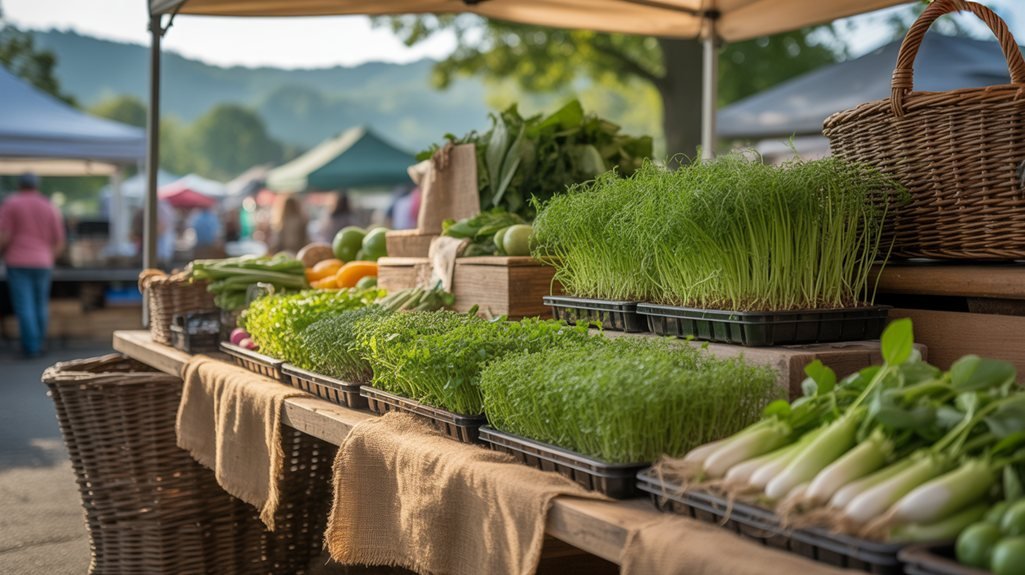
Tennessee hosts approximately 161 USDA-listed farmers markets, most operating seasonally from April through November, giving microgreens vendors a structured window to build direct customer relationships. Urban corridors like Nashville, Memphis, and Knoxville anchor the strongest foot traffic, though each city demands a distinct entry strategy. Sunflower shoots, pea shoots, and spicy mixes consistently outperform niche varieties across Tennessee markets. If you’re targeting the right stall, what follows will sharpen your approach considerably.
Key Takeaways
- Tennessee has approximately 161 USDA-listed farmers markets, with most operating seasonally from spring through fall, typically April through November.
- Nashville, Memphis, and Knoxville are the primary urban markets, each requiring different application strategies based on competition and community culture.
- Sunflower shoots, pea shoots, and spicy mixes consistently perform best at Tennessee markets, driven by familiarity and texture over complex flavor profiles.
- Market managers prioritize vendors demonstrating production consistency, professional booth presentation, and clear operational details over general enthusiasm or product quality alone.
- The MGW Market Finder at markets.microgreensworld.com provides structured, USDA-sourced access to all 161 Tennessee markets, filterable by region and vendor representation.
Farmers Markets in Tennessee for Microgreens Vendors

Tennessee’s approximately 161 USDA-listed farmers markets represent a substantial distribution infrastructure for microgreens vendors who are ready to move product consistently.
The state’s primary selling season runs spring through fall, which aligns well with the production cycles most growers are already managing, particularly in high-density markets like Nashville, Memphis, and Knoxville.
If you’re looking for your first vendor spot or expanding beyond your current market, understanding where Tennessee’s market activity concentrates will shape how you allocate your production capacity and logistics.
Why Tennessee Markets Are Worth Your Attention
If you’re growing microgreens at any meaningful volume, Tennessee’s farmers market infrastructure deserves a serious look. The state carries roughly 161 markets in the USDA database, distributed across urban corridors and smaller regional hubs. That density matters when you’re mapping a viable vendor route.
| Market Characteristic | Tennessee Reality |
|---|---|
| Total USDA-listed markets | ~161 statewide |
| Primary season window | Spring through fall |
| Major urban concentrations | Nashville, Memphis, Knoxville |
| Microgreens market fit | High, due to culinary demographics |
| Vendor competition level | Varies significantly by region |
Farmers markets in Tennessee skew toward food-literate buyers in metro areas, which directly supports microgreens farmers market viability. Understanding where demand concentrates before you apply for a booth spot is how serious growers operate.
What the Tennessee Market Season Looks Like
Knowing where markets concentrate is only part of the equation, because timing determines whether you can actually sustain a selling schedule week over week.
Tennessee’s market calendar runs primarily spring through fall, with most venues opening between April and May, then closing in October or November.
As a microgreens vendor Tennessee growers quickly learn that winter markets exist but remain sparse, concentrated mainly in larger metro areas like Nashville. You’ll find farmers market Tennessee vendors operating year-round at a handful of indoor venues, but those spots fill fast and competition intensifies.
Planning your entry around April gives you maximum runway to establish customer relationships before the season contracts.
Understanding this seasonal compression helps you prioritize applications strategically rather than scrambling reactively when prime slots disappear.
How to Find the Right Market in Tennessee

Before you apply to any market in Tennessee, you need to evaluate vendor density, customer traffic patterns, and whether the market’s existing produce mix leaves room for specialty crops like microgreens. Nashville’s larger markets, including those in Davidson County, attract consistent foot traffic but often carry waitlists and higher booth fees that demand you arrive with a reliable, scalable production system. Memphis and Knoxville markets tend to operate with smaller vendor pools, which can mean faster acceptance and a stronger opportunity to establish yourself as the primary microgreens source before competition fills that gap.
What to Look for Before You Apply
Not every farmers market in Tennessee is worth your time, and applying to the wrong one early on can slow your momentum considerably.
Before you commit to a microgreens booth farmers market setup, you need to evaluate foot traffic, vendor saturation, and whether the customer base actually buys specialty produce. A farmers market vendor Tennessee application takes real time to complete, so prioritize markets where perishable, value-added products already move well.
Look at whether the market runs weekly or biweekly, since inconsistent schedules hurt product freshness and customer retention similarly.
Check if competing microgreens vendors are already established there. A market with one existing microgreens seller isn’t automatically closed to you, but it demands a clear differentiation strategy before you invest in booth fees.
Markets Near Nashville
Once you’ve filtered out the markets that don’t fit your product, geography becomes your next variable, and the Nashville metro offers enough options to be both an opportunity and a decision problem.
As a microgreens grower Tennessee-based or willing to drive, you’re looking at a cluster of markets ranging from high-volume urban settings to smaller community spots in surrounding counties.
The Nashville farmers market operates year-round downtown, drawing consistent foot traffic from culinary-minded buyers.
Surrounding markets in Williamson, Rutherford, and Wilson counties run seasonally and tend to attract buyers who return weekly.
Your application strategy should account for saturation at larger markets, where multiple microgreens vendors may already hold spots, making secondary markets a smarter entry point for newer growers.
Markets Near Memphis and Knoxville
Though Nashville dominates most conversations about Tennessee’s farmers market landscape, Memphis and Knoxville each operate distinct market ecosystems that reward growers who understand their structural differences.
The Memphis farmers market network skews toward weekend formats, with larger anchor markets drawing substantial foot traffic but also attracting more established vendors, meaning you’ll face real competition for booth space.
Knoxville farmers market culture tends toward community-embedded formats, where smaller neighborhood markets often have shorter vendor waitlists and more receptive customers for specialty products like microgreens.
Your application strategy should reflect these differences directly.
Memphis demands a polished presentation and clear product differentiation from day one.
Knoxville rewards consistency and relationship-building within tighter community networks.
Research both cities thoroughly using the free Market Finder at markets.microgreensworld.com before committing to any application.
What to Expect When You Get There

Once you’ve secured a spot, the operational realities of Tennessee markets will shape how you structure your setup, your pricing, and your product mix from the first morning forward.
Booth fees vary considerably across the state, ranging from nominal daily rates at smaller community markets to weekly or seasonal contracts at established urban venues like the Nashville Farmers Market, where demand and foot traffic justify higher entry costs.
What actually moves at these markets reflects both regional culinary preferences and the demographic profile of each venue, so tracking which varieties sell through quickly at your first few markets gives you the data you need to fine-tune your grow schedule accordingly.
Booth Fees and Setup Basics
Two distinct cost structures define most Tennessee farmers markets: flat weekly booth fees and percentage-based commission arrangements.
Flat fees at farmers markets Tennessee microgreens vendors frequent typically range from $20 to $50 per market day, depending on location size and foot traffic volume. Nashville and Memphis metro markets tend toward the higher end, while smaller regional markets offer more accessible entry points.
Understanding how to get a farmers market booth means recognizing that some markets require annual membership fees alongside weekly stall costs.
Your standard setup requires a 10×10 canopy, weighted appropriately for wind, plus a folding table, signage, and a payment processing solution.
Budget for these infrastructure costs before your first market, because they represent fixed overhead regardless of your weekly sales volume.
What Moves at Tennessee Markets
Sunlight and foot traffic will tell you quickly which microgreens actually sell at Tennessee markets, and the answer tends to surprise growers who assumed broad appeal would distribute evenly across their tray lineup. When selling microgreens locally, you’ll find that sunflower and pea shoots consistently outperform more nuanced varieties, because shoppers respond to size, texture, and familiarity before flavor.
Radish moves well in Nashville’s weekend markets, where health-conscious buyers recognize it on sight. Spicy mixes attract chefs and regulars who already cook with intention.
To sell microgreens at farmers market venues successfully, you need to observe two or three market cycles before drawing determinations about your product mix, since regional food culture, seasonal timing, and neighboring vendors all shape what actually leaves your table.
Getting Your Application Ready

When you submit a market application in Tennessee, the manager reviewing it’s evaluating whether your product fits the market’s current vendor mix, not simply whether microgreens are a viable crop.
Most applications request proof of production origin, a basic product list, and documentation like a cottage food registration or state food handler’s certification, depending on the market’s requirements.
Submitting an incomplete application, or one that omits your growing method and sourcing details, typically results in a rejection that could have been avoided with a single follow-up call before you applied.
What Market Managers Want to See
Market managers in Tennessee are evaluating far more than just your product when they review an application, and understanding that selection process gives you a measurable advantage before you ever submit a single form. They’re assessing vendor mix, meaning they already have a mental inventory of what’s currently represented at their market.
Your farmers market vendor application needs to position microgreens for sale Tennessee customers haven’t already seen week after week at that specific location. Demonstrate production consistency by referencing your grow cycle, variety rotation, and volume capacity.
Managers want evidence that you’ll show up reliably, maintain a professional booth, and contribute positively to the market’s overall identity. Concrete details outperform vague enthusiasm every time, so lead with specifics rather than generalities when completing any application form.
Common Mistakes to Avoid
Errors in your farmers market application rarely stem from ignorance of the product itself, but rather from a failure to understand what the submission process is actually evaluating.
Managers reviewing your microgreens market stand application are assessing operational credibility, not just product quality.
Submitting photos without context, skipping the business license documentation, or leaving insurance fields incomplete signals carelessness before you’ve said a word.
When learning how to sell microgreens professionally, treat each application field as evidence supporting your case for a booth spot.
Many rejections in Tennessee markets trace back to vague production descriptions, where growers list varieties without specifying scale, growing medium, or harvest protocols.
Precision in those details separates vendors who get callbacks from those who don’t.
—
Find Tennessee markets ready for your application at [markets.microgreensworld.com](https://markets.microgreensworld.com).
Use the Market Finder to Shortcut Your Search

Tracking down viable farmers markets across Tennessee doesn’t have to consume weeks of cold-calling and windshield time. The MGW Market Finder at markets.microgreensworld.com pulls directly from USDA data, giving you structured access to roughly 161 Tennessee markets without manual searching. For a developing microgreens business, that efficiency matters. You can filter by region, identify whether local microgreens Tennessee vendors are already represented, and prioritize markets that align with your production capacity before making a single call.
Rather than working from incomplete lists or outdated chamber websites, you’re working from a centralized, regularly sourced database. That distinction affects how quickly you move from research to application. Employ the tool, build your target list, and spend your time on outreach that already has directional logic behind it.
Frequently Asked Questions
Can I Sell Microgreens at Tennessee Farmers Markets Without a Business License?
You can often sell without a business license at smaller Tennessee markets, but each market sets its own vendor rules. Check directly with the market manager before you assume you’re covered.
How Early Should I Arrive to Set up My Microgreens Booth?
Arrive at least 90 minutes before opening. You’ll need time to unload, arrange your display, and handle anything unexpected. Most experienced vendors are set up and ready 30 minutes before the first customer walks in.
Do Tennessee Markets Require Vendors to Grow Everything They Sell?
Most Tennessee markets require a producer-only policy, meaning you’ll grow what you sell. Some allow resale with disclosure. Always confirm the specific rule with each market manager before you apply.
What Happens if My Application Gets Rejected by a Market Manager?
Don’t treat rejection as final. Ask the manager what’s missing from your application, fix it, and reapply. Some vendors get accepted on their second or third attempt after addressing specific concerns.
Can I Vend at Multiple Tennessee Farmers Markets Simultaneously?
Yes, you can vend at multiple Tennessee markets simultaneously. Most markets don’t require exclusivity, but confirm each market’s vendor agreement before committing, since some restrict competing at nearby markets on the same day.
Wrap-up
Tennessee’s market landscape offers you real entry points, but the work doesn’t stop at finding a listing. You’ve got to match your production capacity to market volume, submit your application early, and show up prepared. The vendors who succeed here treat market selection as a strategic decision, not an afterthought. Employ the tools available, narrow your options deliberately, and you’ll position your microgreens operation where it can actually grow.
Leave a Reply