Selling at a farmers market is worth it if your weekly transactions clear your break-even number. At a $75 booth fee and $8 average sale, you need 10 transactions just to cover the booth. Add production costs of $1.50 per unit, and that floor rises to about 15. Most growers hit 20 to 30 transactions by week six. The math beyond that point is where things get interesting.
Key Takeaways
- At a $75 booth fee and $8 average sale, you need only 10 transactions to break even on the booth fee alone.
- Including production costs of $1.50 per unit, break-even rises to roughly 15 transactions, not 10.
- Most growers reach 20–30 transactions on a productive Saturday, generating approximately $160–$240 in gross revenue.
- Farmers markets let you set retail prices, earning $10 versus $2.50 from a distributor — a $7.50 per-unit difference.
- Year-round markets across 52 weeks can generate $10,400 annually versus $4,000 from a 20-week seasonal market.
What does it actually cost to sell at a farmers market each week?
You need to know your real weekly number before you commit to a booth.
Most vendors undercount because they forget recurring costs like insurance and only add up what they see on market day.
The actual cost stack includes the booth fee, your share of annual insurance, and any supplies you replenish each week.
Booth fees, insurance, and setup costs broken down
Before you apply to any market, know what it’s going to cost you each week.
Farmers market booth costs run $20 to $150 per market day. Some markets charge a flat seasonal fee instead of weekly. Application fees are typically $15 to $50, paid once.
Liability insurance runs $300 to $600 per year. Most markets require it before you set up. Budget $25 to $50 per month to account for it weekly.
Your setup costs are a one-time hit. A tent, table, and basic display will run you $300 to $800 total.
Add it up before your first market day. Knowing your real number keeps you from guessing when it’s time to price your trays.
What the recurring weekly costs look like for a microgreens vendor
One-time costs are done. Now the recurring numbers start.
Every market day, you pay a booth fee. That’s $20 to $150 depending on the market.
Your production cost per clamshell runs $0.50 to $2.00. If you bring 60 units, that’s up to $120 in product cost alone.
Add fuel, bags, and printed labels. Budget $10 to $20 per Saturday for those.
At a $75 booth fee and $8 average sale, you need 10 transactions just to break even. That’s before microgreens farmers market profit starts.
Most growers hit 20 to 30 transactions on a productive day. That’s where the margin gap opens up.
Watch those weekly numbers every single market day.
What is a realistic revenue target for a microgreens booth at a farmers market?
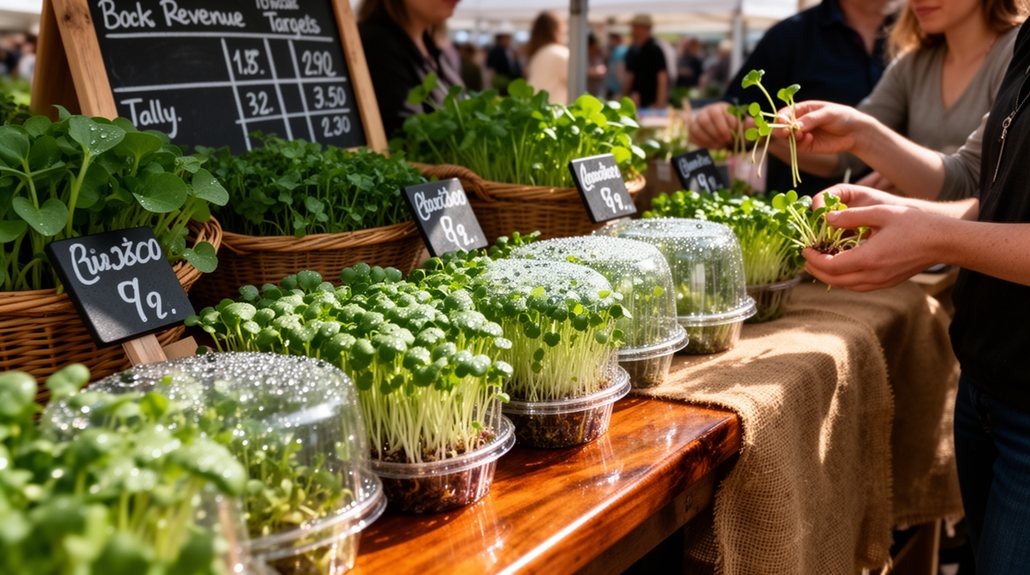
You need a number to work toward before you show up Saturday morning. At $8 per transaction, you need 10 sales just to cover a $75 booth fee.
A productive Saturday runs 20 to 30 transactions, putting gross revenue between $160 and $240.
What typical transaction sizes and weekly sales look like for specialty greens
Most microgreens vendors price clamshells between $5 and $15, depending on variety and market location. Sunflower and pea shoots typically sell at the lower end. Specialty mixes like amaranth or nasturtium command the higher range.
Farmers market weekly sales for microgreens depend heavily on customer volume and average transaction size.
| Transaction size | Transactions needed | Weekly gross |
|---|---|---|
| $5 | 30 | $150 |
| $8 | 25 | $200 |
| $10 | 20 | $200 |
| $12 | 25 | $300 |
| $15 | 20 | $300 |
Most productive booths hit 20 to 30 transactions on a Saturday. Bundling two clamshells at a discount moves volume and raises your per-customer average.
How many customers you need each Saturday to cover costs and profit
Three numbers define whether a Saturday is worth showing up: booth fee, cost of goods, and how many transactions you close.
At a $75 booth fee and an $8 average sale, you need 10 transactions just to farmers market booth break even. That covers nothing else.
Add your cost of goods. At $1.50 per unit, selling 30 units costs you $45. Now your real break-even is closer to 15 transactions.
Twenty to 30 transactions is a productive Saturday. That puts $160 to $240 in gross revenue after the booth fee.
Most growers here hit 25 transactions by week six. That’s the number to target.
Why is the price maker versus price taker distinction the real answer to the worth it question?
When you sell to a distributor, they set the price. You take what they offer or you walk away empty-handed.
At a farmers market booth, you set the price, and that single difference changes every number in your profitability calculation.
What retail and distribution actually pay growers versus what a vendor sets at market
Retail and distribution put you in a price taker position. A buyer sets the number, and you accept it or walk away.
A grocery distributor might pay $2.50 for a clamshell you could sell for $8 at a Saturday market. That gap isn’t small. It’s your margin walking out the door.
As a farmers market vendor, you set the price. That’s the core of farmers market vendor profit. You priced the tray at $8 because your costs, your time, and your market support it.
Retail also moves slowly. Payment terms of 30 to 60 days are common. At market, you collect cash or card the same morning.
How margin control changes the profitability calculation entirely
Because you set the price, every dollar above your cost is yours to keep. That’s the core of the farmers market vendor profit margin advantage.
A distributor pays you $2.50 per tray. You sell the same tray for $10 at market. That’s a $7.50 difference on one unit.
At 25 sales, that gap becomes $187.50 in margin you never see through retail.
You’re not taking what someone offers. You’re deciding what the product is worth and pricing it there.
Other growers at your market do this every Saturday. It’s not complicated pricing theory. It’s a direct decision you make before you set up your tent.
That control is why the worth-it question can’t be answered without looking at who sets the price.
How does market type change the economics of a farmers market booth?
The type of market you pick changes your annual revenue ceiling before you sell a single tray.
A 52-week year-round market gives you up to 52 revenue days. A 20-week seasonal market cuts that number by more than half.
Why year-round markets produce different annual numbers than seasonal ones
When a market runs 52 weeks instead of 20, your fixed costs spread across more revenue opportunities. Your $500 tent and $400 insurance cost the same either way.
At a seasonal market, those fixed costs compress into 20 Saturdays. At a year-round market, you’re dividing that same number across 52 dates.
That changes your farmers market vendor income picture fast. At $8 average per sale and 25 transactions, a seasonal vendor earns roughly $4,000 gross over a full run. A year-round vendor at the same pace earns close to $10,400.
Check whether your target market runs year-round before you apply. That single fact shifts the entire annual math.
What a 52-week market means for annual revenue potential versus a 20-week season
Most growers underestimate how much the market calendar controls annual revenue. A 20-week seasonal market limits your ceiling before you sell a single tray.
Run the numbers. At $200 net per market day, a 20-week season produces $4,000. A 52-week market produces $10,400 at that same rate. That’s a $6,400 difference from one scheduling decision.
Asking whether a farmers market booth is profitable depends on which market you’re talking about. Seasonal and year-round markets aren’t the same business model.
Year-round markets also build repeat customers faster. Buyers see you weekly and develop buying habits around your product.
A 52-week market compresses the time it takes to recover your $300 to $800 setup cost and your $300 to $600 insurance expense.
How do you calculate your specific break-even and income target?
You need real numbers before you commit to a booth. Your break-even depends on four inputs: booth fee, production cost per unit, retail price per unit, and your target number of transactions. The Growth Path Tool at growthpath.microgreensworld.com runs those numbers using local market data so you’re not guessing.
What inputs go into a farmers market profitability model
Before you can decide if a market’s worth your time, you need four numbers: booth fee, production cost per unit, average sale price, and expected transaction count.
Booth fees run $20 to $150 per day. Production cost per clamshell runs $0.50 to $2.00. Average sale price runs $5 to $15.
Plug those into a simple formula. Subtract your booth fee and total production costs from gross sales.
At a $75 booth fee and $8 average sale, you need 10 transactions just to break even. That’s the floor.
Selling at a farmers market is worth it when you consistently hit 20 to 30 transactions per Saturday. That’s the target range most growers employ.
How to use the Growth Path Tool to run your own numbers
The Growth Path Tool at growthpath.microgreensworld.com processes your local market data and spits out your exact break-even number. Enter your booth fee, your average price per clamshell, and your production cost.
The tool calculates how many transactions you need before you’re profitable. At a $75 booth fee and an $8 average sale, that’s 10 transactions to break even.
Your microgreens profit margin at a farmers market depends on hitting 20 to 30 transactions per Saturday. That’s where the numbers shift from covering costs to building real revenue.
The MGW Farmers Market Finder has 7,842 USDA-verified markets searchable by zip code, city, or state. Utilize it to find and compare markets near you before you apply – markets.microgreensworld.com.
The Microgreens Growth Path Tool maps your first move using local market data – growthpath.microgreensworld.com.
Frequently Asked Questions
Can You Sell Microgreens at a Farmers Market Without a Business License?
You can sell microgreens at some markets without one, but most states require at least a cottage food or agricultural sales registration. Check your state’s department of agriculture website before your first market day.
How Many Weeks Does It Take to Build a Repeat Customer Base?
Most growers see repeat faces by week six. You’ll lock in a core group of regulars between weeks eight and twelve if you’re consistent, same spot, same day, every market.
What Microgreens Varieties Sell Fastest at Farmers Markets?
Sunflower, pea shoots, and radish move fastest. Broccoli and basil follow close behind. You’ll sell more of what your regulars request, so ask them directly by week three.
Do Farmers Markets Require a Certified Kitchen to Sell Microgreens?
Most markets don’t require a certified kitchen for microgreens. You’re selling a raw, unprocessed crop. Check your state’s cottage food laws and confirm directly with each market manager before applying.
How Do Seasonal Markets Affect Your Annual Revenue as a Microgreens Vendor?
Seasonal markets cut your selling weeks down, sometimes to 20 or fewer. You’ll need to plan your income around those gaps or find year-round indoor markets to fill them.
Leave a Reply