Tag: microgreens

  • Where to Find Fresh Microgreens at Farmers Markets in Seattle

    Where to Find Fresh Microgreens at Farmers Markets in Seattle

    Pike Place Market, Ballard Farmers Market, and the University District Farmers Market are Seattle’s three year-round options for fresh microgreens. Ballard runs Sundays, University District runs Saturdays, and Pike Place operates daily. Vendors at these markets often harvest the same day or the day before. Arrive before noon at Ballard or Pike Place to beat sellouts. Keep reading to find out exactly which vendors to target and what to ask them.

    Key Takeaways

    • Pike Place Market operates daily year-round, offering flexible timing to find fresh microgreens directly from local growers in the North Arcade.
    • Ballard Farmers Market runs every Sunday year-round at Ballard Commons Park, regularly featuring Skagit Valley growers who harvest same-day.
    • Arrive before noon at Pike Place or Ballard to avoid specialty microgreen vendors selling out early.
    • Ask vendors directly when harvest occurred; same-day or previous-day answers confirm optimal freshness and longer shelf life.
    • Use the MGW Market Finder at markets.microgreensworld.com to filter Seattle markets by season dates, hours, and location before traveling.

    Why does buying microgreens at a Seattle farmers market matter?

    The microgreens at your grocery store were likely harvested 3 to 7 days ago.

    At a Seattle farmers market, you’re often getting greens cut that same morning.

    That gap changes everything about flavor, texture, and how long they’ll last in your fridge.

    What same-day harvest means for flavor and shelf life

    When a farmer harvests microgreens the morning of a market, you’re getting them within hours of the cut. That timing changes everything about what you taste.

    Grocery store microgreens travel through distribution chains that take 3 to 7 days from harvest to shelf. By then, the leaves are softer and the flavor is flatter.

    Same-day microgreens have a clean snap and a concentrated taste you’ll notice immediately. The shelf life in your refrigerator is also longer because the greens haven’t already aged in transit.

    When you pick up fresh microgreens at Pike Place Market or Ballard, you’re getting what grocery stores can’t match. The difference isn’t subtle.

    Why farmers market microgreens differ from what you find at the grocery store

    Most grocery store microgreens are 3 to 7 days old by the time they reach your hands. That’s distribution time. The flavor and texture you’re missing are real.

    Farmers market growers harvest the same day or the day before. You’re getting something genuinely different, not a fresher version of the same product.

    When you search for fresh microgreens near me Seattle, you’re looking for that gap to close. Ballard Farmers Market on Sundays and Pike Place Market daily are where that gap closes consistently.

    The growers selling there are local. They don’t ship through a warehouse. What they cut yesterday is what you’re buying today.

    Which Seattle farmers markets are most likely to have microgreens vendors?
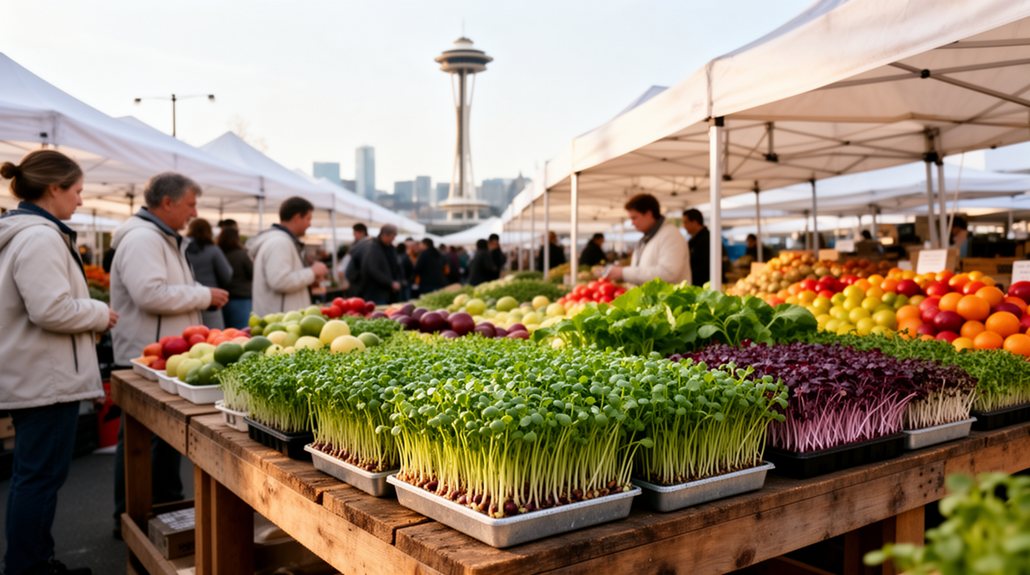
    pike place and ballard markets

    Two Seattle markets give you the best shot at finding fresh microgreens.

    Pike Place Market runs daily and year-round, so you can show up almost any day and walk the Farm Program stalls.

    Ballard Farmers Market runs Sunday mornings and draws local specialty produce vendors who come back week after week.

    Pike Place Market Farm Program and what to expect there

    Pike Place Market runs seven days a week, every week of the year. The Farm Program puts you directly in front of local produce growers, not resellers.

    Look for pike place farmers market microgreens vendors in the North Arcade.

    Detail Information Tip
    Hours 9 AM to 6 PM daily Go before noon
    Location North Arcade stalls Ask for the Farm Program
    Harvest timing Same day or day prior Ask when they cut

    Vendors rotate stalls, so the same grower may not be in the same spot each visit. Ask any farmer directly where the microgreens are.

    Expect small-batch trays and cut selections.

    Ballard Farmers Market and its specialty produce vendor presence

    The Ballard Farmers Market runs every Sunday from 10 AM to 3 PM year-round at the Ballard Commons Park on NW 58th Street. This is a neighborhood market, not a tourist stop.

    The regulars here show up weekly. Vendors know their customers by name, and specialty growers bring exactly what those customers ask for. That repeat-customer culture makes Ballard Farmers Market microgreens vendors more likely to carry niche varieties you won’t find elsewhere.

    Arrive before noon. The specialty produce sellers sell out fast, and microgreens go first.

    Ballard draws farms from the Skagit Valley, just 30 minutes north. Those growers harvest the morning of market day. You’re getting product that’s hours old, not days old.

    What should you look for when you find a microgreens booth at a Seattle market?
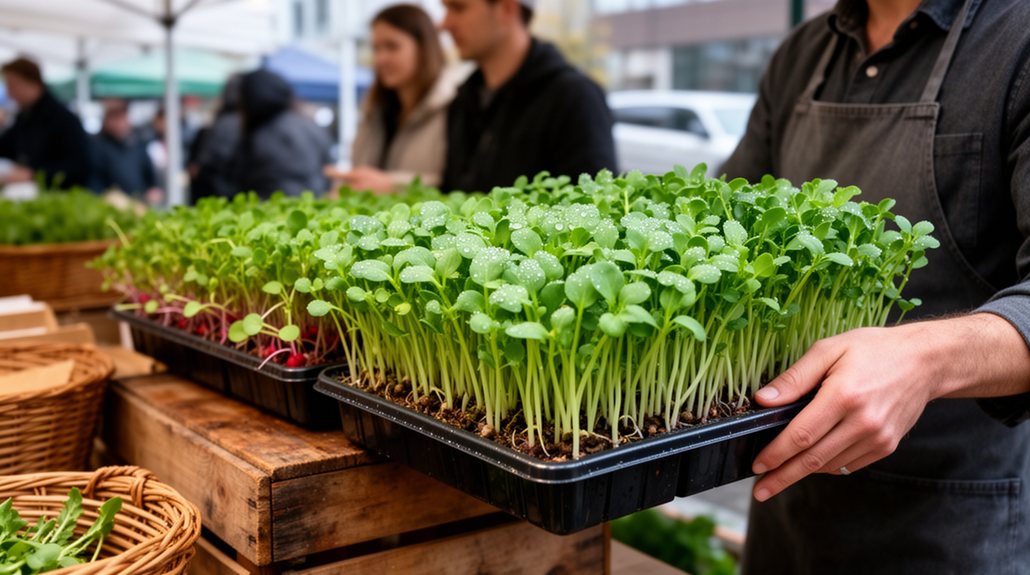
    check trays ask questions

    Finding a booth is the easy part. Knowing what to check before you hand over money takes a little more attention.

    Look at the trays and ask a few direct questions before you buy.

    How to tell if the microgreens were harvested recently

    Once you spot a microgreens booth, check the stems first. Fresh-cut stems look moist at the base. Dry or brown stem ends mean they were cut days ago.

    Next, look at the leaves. They should stand upright and hold their shape. Wilted or matted leaves signal age.

    Ask the vendor directly when they harvested. Most sellers at places like Ballard Farmers Market or Pike Place cut the same morning or the day before. That’s the standard for where to buy microgreens Seattle locals trust.

    Finally, smell the tray. Fresh microgreens have a clean, green scent. A sour or damp smell means moisture has been sitting too long.

    If anything looks off, move to the next booth.

    What to ask the vendor before you buy

    When you find a microgreens booth, start with one question: when did you harvest these?

    If the answer is today or yesterday, you’re in good shape. Anything older than two days means you’re getting close to grocery store quality.

    Next, ask where the farm is located. Most vendors selling microgreens in Seattle source locally. Skagit Valley farms sit 30 minutes north and harvest same-day for weekend markets.

    Ask if they’ll be at the same market next week. Regulars at Ballard or University District build relationships with repeat buyers. You want that.

    When you buy microgreens in Seattle this way, you skip the guesswork. You know exactly what you’re getting before you hand over your money.

    What microgreens varieties can you find at Seattle farmers markets?
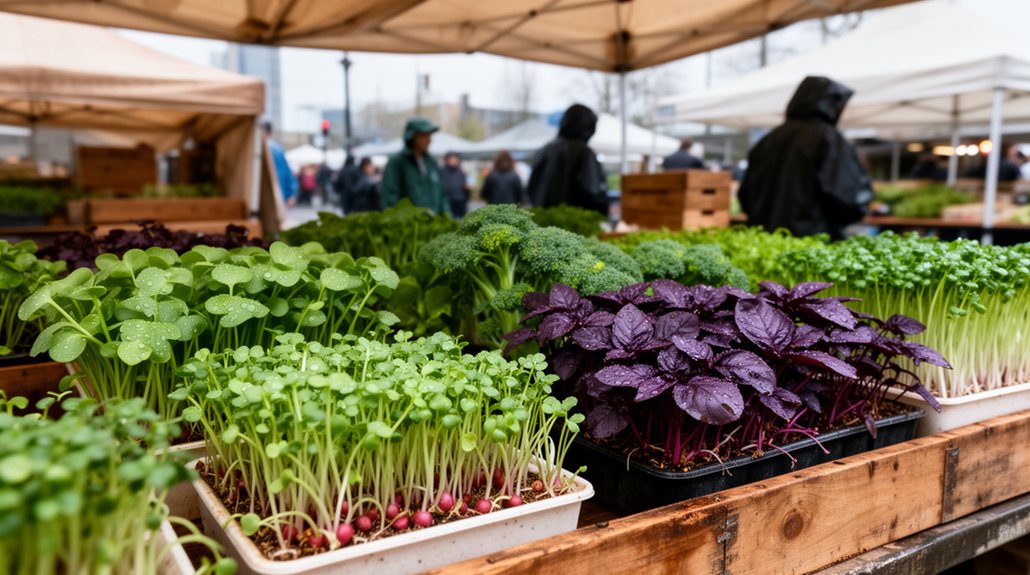
    sunflower pea radish broccoli

    Seattle market vendors carry more variety than most grocery stores stock. Sunflower, pea shoots, radish, broccoli, amaranth, and wheatgrass show up regularly at Ballard and Pike Place booths. Knowing which varieties suit your cooking style helps you pick the right trays before you reach the booth.

    The most common varieties at Washington markets and their flavors

    Pea shoots show up at nearly every Washington farmers market stall. They taste mild and slightly sweet, and they’re a good starting point if you’re new to microgreens.

    Sunflower microgreens are the next most common. They’ve a nutty, satisfying flavor that most people like right away.

    Radish microgreens bring noticeable heat. Microgreens vendors in Seattle often carry at least one radish variety, from daikon to purple radish.

    Broccoli microgreens taste mildly bitter and earthy. Regular buyers know to grab them early.

    Amaranth and basil show up less often but are worth watching for. Ask vendors what’s coming in next week. Most appreciate the question, and it puts you on their radar as a serious buyer.

    Which varieties work best for salads, sandwiches, and cooking

    Knowing which variety to buy saves you from a disappointing plate.

    For salads, grab sunflower or pea shoots. They’re mild, filling, and hold up under dressing without wilting fast.

    For sandwiches, radish or mustard microgreens cut through rich spreads like mayo or hummus. One small handful does the work.

    For cooking, use beet or amaranth microgreens. Add them at the end of a warm dish. Heat kills delicate greens fast.

    Spicy varieties like arugula and wasabi go on top of pizza or eggs right before serving.

    People buying local microgreens Seattle vendors grow tend to ask growers directly which batch came in that morning. Do that. You’ll get the freshest pick and the right variety for what you’re making.

    How do you find a Seattle farmers market with microgreens near you?
    search mgw market finder

    Not every farmers market in Washington carries microgreens. Year-round markets and those with strong specialty produce programs are your best bet.

    Use the MGW Market Finder at markets.microgreensworld.com to search by zip code before you make the trip.

    What market types are most likely to carry specialty greens in Washington

    Year-round markets beat seasonal ones if you want microgreens consistently.

    Ballard Farmers Market runs Sundays year-round, and University District runs Saturdays year-round. Both draw growers who commit to specialty produce, including microgreens.

    At a microgreens farmers market Seattle search, filter for “year-round” first.

    Seasonal markets open in May and close in October. That’s too inconsistent for a regular microgreens habit.

    Daily markets like Pike Place give you the most flexibility on timing.

    Neighborhood markets like Ballard tend to have growers who come back every week with the same products.

    If you find a vendor you like, ask what day they harvest. Most microgreens at these markets were cut the day before.

    How to use the MGW Market Finder before you make the trip

    Before you drive to any market, check the MGW Market Finder at markets.microgreensworld.com. Search by zip code or city to filter Seattle specialty produce farmers market options fast.

    The tool shows hours, season dates, and SNAP/EBT acceptance upfront.

    What to check Why it matters
    Season dates Some markets close October through April
    Hours Most Saturday markets close by 1 p.m.
    SNAP/EBT Confirms payment options before you go
    Location Confirms neighborhood, not just city

    Use those four filters before leaving home. You’ll find the right market on the first try.

    The MGW Farmers Market Finder covers 7,842 USDA-verified markets across all 50 states. Search by zip code or city to find markets near you with hours, season dates, and SNAP/EBT acceptance before you leave home – markets.microgreensworld.com.

    Frequently Asked Questions

    Can You Freeze Fresh Microgreens You Buy at a Seattle Farmers Market?

    You can freeze them, but you’ll lose the texture. Fresh microgreens go limp after freezing. Most Seattle market vendors recommend buying smaller amounts weekly instead.

    Are Seattle Farmers Market Microgreens Safe to Eat Without Washing?

    Most are safe, but you should still rinse them. Farmers harvest them fresh, often the same morning, but soil and handling happen. A quick cold rinse before eating protects you without hurting texture.

    How Much Do Microgreens Typically Cost at Seattle Farmers Markets?

    You’ll typically pay $4 to $8 for a small clamshell at Seattle farmers markets. Specialty mixes or microgreens from Skagit Valley farms sometimes run closer to $10.

    Can You Use SNAP or EBT to Buy Microgreens at Seattle Markets?

    Yes, you can use SNAP/EBT at several Seattle farmers markets. Ballard, University District, and West Seattle markets accept EBT. Check with each vendor directly, since not every individual stall participates even when the market does.

    What Is the Best Way to Store Microgreens After Buying Them?

    Keep them in the container they came in. Store them dry in your fridge. Don’t rinse until you’re ready to eat. They’ll stay fresh for five to seven days that way.
  • Where to Find Fresh Microgreens at Farmers Markets in Chicago

    Where to Find Fresh Microgreens at Farmers Markets in Chicago

    Green City Market is your best starting point for fresh microgreens in Chicago. It runs Wednesdays and Saturdays in Lincoln Park and stays open year-round. Logan Square Farmers Market runs Sundays from May through October and draws independent growers focused on specialty crops. Both markets sell out before noon, so arrive early. Vendors often cut greens the same morning, which means better flavor and a longer shelf life once you get home. Keep going to learn exactly what to look for.

    Key Takeaways

    • Green City Market (Lincoln Park, Wed & Sat) is Chicago’s top microgreens destination, operating year-round with vendors following strict sustainable sourcing rules.
    • Logan Square Farmers Market (Sundays, May–October) attracts independent specialty growers who often focus on crops like microgreens.
    • Arrive early at both Green City Market and Logan Square, as microgreens vendors frequently sell out before noon.
    • Look for sunflower, pea shoots, radish, broccoli, and amaranth varieties; ask vendors if greens were harvested same-day or yesterday.
    • Use the MGW Market Finder at markets.microgreensworld.com to locate Chicago-area markets by zip code, including hours and season dates.

    Why does buying microgreens at a Chicago farmers market matter?

    Grocery store microgreens travel through distribution chains that take 3 to 7 days from harvest to shelf.

    At a Chicago farmers market, you’re often getting microgreens cut the same morning.

    That gap in time changes the flavor, texture, and how long they last once you get them home.

    What same-day harvest means for flavor and shelf life

    Most microgreens at the grocery store were cut 3 to 7 days before you picked them up. That gap costs you flavor, texture, and shelf life before you even get home.

    Farmers market growers harvest the same day or the day before. That’s the difference you’ll taste.

    Factor Grocery store
    Days since harvest 3 to 7 days
    Texture Soft, wilted
    Shelf life remaining 1 to 2 days

    When you search for fresh microgreens near me Chicago, you’re looking for that same-day cut. Green City Market vendors meet that standard.

    Buy on Wednesday or Saturday at Lincoln Park and use them within three days.

    Why farmers market microgreens differ from what you find at the grocery store

    When you buy microgreens at a grocery store, you’re getting a product that’s already 3 to 7 days old. That’s time spent in distribution centers, trucks, and cold storage before it reaches the shelf.

    Farmers market microgreens are cut the same day or the day before market. The difference shows up immediately in taste and texture.

    When you buy microgreens in Chicago at Green City Market or the 61st Street Farmers Market, you’re getting what serious home cooks and restaurant chefs actually want. Alinea’s chefs shop Green City Market for a reason.

    Fresher microgreens also last longer in your refrigerator. You’re not starting the clock at day four.

    Which Chicago farmers markets are most likely to have microgreens vendors?

    best chances green city logan

    Two markets give you the best shot at finding microgreens in Chicago.

    Green City Market runs Wednesdays and Saturdays in Lincoln Park from May through October, then moves indoors to the Peggy Notebaert Nature Museum from November through April.

    Logan Square Farmers Market runs Sundays from May through October and draws specialty produce vendors worth checking.

    Green City Market and what to expect there

    Green City Market is consistently your best starting point for fresh microgreens in Chicago.

    It runs Wednesday and Saturday from May through October in Lincoln Park. November through April, it moves indoors to the Peggy Notebaert Nature Museum.

    This is the only year-round market in Illinois. That matters because you don’t lose access to green city market microgreens in winter.

    Vendors must source within 250 miles of Chicago and follow sustainable practices. That filter keeps specialty produce vendors, including microgreens growers, in the mix consistently.

    Arrive early on Saturday. The best microgreens vendors sell out before noon.

    Chefs from Alinea and Girl and the Goat shop here. You’re buying from the same vendors feeding those kitchens.

    Logan Square Farmers Market and its specialty produce vendor presence

    Logan Square Farmers Market runs every Sunday from May through October at Logan Boulevard and Milwaukee Avenue.

    The market draws a steady crowd of specialty produce buyers.

    If you’re looking for logan square farmers market microgreens, go early.

    Vendors with limited crops sell out before noon.

    This market skews toward independent growers who focus on one or two crops.

    That’s exactly where microgreens vendors tend to show up.

    They’re not selling bulk produce.

    They’re selling what they grew that week.

    Walk the full loop before you buy.

    You might find two or three vendors with microgreens, and the varieties differ.

    Sunflower, pea shoots, and radish are common finds.

    Bring cash.

    Not every vendor here takes cards.

    What should you look for when you find a microgreens booth at a Chicago market?

    check freshness and harvest info

    Finding a microgreens booth is only half the job. You still need to check what’s in front of you and ask the right questions.

    Two things matter most: how fresh the greens actually are and what the vendor can tell you about the harvest.

    How to tell if the microgreens were harvested recently

    Once you spot a microgreens booth, look at the trays or clamshells first. The greens should stand upright, not slump.

    Wilting means age. So does yellowing at the tips.

    Sign Fresh Old
    Stems Firm, upright Limp, bent
    Color Deep, even green Yellowing edges
    Smell Clean, grassy Sour or musty

    Ask the vendor directly: “When did you cut these?” Most people who know where to buy microgreens chicago end up returning to vendors who answer that question without hesitation.

    Same-day or yesterday harvests are what you want. Anything beyond 48 hours matters.

    Touch the greens lightly. They should feel crisp, not soft.

    What to ask the vendor before you buy

    When you find a microgreens booth, ask three questions before you reach for your wallet.

    First, ask when they harvested. Same day or yesterday is good. Anything older than two days isn’t worth full price.

    Second, ask where they grow. Most microgreens vendors in Chicago source locally or grow on-site. You want to know they’re not reselling.

    Third, ask how they store the trays. Cool and dry is the answer you want.

    These three questions separate the serious vendors from everyone else. Regulars at Green City Market and the 61st Street Farmers Market already know to ask. Now you do too.

    What microgreens varieties can you find at Chicago farmers markets?

    common microgreens at chicago markets

    Chicago market vendors carry more variety than most people expect.

    Sunflower, pea shoots, radish, broccoli, and amaranth show up regularly at Green City Market and the 61st Street Farmers Market.

    Knowing which variety fits your meal before you arrive saves time at the booth.

    The most common varieties at Illinois markets and their flavors

    Sunflower, pea shoots, radish, and spicy mustard show up at most Chicago-area markets. These are the varieties most growers bring consistently.

    Sunflower microgreens taste nutty and mild. Pea shoots are sweet and tender. Radish runs sharp and peppery. Spicy mustard is the boldest of the four.

    You’ll also find arugula, broccoli, and amaranth at larger markets. Fresh microgreens at Green City Market often include less common varieties like shiso or cabbage. Vendors there follow sustainable sourcing rules, so the quality is reliable.

    Bring a tote and plan to buy same-day-harvested greens. That’s what separates market microgreens from grocery store versions, which can be 3 to 7 days old by the time you open the package.

    Which varieties work best for salads, sandwiches, and cooking

    Knowing what each variety tastes like helps you shop with a plan.

    Match the green to how you’ll eat it.

    Use Best variety
    Salads Sunflower, pea shoots
    Sandwiches Radish, mustard
    Cooking Beet, amaranth

    Sunflower and pea shoots add mild, nutty sweetness to a salad. They hold up without wilting fast.

    Radish and mustard bring sharp heat to sandwiches. A small handful goes a long way.

    Beet and amaranth handle light heat without losing texture. Fold them into eggs or grain bowls.

    Local microgreens Chicago vendors grow are picked the same day or the day before market. That freshness changes everything about how these varieties perform on your plate.

    How do you find a Chicago farmers market with microgreens near you?

    find nearby microgreens markets

    Not every farmers market in Illinois carries microgreens. Specialty produce vendors are more common at sustainability-focused markets like Green City Market and the 61st Street Farmers Market in Hyde Park.

    Use the MGW Market Finder at markets.microgreensworld.com to check which markets near you’re open before you make the trip.

    What market types are most likely to carry specialty greens in Illinois

    If you want microgreens, skip general produce markets and go straight to specialty-focused ones. Sustainability-mission markets carry them most often.

    Green City Market is your best starting point for microgreens farmers market Chicago searches. Its vendor rules require sustainable practices, which attracts specialty growers directly.

    The 61st Street Farmers Market in Hyde Park runs Saturdays from June through November. Specialty produce vendors show up there consistently.

    Logan Square Farmers Market, open Sundays from May through October, also draws vendors who grow beyond standard produce.

    General neighborhood markets rarely carry microgreens. Chefs and experienced home cooks already know this. That’s how you know which markets are worth your Saturday morning.

    How to use the MGW Market Finder before you make the trip

    Before you drive anywhere, pull up markets.microgreensworld.com on your phone. Enter your Chicago zip code or neighborhood name.

    The finder shows illinois microgreens farmers market options with hours, season dates, and SNAP/EBT status.

    Search input What you’ll see
    Zip code Nearest markets with hours
    City name All active markets in range

    Check the season dates column first. Some markets run June through November only.

    If a market shows Thursday hours, that’s likely Daley Plaza. Saturday results often include Green City Market or the 61st Street market in Hyde Park.

    The MGW Farmers Market Finder covers 7,842 USDA-verified markets across all 50 states. Search by zip code or city to find markets near you with hours, season dates, and SNAP/EBT acceptance before you leave home – markets.microgreensworld.com.

    Frequently Asked Questions

    Can You Freeze Microgreens Bought at a Chicago Farmers Market?

    You can freeze them, but you’ll lose the crisp texture. Blanch briefly, pat dry, and freeze flat. They work best in smoothies or cooked dishes after freezing, not fresh salads.

    Are Chicago Farmers Market Microgreens Safe to Eat Without Washing?

    Most are safe to eat without washing, but you should rinse them quickly under cold water anyway. It removes dust, debris, and any handling residue from market day. Pat them dry before eating.
    How Much Do Microgreens Typically Cost at Chicago Farmers Markets?

    You’ll typically pay $4 to $8 for a small clamshell at Chicago farmers markets. Specialty or mixed varieties can run $10 to $12. Most vendors offer samples so you can try before you buy.
    Do Chicago Farmers Market Vendors Accept SNAP or EBT Payments?

    Many Chicago farmers market vendors accept SNAP/EBT. Green City Market and Daley Plaza both participate. Check with individual microgreens vendors at the market, since not every stand accepts it, even when the market does.
    How Should You Store Microgreens After Buying Them at a Market?

    Keep microgreens in their original container or a loosely covered bowl. Store them dry in your fridge. Don’t wash them until you’re ready to eat. They’ll stay fresh for five to seven days this way.

  • Retail Shelves Are Filling Up With Microgreens. Here Is Why That Is Good for Your Farmers Market Booth.

    Retail Shelves Are Filling Up With Microgreens. Here Is Why That Is Good for Your Farmers Market Booth.

    Sunswell Greens just stocked Publix and Winn-Dixie shelves across the Southeast, and that’s your opening. Retail proves customers already want microgreens, so you’re not educating a cold crowd anymore. But retail can’t match what you cut this morning. Your booth sets the price — $8 or $12 — without freight, brokers, or retailer margins cutting your take. Keep going to see exactly how to turn Sunswell’s shelf space into weekly loyal buyers at your booth.

    Key Takeaways

    • Retail microgreens expansion proves real consumer demand exists, meaning buyers already recognize the product before reaching your booth.
    • Sunswell Greens’ Publix presence educates shoppers for free, eliminating the need to convince a cold audience at market.
    • Retail builds awareness but cannot build loyalty; that relationship belongs exclusively to the farmers market vendor.
    • Your product cut this morning beats any retail pack cut days earlier—freshness is measurable, smellable, and closes sales.
    • Retail sparks curiosity; your booth converts that curiosity into repeat weekly buyers retail can never capture.

    What did Sunswell Greens just do in the Southeast?

    Sunswell Greens, formerly Green Life Farms, rebranded in late 2025 and expanded into 300+ retail stores across the Southeast. You’ll find their products in Publix and Winn-Dixie locations as far north as Virginia.

    That kind of footprint tells you the demand for microgreens in this region is real and growing fast.

    The retail expansion and what it signals about microgreens demand

    A Florida hydroponic grower just made a move worth paying attention to. Sunswell Greens, formerly Green Life Farms, rebranded in late 2025 and pushed into 300+ retail stores across the Southeast.

    Director of Sales John Halle Jr. confirmed the expansion. Products like Micro Broccoli, Micro Arugula, and Spicy Mix now reach Publix and Winn-Dixie locations as far north as Virginia.

    That’s not a small test. That’s a category signal.

    When a commercial operation scales retail microgreens Southeast-wide, it means consumer demand is real enough to support mass distribution. Buyers already know what microgreens are. They’ve seen them on shelves. You’re not educating a cold audience at your booth. You’re meeting people who are already looking.

    Why Southeast markets are seeing more microgreens on store shelves

    One Florida grower just changed the shelf landscape across the entire Southeast. Sunswell Greens, formerly Green Life Farms, rebranded in late 2025 and pushed into 300+ retail stores by early 2026.

    Director of sales John Halle Jr. confirmed the Sunswell Greens Southeast expansion. Products like Micro Broccoli, Micro Arugula, and Spicy Mix now sit in Publix and Winn-Dixie locations from Florida to Virginia.

    Two hydroponic greenhouses in Lake Worth and Punta Gorda are driving that volume. The company holds Non-GMO Project Verified status and Fresh from Florida membership.

    That kind of retail reach doesn’t happen unless buyers are already asking for microgreens. The category demand is confirmed. You’re not introducing a new concept anymore.

    Why does retail expansion actually mean opportunity for farmers market vendors?

    retail demand opens vendor opportunity

    Sunswell Greens now stocks microgreens in 300+ stores across the Southeast, and that number tells you something.

    Buyers in your region already know what microgreens are and they’re already spending money on them.

    Retail proved the demand, but it didn’t lock it up.

    Rising demand is real and documented

    When a company like Sunswell Greens expands to 300+ retail stores across the Southeast, that’s not a threat to you. It’s proof that buyers in your region already want microgreens.

    Publix and Winn-Dixie don’t stock new categories unless the demand is there. They’ve done the market research. You get the benefit of that signal for free.

    Retail confirms the category. It doesn’t own your customer.

    The shopper grabbing a clamshell at Publix and the buyer stopping at your booth on Saturday are different people making different decisions. One wants convenience. The other wants freshness and a face they recognize.

    That second buyer is yours. Retail can’t compete there.

    Retail proves the market but does not own it

    Retail and farmers markets don’t compete for the same buyer. Publix shoppers grab retail microgreens vs fresh market microgreens for convenience. Your booth buyer comes for freshness and the person growing it.

    Sunswell Greens ships to 300+ Southeast stores. That product sits in a cooler for days before purchase. You harvest Thursday and sell Saturday. That gap is your advantage.

    Retail expands the category. More people learn what microgreens are. Some of those people start looking for a local grower they can trust.

    Retail is a price taker environment. You’re a price setter at your booth. Sunswell takes distributor terms. You set your own.

    What is the one thing retail microgreens cannot do?

    hand cut same day microgreens

    Retail microgreens sit in a cooler for days before you buy them.

    You can hand a customer a tray cut that morning.

    That’s something no distribution chain can copy.

    Freshness that a distribution chain cannot match

    A box of Sunswell Greens Micro Broccoli sitting on a Publix shelf was cut, packed, and shipped days before you picked it up.

    Your tray gets harvested the morning of market day. That gap is your entire advantage.

    Farmers market microgreens freshness is measurable. A customer can taste the difference between a three-day-old retail pack and something cut six hours ago.

    Sunswell ships from Lake Worth or Punta Gorda through a distributor network reaching Virginia. That chain adds time. You subtract it.

    Retail buyers accept that lag. They’ve no other option.

    Your buyers do. They found you. That’s why farmers market shoppers come back to the same booth every week. They’re buying something the shelf can’t offer.

    The vendor relationship retail will never have

    Freshness gets customers to your booth. Relationship keeps them coming back every week.

    A Publix shopper doesn’t know who grew their Micro Broccoli. You do. That gap is your advantage as a farmers market microgreens vendor in the Southeast.

    Retail buyer Farmers market buyer
    Buys from a brand Buys from a person
    No grower contact Asks questions directly
    Fixed SKUs only Requests custom varieties
    One-time transaction Repeats weekly

    Name your regulars. Remember what they bought last Saturday. That’s something Sunswell Greens and any distributor chain physically cannot do at scale.

    You’re not just selling greens. You’re the grower they trust.

    Why does the price maker versus price taker distinction matter at your booth?

    you set price keep margin

    When a distributor is in the middle, they take a cut. That cut comes out of your margin, not theirs.

    At a farmers market booth, you set the price and keep the difference.

    What happens to your margin when a distributor is involved

    Distributors take a cut. For Sunswell Greens, that means Publix and Winn-Dixie set the shelf price. Sunswell takes what the distributor offers.

    That’s the price taker side of microgreens price maker price taker math.

    Your farmers market booth works differently. You set $8 for a 2 oz clamshell of micro broccoli. Nobody negotiates it down. A customer either buys it or moves on.

    That’s the price maker position.

    Retail growers shipping into Southeast distributors are absorbing freight, broker fees, and retailer margins. Those costs compress what they keep per unit.

    You have none of those layers. Your margin stays closer to full because the transaction is direct. The person handing you money is the end buyer.

    Why farmers market vendors set their own price

    Setting your own price isn’t a perk. It’s the core microgreens vendor advantage over retail.

    Sunswell Greens ships to Publix and Winn-Dixie. The distributor sets the margin. Sunswell takes what’s offered.

    You don’t do that. You stand at your booth in Sarasota or Raleigh and name your number. Customers who buy from you aren’t comparing shelf tags. They’re buying from someone they recognize.

    That relationship holds your price. A $12 clamshell of Micro Broccoli at your booth doesn’t compete with the $6 retail version. Different buyer. Different reason to purchase.

    Your community of repeat customers is what keeps that price stable week after week.

    How do you use this moment at a Southeast farmers market?

    leverage supermarket brand exposure

    Sunswell Greens is now on shelves at Publix and Winn-Dixie across the Southeast. That puts their name in front of your future customers before you ever meet them.

    You can utilize that exposure to your advantage at the booth and find the right markets where those customers are already shopping.

    What to say when customers mention store-bought Sunswell products

    When a customer says they’ve seen Sunswell at Publix, that’s your opening.

    Don’t get defensive. Say: “That’s us at a different level. What you’re holding here was cut this morning.

    That one line does the work. It separates you from the microgreens retail expansion southeast shoppers are seeing on store shelves. Sunswell ships product days ahead of sale. You don’t.

    Ask the customer when they bought the store pack. Then ask them to smell what’s in your hand. That comparison closes itself.

    You’re not competing with Sunswell. You’re showing the customer what fresh actually means. Retail gets them curious. You get them loyal.

    Loyal buyers come back every week. That’s the relationship retail can’t build. You can.

    How to find Southeast markets where the right customers are already shopping

    Finding the right market comes down to one thing: who’s already buying specialty produce there.

    Look for southeast farmers market microgreens vendors already operating. Their presence means buyers exist. That’s your baseline.

    Check foot traffic numbers and vendor mix before you apply. A market with a kombucha booth, an artisan cheese table, and a mushroom grower already has your customer.

    Dr. Booker T. Whatley called this building a Critical Mass of Customers. Know the buyer before you pick the location.

    The MGW Farmers Market Finder has 7,842 USDA-verified markets searchable by zip code, city, or state. Employ it to find and compare markets near you before you apply – markets.microgreensworld.com.

    The Microgreens Growth Path Tool maps your first move using local market data – growthpath.microgreensworld.com.

    Frequently Asked Questions

    How Many Trays Should a First-Time Farmers Market Vendor Bring Each Week?

    Bring 20 to 30 trays your first week. You’ll sell out faster than you expect. That sellout signals demand. Track what moves, then scale up the next week based on real buyer patterns.

    Do You Need a Business License to Sell Microgreens at a Farmers Market?

    You’ll likely need one, but it depends on your state and county. Check with your local clerk’s office first. Most markets also require a vendor permit. Get both before your first day.

    Which Microgreen Varieties Sell Fastest at Southeast Farmers Markets?

    Sunflower, pea shoots, and radish move fastest at Southeast farmers markets. Broccoli and spicy mixes sell well too. You’ll clear trays quicker when you’re set up near produce vendors with high foot traffic.

    How Do You Store Microgreens so They Stay Fresh at an Outdoor Booth?

    Keep your microgreens in a cooler with ice packs, never in direct sun. Harvest day-of, mist lightly before display, and utilize shallow trays so air circulates. Your customers notice the difference immediately.

    What Should a Farmers Market Table Setup Look Like for Microgreens?

    Your table needs a clean riser setup, labeled trays at eye level, and a small chalkboard with prices. Keep samples front and center. Shoppers buy what they can see and touch first.

  • Where to Find Fresh Microgreens at Farmers Markets in San Francisco

    Where to Find Fresh Microgreens at Farmers Markets in San Francisco

    Ferry Plaza Farmers Market on Embarcadero is your best bet — go on Saturday and arrive before 10 a.m. Heart of the City at UN Plaza runs Wednesday and Sunday and draws solid small-farm vendors too. Both markets are certified, carry 40-plus vendors, and let you talk directly to growers. Grocery-store microgreens are already 3 to 7 days old when you buy them. Market microgreens are harvested the same day or the day before, which means better flavor and a longer shelf life at home. There’s more to know before you go.

    Key Takeaways

    • Ferry Plaza Farmers Market (Embarcadero) on Saturdays offers the most reliable microgreens selection; arrive before 10 a.m. to beat chefs and early shoppers.
    • Heart of the City Farmers Market (UN Plaza) runs Wednesdays and Sundays year-round, with Sundays drawing more vendors and microgreens options.
    • Alemany Farmers Market on Saturdays meets the 40-vendor threshold, giving it a solid chance of carrying microgreens.
    • Certified farmers markets with 40 or more vendors provide the most consistent access to specialty microgreens growers selling direct.
    • Common varieties found at Bay Area markets include sunflower, pea shoots, radish, broccoli, and amaranth, sold individually or in blends.

    Why does buying microgreens at a San Francisco farmers market matter?

    You’re not buying the same product at a grocery store.

    Those microgreens sat in a distribution chain for 3 to 7 days before they hit the shelf.

    At a San Francisco farmers market, you’re getting cuts from the day before or the morning of market day.

    What same-day harvest means for flavor and shelf life

    When you grab microgreens at a grocery store, they’re already 3 to 7 days out from harvest. The cells are breaking down. The flavor is fading.

    Vendors at Ferry Plaza Farmers Market harvest their microgreens the same day or the day before. That gap matters more than most people realize.

    Same-day harvest means the sugars haven’t broken down yet. You taste the actual crop, not a dulled version of it.

    Fresh microgreens from Ferry Plaza also last longer once you get them home. You’re starting the clock at day one, not day five.

    Chefs who shop Ferry Plaza weekly know this. They won’t buy microgreens any other way. Once you taste the difference, you’ll understand why.

    Why farmers market microgreens differ from what you find at the grocery store

    The flavor difference is real, but the supply chain gap explains it. Grocery store microgreens travel 3 to 7 days through distribution before you touch them. Fresh microgreens SF growers harvest the same day or the night before market.

    That gap changes everything on your plate.

    Factor Farmers market Grocery store
    Days since harvest 0 to 1 3 to 7
    Texture Crisp, upright Limp, compressed
    Shelf life remaining 5 to 7 days 1 to 3 days

    You’re buying closer to the source. That’s what people who shop Ferry Plaza or Alemany already know. Now you do too.

    Which San Francisco farmers markets are most likely to have microgreens vendors?

    ferry plaza and heart

    Two markets give you the best odds of finding fresh microgreens in San Francisco.

    Ferry Plaza Farmers Market on the Embarcadero runs Saturday, Tuesday, and Thursday, with Saturday drawing the most specialty produce vendors.

    Heart of the City Farmers Market at UN Plaza operates Wednesday and Sunday year-round and carries a strong mix of small-farm growers.

    Ferry Plaza Farmers Market and what to expect there

    If you’re looking for the best shot at finding fresh microgreens in San Francisco, Ferry Plaza Farmers Market is your first stop. It runs Saturday, Tuesday, and Thursday on the Embarcadero. Saturday is the largest market.

    Ferry Plaza farmers market microgreens vendors show up most consistently on Saturdays. Arrive before 10 a.m. Serious shoppers and Bay Area chefs clear out specialty produce early.

    Vendors here must follow sustainable farming practices. That standard filters out low-quality growers. What you find is usually harvested the day before or the morning of market day.

    That matters. Grocery store microgreens travel three to seven days through distribution before you touch them. Ferry Plaza cuts that gap. The flavor difference is immediate and obvious.

    Heart of the City Farmers Market and its specialty produce vendor presence

    Heart of the City Farmers Market runs Wednesday and Sunday at UN Plaza year-round. Hours are 7 a.m. to 5:30 p.m. on Wednesdays and 7 a.m. to 5 p.m. on Sundays.

    This market draws specialty produce vendors who serve the neighborhood regularly. You’ll find the same growers week after week. That consistency matters when you’re looking for microgreens.

    Talk to vendors directly. Ask if they grow microgreens and which varieties they bring each week. Some growers rotate what they harvest based on demand.

    Sunday draws a larger crowd and more vendor options. Wednesday is quieter and easier to browse.

    Heart of the City Farmers Market is a reliable stop for fresh specialty produce. Go early for the best selection.

    What should you look for when you find a microgreens booth at a San Francisco market?

    check freshness and knowledge

    Finding a microgreens booth is the easy part.

    Knowing what to look at before you hand over your money takes a little more work.

    Two things matter most: how fresh the greens actually are and what the vendor can tell you about them.

    How to tell if the microgreens were harvested recently

    Four things tell you whether microgreens were harvested recently. These checks take seconds and separate same-day cuts from three-day-old stock.

    Look at the stems. Fresh stems stand upright and hold tension. Limp or bent stems mean age.

    Check the cut ends. A clean, moist cut end is recent. A dry or browned end means the tray sat before harvest.

    Feel the leaves. Crisp leaves mean water is still in the cells. Soft or translucent leaves have already started to break down.

    Smell the tray. Fresh microgreens near me San Francisco buyers learn this fast. A bright, green scent means recent harvest. A flat or sour smell means skip it.

    What to ask the vendor before you buy

    When you walk up to a microgreens booth, don’t just look. Ask when they harvested.

    Most vendors at Ferry Plaza or Heart of the City will tell you same-day or yesterday. That’s the answer you want. If they pause or say “this week,” keep walking.

    Ask what variety they’re selling. Sunflower, pea shoots, and radish are common. Knowing the name helps you compare vendors and find your preference.

    Ask if they grow indoors or outdoors. Both are fine. You’re just building the habit of talking to the people who know where to buy microgreens San Francisco has at its best.

    Vendors who answer fast and clearly know their product. That matters.

    What microgreens varieties can you find at San Francisco farmers markets?

    sunflower pea radish broccoli

    San Francisco market vendors carry more variety than most cities. You’ll spot sunflower, pea shoots, radish, broccoli, amaranth, and specialty blends regularly.

    Each variety has a specific use, and knowing which one fits your plate saves you time at the booth.

    The most common varieties at California markets and their flavors

    Most Bay Area vendors carry four or five core varieties at any given market day. At the microgreens Embarcadero market, you’ll typically see sunflower, pea shoots, radish, broccoli, and amaranth.

    Sunflower microgreens taste nutty and mild. They’re the easiest starting point if you’re new.

    Pea shoots are sweet and tender. They work well raw on salads or stirred into soup.

    Radish microgreens are spicy and sharp. A small handful adds heat without any prep.

    Broccoli microgreens taste mild and slightly earthy. They’re among the most requested by regular shoppers.

    Amaranth runs vibrant magenta and tastes mildly beet-like. It shows up more at California markets than most other states.

    Ask the vendor what came in that morning. The freshest cut is always the best choice.

    Which varieties work best for salads, sandwiches, and cooking

    Knowing what each variety tastes like is only half the job. You also need to match the variety to how you’re eating it.

    For salads, use sunflower or pea shoots. They’re mild, filling, and hold up to dressing without wilting fast.

    For sandwiches, radish or mustard microgreens cut through rich spreads like mayo or avocado. One layer goes a long way.

    For cooking, broccoli microgreens handle light heat better than most. Add them at the very end.

    When you’re searching where to buy microgreens bay area, think about your weekly meals first. Then buy what fits your actual plate.

    Most Ferry Plaza vendors on Saturday carry at least three varieties. Ask which was harvested that morning.

    How do you find a San Francisco farmers market with microgreens near you?

    check microgreens market locations

    Not every farmers market carries microgreens.

    Larger markets with specialty produce vendors, like Ferry Plaza on Saturdays or Alemany on Saturdays, are your best starting points.

    Check the MGW Farmers Market Finder at markets.microgreensworld.com before you go so you know hours and SNAP/EBT acceptance ahead of time.

    What market types are most likely to carry specialty greens in California

    San Francisco’s certified farmers markets are your best starting point. California certifies markets through county agricultural commissioners, which means vendors have verified growing operations.

    Certified markets attract specialty growers. That’s where you’ll find local microgreens Bay Area farms selling direct. Non-certified swap meets and pop-up events rarely carry them.

    Look for markets with 40 or more vendors. Larger markets have room for specialty producers who can’t compete on volume crops.

    Ferry Plaza on the Embarcadero and Heart of the City at UN Plaza both meet this threshold. Alemany on Saturdays does too.

    Smaller neighborhood markets sometimes carry microgreens, but stock is inconsistent. Certified and large-format markets give you the most reliable shot.

    How to use the MGW Market Finder before you make the trip

    Pull up markets.microgreensworld.com before you leave the house. Type in your San Francisco zip code or neighborhood name.

    The tool covers 7,842 USDA-verified markets. Filter results by SNAP/EBT acceptance, season dates, and hours.

    Look for Saturday markets first. Ferry Plaza runs the largest CUESA farmers market. Microgreens vendors are common there. Tuesday and Thursday options also appear in the results.

    Check the hours listed before you plan your trip. Some markets run only four hours. Arriving late means missing specialty vendors who sell out early.

    The MGW Farmers Market Finder covers 7,842 USDA-verified markets across all 50 states. Search by zip code or city to find markets near you with hours, season dates, and SNAP/EBT acceptance before you leave home – markets.microgreensworld.com.

    Frequently Asked Questions

    Can You Buy Microgreens With SNAP or EBT at San Francisco Markets?

    Yes, you can use SNAP/EBT at several San Francisco farmers markets. Heart of the City and Alemany both accept EBT. Check each vendor, as not every stand participates.

    How Should You Store Microgreens After Buying Them at a Farmers Market?

    Keep microgreens in their original container or a loosely covered bowl. Store them in the fridge. Don’t wash them until you’re ready to eat. They’ll stay fresh for five to seven days.

    Are San Francisco Farmers Market Microgreens More Expensive Than Grocery Store Microgreens?

    Yes, they usually cost more. But you’re getting same-day-harvested greens, not week-old ones. The flavor and shelf life make the difference real. Most shoppers find it’s worth it.

    Can You Ask a Vendor to Set Aside Microgreens for Next Week?

    Yes, you can ask. Most vendors love regulars. Walk up, introduce yourself, and ask if they’ll hold a flat for you next week. Many will say yes.

    What Is the Best Time to Arrive Before Microgreens Sell Out?

    Arrive by 8:00 a.m. The serious shoppers know to get there early. Most microgreens vendors sell out by 10:00 a.m., especially on Saturdays at Ferry Plaza.

  • Where to Find Fresh Microgreens at Farmers Markets in Los Angeles

    Where to Find Fresh Microgreens at Farmers Markets in Los Angeles

    The Hollywood Farmers Market runs every Sunday on Ivar Avenue, and Santa Monica’s market runs Wednesdays and Saturdays. Vendors at certified markets cut their trays the same morning, so you’re getting microgreens hours old, not days old. Show up before 9 a.m. because the best trays sell fast. California’s certified producer rules mean vendors grew what they’re selling. Keep going and you’ll know exactly what to ask, what to avoid, and which varieties to grab first.

    Key Takeaways

    • Hollywood Farmers Market runs every Sunday on Ivar Avenue year-round, with vendors harvesting microgreens before dawn for same-day freshness.
    • Santa Monica Farmers Market operates Wednesday and Saturday in downtown Santa Monica, attracting serious specialty-produce growers and restaurant chefs.
    • Arrive before 9–10 a.m. at any LA market; the best microgreen trays sell out early.
    • Use the MGW Market Finder at markets.microgreensworld.com to check hours, season dates, and SNAP/EBT acceptance before traveling.
    • Stick to certified producer markets, which require vendors to sell only what they grew, eliminating resellers.

    Why does buying microgreens at a Los Angeles farmers market matter?

    You’re not just choosing between vendors when you pick a farmers market over a grocery store.

    Microgreens at the grocery store traveled through a distribution chain that took 3 to 7 days from harvest to your hand.

    At a Los Angeles farmers market, what you’re buying was likely cut that morning.

    What same-day harvest means for flavor and shelf life

    Buying microgreens at an LA farmers market the same morning they were cut changes everything about the product.

    Grocery store microgreens travel through distribution chains. That process takes three to seven days from harvest to shelf. By the time you open the package, flavor and texture are already fading.

    Same-day-cut microgreens taste sharper and more concentrated. The leaves hold their structure. They last longer in your fridge because the clock started hours ago, not days ago.

    When you pick up fresh microgreens Hollywood vendors harvest before dawn on Sunday, you’re getting a different product entirely. Most regulars at the Hollywood Farmers Market on Ivar Avenue know this. That’s why they show up before 9 a.m. The best trays go fast.

    Why farmers market microgreens differ from what you find at the grocery store

    The gap between those two products goes beyond freshness dates. Grocery store microgreens move through a distribution chain that takes 3 to 7 days from harvest to your hands.

    That delay costs you flavor and texture. The leaves lose structure. The taste flattens.

    When you buy microgreens Los Angeles farmers markets carry, you’re getting product cut that morning or the night before. That’s the difference between a sharp, clean bite and something that’s already declining.

    California’s certified producer rules mean every agricultural vendor at an LA market grew what they’re selling. No middlemen. No warehouses.

    That standard doesn’t exist at the grocery store. You don’t know when those microgreens were cut or where they sat.

    Which Los Angeles farmers markets are most likely to have microgreens vendors?

    hollywood and santa monica markets

    Two markets give you the best odds of finding microgreens in LA.

    Hollywood Farmers Market runs every Sunday on Ivar Avenue in Hollywood, year-round.

    Santa Monica Farmers Market operates Wednesday and Saturday in downtown Santa Monica, and both locations draw specialty produce vendors who grow what they sell.

    Hollywood Farmers Market and what to expect there

    Hollywood Farmers Market runs every Sunday on Ivar Avenue, year-round.

    It starts at 8 a.m. and wraps up by 1 p.m. Show up before 10 a.m. if you want the best selection.

    Hollywood Farmers Market microgreens vendors sell out early. Sunflower, pea shoots, and radish are the most common varieties you’ll find.

    California’s certified producer rules mean every agricultural vendor grew what they’re selling. You’re not getting repackaged product from a warehouse.

    Parking on Ivar fills fast. Use the surrounding side streets or the Metro Red Line Hollywood/Vine stop one block away.

    Walk the full market before you buy. Some Sundays bring two or three microgreens vendors. Comparing cuts and freshness takes less than five minutes.

    Santa Monica Farmers Market and its specialty produce vendor presence

    Santa Monica Farmers Market runs Wednesday and Saturday in downtown Santa Monica.

    The Wednesday market draws serious buyers. Top LA restaurant chefs shop here weekly, which pushes vendors to bring their best specialty produce. If you’re looking for santa monica farmers market microgreens, Wednesday is your best shot.

    California’s certified producer rules matter here. Vendors must grow what they sell. That means the microgreens you find came from the grower standing in front of you.

    The market has run since 1981. It helped shape California’s farm-to-table food culture. Specialty produce vendors show up consistently because the buyer base expects it.

    Go early on Wednesday. The chef crowd moves through fast, and small-batch items like microgreens sell out before mid-morning.

    What should you look for when you find a microgreens booth at a Los Angeles market?

    check freshness upright fragrant recent

    You found a booth. Now check the trays before you buy anything.

    Fresh microgreens stand upright, show bright color, and smell clean. Ask the vendor when they harvested the batch you’re looking at.

    How to tell if the microgreens were harvested recently

    Most microgreens vendors at LA markets will have their trays or clamshells set out on the table. Look at the stems first. They should stand upright, not lean or droop.

    Press gently on the greens. Fresh ones feel firm and slightly springy. Limp or wet greens mean they’ve been sitting too long.

    Check the cut ends at the base. A clean, dry cut is good. A slimy or darkened base means the harvest wasn’t recent.

    Smell the tray. Fresh microgreens have a clean, sometimes grassy scent. An off or musty smell is a red flag.

    If you’re searching for fresh microgreens near me Los Angeles, these checks take ten seconds and tell you everything before you buy.

    What to ask the vendor before you buy

    When you find a microgreens booth, ask the vendor one question first: when did you harvest this?

    Same day or yesterday is the answer you want. Anything beyond two days means you’re getting close to grocery store quality.

    Next, ask where the farm is located. Vendors at certified California markets must grow what they sell. A local farm address confirms you’re getting produce that didn’t travel through a warehouse.

    If you’re figuring out where to buy microgreens LA has to offer, these two questions filter out the weak options fast.

    Ask what varieties are available that week. Supply changes with the season, and knowing your options helps you plan before your next visit.

    What microgreens varieties can you find at Los Angeles farmers markets?

    sunflower pea radish broccoli

    Los Angeles farmers market vendors carry more variety than most grocery stores ever stock.

    You’ll commonly find sunflower, pea shoots, radish, broccoli, amaranth, and specialty mixes like spicy or Asian blends.

    Knowing which varieties match your cooking style helps you pick the right ones fast.

    The most common varieties at California markets and their flavors

    Sunflower, pea shoot, and radish microgreens show up at nearly every LA market.

    Sunflower tastes nutty and mild. Pea shoots are sweet with a clean finish. Radish runs spicy and sharp.

    Beyond those, look for broccoli, arugula, and amaranth.

    Broccoli microgreens taste earthy with a slight bitterness. Arugula hits with a peppery punch. Amaranth is mild and slightly sweet, with a soft texture.

    At a microgreens farmers market LA stop, you’ll also find specialty trays like cilantro, basil, and beet microgreens.

    These show up less often but reward patient shoppers.

    Knowing the flavor profile before you buy helps you pair smarter.

    Ask the vendor how each variety was grown.

    California certified producers grew it themselves, so they’ll know exactly what to say.

    Which varieties work best for salads, sandwiches, and cooking

    Picking the right variety starts before you reach the market stall.

    For salads, choose sunflower or pea shoots. They’re mild, tender, and hold their texture without wilting fast.

    For sandwiches, radish or mustard microgreens work better. They add heat and structure without going soggy under pressure.

    For cooking, beet microgreens handle light heat well. Add them at the end of a warm dish.

    When you search microgreens near me LA, you’ll find vendors at Silver Lake on Saturday and Culver City on Tuesday carrying all three types.

    Tell the vendor how you plan to use them. They’ll point you to the right flat.

    That’s how regulars shop. Now you’re one of them.

    How do you find a Los Angeles farmers market with microgreens near you?

    certified producer markets nearby

    Not every LA farmers market carries microgreens. Certified producer markets are your best bet because vendors must grow what they sell.

    Use the MGW Market Finder to check specific markets near you before you make the trip.

    What market types are most likely to carry specialty greens in California

    California’s certified producer requirement is your best filter. Vendors at certified farmers markets must grow what they sell. That pushes out resellers and keeps specialty growers like local microgreens LA farms front and center.

    Chef-driven markets attract the most serious growers. The Santa Monica Wednesday market draws top restaurant buyers weekly. Vendors there grow for quality, not volume.

    Year-round markets matter too. Hollywood Farmers Market runs every Sunday on Ivar Avenue. Consistent weekly schedules mean growers invest in steady crops, including microgreens.

    Avoid swap meets and uncertified pop-up markets. They don’t carry the same producer rules. Stick to USDA-listed, certified markets and your odds of finding fresh specialty greens go up markedly.

    How to use the MGW Market Finder before you make the trip

    Before you drive anywhere, check the MGW Farmers Market Finder at markets.microgreensworld.com. It covers 7,842 USDA-verified markets across all 50 states.

    Type your Los Angeles zip code or neighborhood name. The results show market hours, season dates, and SNAP/EBT acceptance.

    Use the filters to narrow your search. Saturday and Sunday markets in LA give you the most options for farmers market microgreens Los Angeles shoppers actually want.

    Check the hours before you leave. The Hollywood Farmers Market runs Sunday mornings. The Santa Monica Wednesday market opens early and moves fast.

    The MGW Farmers Market Finder covers 7,842 USDA-verified markets across all 50 states. Search by zip code or city to find markets near you with hours, season dates, and SNAP/EBT acceptance before you leave home – markets.microgreensworld.com.

    Frequently Asked Questions

    Can You Buy Microgreens Year-Round at Los Angeles Farmers Markets?

    Yes, you can. Los Angeles farmers markets run year-round, and microgreens vendors show up consistently. Hollywood Farmers Market on Ivar Avenue operates every Sunday, so you’ll always have a reliable spot to shop.

    Do Los Angeles Farmers Markets Accept SNAP or EBT for Microgreens?

    Yes, many Los Angeles farmers markets accept SNAP/EBT. Hollywood Farmers Market and Santa Monica Farmers Market both participate. Look for the EBT sign at the market info booth before you shop the microgreens vendors.

    How Much Do Microgreens Typically Cost at an LA Farmers Market?

    You’ll typically pay $5 to $8 for a small tray or clamshell of microgreens at an LA farmers market. Larger portions run $10 to $14. Prices vary by grower and variety.

    Can You Request Specific Microgreens Varieties From a Market Vendor?

    Yes, you can. Ask your vendor directly at the market. Many growers take special requests for next week’s harvest. It helps to become a regular. They’ll often grow what their loyal customers want.

    Are Los Angeles Farmers Market Microgreens Certified Organic?

    Some are, but not all. Ask each vendor directly. California’s certified producer rules mean they grew it themselves, but organic certification is separate and costs growers extra to maintain.

  • Commercial Microgreens Growers Are Pitching to Restaurants. Here Is Why That Is Good for Your Farmers Market Booth.

    Commercial Microgreens Growers Are Pitching to Restaurants. Here Is Why That Is Good for Your Farmers Market Booth.

    BrightFarms executives pitched microgreens and edible flowers at West Coast Produce Expo 2026, targeting restaurants and retail chains, not your Saturday morning shoppers. That’s a different customer entirely. When commercial operators build awareness around a category, local vendors benefit without sharing the channel. You keep full retail price, skip distributor cuts of 20% to 40%, and sell product harvested that same morning. The gap between their supply chain and your booth is your advantage, and there’s more to it.

    Key Takeaways

    • Commercial operators like BrightFarms target restaurants and retail chains, not Saturday morning farmers market shoppers, so direct competition is minimal.
    • Large commercial investment in microgreens signals genuine category demand, validating what local vendors already sell.
    • Commercial expansion builds consumer awareness and familiarity with microgreens, warming up potential farmers market buyers.
    • Local vendors retain a freshness advantage commercial distribution cannot match, with same-day harvests versus two-to-four-day transit times.
    • Farmers market vendors keep full retail margins without distributor cuts, unlike commercial operators accepting volume-based price-taker economics.

    What did commercial microgreens growers say at West Coast Produce Expo 2026?

    At West Coast Produce Expo 2026, BrightFarms executives Laurie Altenbern, Greg Cyr, and Marc Oshima presented microgreens and edible flowers as growing premium foodservice trends. BrightFarms, based in San Marcos, California and operating as Fresh Origins and BrightFresh, serves commercial foodservice accounts nationally. That presentation tells you commercial operators are putting real money behind microgreens category demand.

    The BrightFarms presentation and what it signals about category demand

    When commercial players talk publicly about microgreens, pay attention. At West Coast Produce Expo 2026, BrightFarms executives Laurie Altenbern, Greg Cyr, and Marc Oshima presented microgreens and edible flowers as evolving premium foodservice trends. The Packer covered it on June 3, 2026.

    BrightFarms microgreens are sold under the Fresh Origins and BrightFresh brands. They operate out of San Marcos, California, and serve commercial foodservice accounts nationally.

    That presentation wasn’t aimed at you. It was aimed at restaurant buyers and distribution networks.

    But here is what it tells you. When a company that size puts microgreens on a stage, the category is no longer a niche conversation. Demand is real. Buyers already exist. You’re just reaching a different one.

    Why commercial operators are betting on microgreens in foodservice

    BrightFarms didn’t put microgreens on a stage at West Coast Produce Expo 2026 without a reason. Laurie Altenbern, Greg Cyr, and Marc Oshima presented microgreens and edible flowers as evolving premium foodservice trends. That presentation came from San Marcos, California, and reached a national audience.

    Commercial players don’t build a microgreens restaurant supply chain around a fad. Restaurants are paying for consistency, plating appeal, and a product that moves check averages up. BrightFarms saw that demand and built infrastructure around it.

    Sunswell Greens expanded into 300+ retail stores in the Southeast. That’s the same pattern. Big operations prove a category works, then scale it.

    The demand is real. The category is proven. You’re just selling it differently.

    What does commercial expansion mean for farmers market microgreens vendors?

    retail demand not supplier source

    Most vendors see BrightFarms and Sunswell Greens expanding and assume it’s bad news. It’s not.

    Commercial growth proves buyers want microgreens. It doesn’t prove those buyers want them from a grocery shelf.

    Why most vendors read this news wrong

    If you saw the BrightFarms presentation at West Coast Produce Expo 2026 and thought “competition,” you read it wrong.

    BrightFarms is targeting restaurants and retail chains. You’re targeting the Saturday morning buyer at your local market. Those are different people with different needs.

    The farmers market microgreens vendor advantage is real. You have same-day harvest. You have face-to-face trust. You have a price you control.

    BrightFarms, Fresh Origins, and Sunswell Greens compete on volume, shelf life, and distribution. You don’t play that game. You don’t have to.

    What their commercial push actually does is build awareness. Buyers see microgreens at restaurants and then look for them locally. That search ends at your table, not at a warehouse loading dock.

    How retail and foodservice growth proves the market without owning it

    Commercial players prove a category works before small growers have to. BrightFarms presented microgreens at West Coast Produce Expo 2026. That presentation cost you nothing and built buyer awareness you inherit.

    Commercial microgreens expansion trains consumers to recognize the product. When someone sees microgreens at a restaurant in San Marcos or a retail chain in the Southeast, they become a primed buyer. You meet them at the farmers market already knowing what they want.

    Sunswell Greens pushed into 300+ retail stores. BrightFarms is pitching national foodservice accounts. Neither of them is coming to your Saturday booth.

    That’s your market. You already belong there. They proved the demand. You collect it.

    What can a farmers market vendor offer that commercial growers cannot?

    morning harvested hyperlocal freshness

    BrightFarms and Fresh Origins ship product days old by the time it hits a restaurant plate.

    You harvest the morning of market day.

    That gap in freshness is something no distribution chain can close.

    Same-day harvest freshness and the distribution chain problem

    The distribution chain cuts into freshness before a restaurant ever opens the box. BrightFarms ships from San Marcos, California to accounts across the country. Transit alone adds two to four days.

    Your farmers market microgreens freshness advantage starts at harvest time. You cut Saturday morning and sell Saturday morning. That’s a same-day product no distributor can match.

    Buyers at your booth know you grew it. They’ve seen your setup. That shared experience is something a commercial label can’t replicate.

    The freshness gap is real and measurable. Sunflower shoots lose texture within 48 hours of harvest. Radish microgreens show yellowing by day three. You’re selling on day zero. That matters to the people standing in front of your table.

    The grower relationship that retail will never replicate

    Retail packaging hides the grower. The buyer sees a logo, not a face.

    Your microgreens vendor competitive advantage is that you’re the product. Buyers at your booth know your name, your farm, and your process.

    Dr. Booker T. Whatley built his framework on this exact point. Know your customer before you choose your market. Your repeat buyers are your critical mass. Ten loyal customers who return weekly beat fifty one-time shoppers.

    BrightFarms serves restaurants in bulk. You serve Sarah who comes back every Saturday for sunflower shoots.

    That relationship isn’t scalable for commercial growers. It belongs to you. Protect it by showing up consistently and knowing your regulars by name.

    Why does price control matter more than market size?

    control price protect margins

    At a farmers market, you set the price. No distributor takes a cut, and no buyer negotiates you down to break-even margins.

    The moment a middleman enters the chain, your margin shrinks before the product ever reaches the customer.

    The price maker versus price taker distinction for farmers market vendors

    When BrightFarms sets a price, restaurants accept it or find another supplier. BrightFarms is a price taker’s nightmare and a price maker’s model.

    You’re on the other side of that equation at your booth. No distributor controls your margin. No contract locks your rate to last quarter’s produce index.

    You set $18 per tray of sunflower microgreens. A customer pays it or doesn’t. You adjust based on what your buyers tell you directly, not what a procurement manager in another state decides.

    That’s the microgreens price maker advantage. Retail vendors chase volume at thin margins. You chase relationship buyers willing to pay for freshness they can’t find at Kroger.

    What happens to your margin when a distributor gets involved

    Setting your own price is one thing. Keeping that margin is another problem entirely.

    When a distributor enters the chain, they take 20% to 40% off the top. That’s before your packaging, labor, or delivery costs.

    Commercial vs local microgreens operate on completely different math. BrightFarms and Fresh Origins absorb that distributor cut because they’re moving volume at scale. You’re not.

    At your booth, no distributor touches your transaction. You collect the full price directly from the buyer standing in front of you.

    That direct margin is what makes your farmers market business structurally different. Protect it by never letting a middleman between you and your customer.

    How do you use this moment to your advantage at a farmers market booth?

    leverage brand driven market traffic

    Customers will mention BrightFarms or something they saw at Whole Foods. That’s your opening, not a problem.

    Here’s what to say and how to find the markets where buyers like that are already shopping.

    What to say when customers mention store-bought microgreens

    Don’t get defensive. Get specific.

    Tell them yours were cut this morning. Tell them the store pack shipped from a facility in San Marcos, California, days before it hit the shelf. That’s your microgreens direct to consumer advantage. Freshness is the product.

    Then name your farm. Say something like, “I’m the grower. These came off my trays at 6 a.m.”

    That answer closes the gap between your booth and any retail shelf. The store can’t say that. You can.

    How to find markets where the right customers are already shopping

    Knowing what to say at the booth is one part. Finding the right market is the other.

    Not every farmers market draws buyers who care about retail microgreens vs farmers market differences. Some markets attract deal-seekers. Others pull in food-curious regulars who ask questions and come back.

    Dr. Booker T. Whatley said it plainly: know your customer before you choose your market. Build enough repeat buyers to sustain revenue. Specialty produce is under-represented at most markets. That gap is your entry point.

    The MGW Farmers Market Finder has 7,842 USDA-verified markets searchable by zip code, city, or state. Employ it to find and compare markets near you before you apply – markets.microgreensworld.com.

    The Microgreens Growth Path Tool maps your first move using local market data – growthpath.microgreensworld.com.

    Frequently Asked Questions

    How Many Trays Should a New Vendor Bring to Their First Market?

    Bring 10 to 15 trays your first market day. That’s enough to look established without overcommitting. You’ll learn your sell-through rate fast, and that number tells you exactly what to bring next time.

    Which Microgreens Varieties Sell Fastest at Outdoor Farmers Markets?

    Sunflower, pea shoots, and radish move fastest. They’re bold, familiar, and easy to sample. Bring those three first. You’ll build repeat buyers quickly when shoppers recognize what they’re tasting.

    How Do You Store Cut Microgreens Overnight Before a Saturday Market?

    Cut them Friday evening. Layer them loosely in a lidded container lined with dry paper towels. Set your fridge between 34°F and 38°F. They’ll hold overnight without wilting if they’re dry going in.

    Do You Need a Cottage Food License to Sell Microgreens at Markets?

    Cottage food laws rarely cover microgreens. You’ll likely need a commercial kitchen license or a produce grower’s exemption. Check your state’s department of agriculture directly. Rules vary significantly by state.

    How Do You Price Microgreens When a Nearby Vendor Is Selling Cheaper?

    You don’t match their price. You hold yours and sell the difference. Tell buyers your greens were cut this morning. That story is what the cheaper vendor can’t offer.

  • Where to Find Fresh Microgreens at Farmers Markets in New York City

    Where to Find Fresh Microgreens at Farmers Markets in New York City

    For the freshest microgreens in New York City, head to a GrowNYC Greenmarket. Union Square Greenmarket runs Monday, Wednesday, Friday, and Saturday. Grand Army Plaza Greenmarket runs every Saturday in Brooklyn. Both consistently draw specialty greens vendors. Microgreens here are often harvested the same day, giving you five to seven days of shelf life. Ask “When were these harvested?” before you buy. There’s more to know about picking the right booth and varieties.

    Key Takeaways

    • Union Square Greenmarket (Monday, Wednesday, Friday, Saturday) and Grand Army Plaza Greenmarket (Saturday) consistently attract specialty greens vendors in New York City.
    • GrowNYC-managed Greenmarkets enforce producer-only rules, meaning every vendor grows what they sell, increasing the likelihood of same-day-harvested microgreens.
    • Saturday market days draw the largest vendor counts, but specialty microgreens sell out faster, so arriving early is advisable.
    • Use the MGW Farmers Market Finder at markets.microgreensworld.com to search by NYC zip code, borough, hours, and season dates before visiting.
    • Ask vendors “When were these harvested?” — same-day or previous-day harvests yield crisper texture, sharper flavor, and 5 to 7 days of shelf life.

    Why does buying microgreens at a New York City farmers market matter?

    The microgreens at your grocery store were likely harvested 3 to 7 days ago.

    Farmers market growers cut them the same day or the day before. That gap changes the flavor, texture, and how long they’ll last in your fridge.

    What same-day harvest means for flavor and shelf life

    Grab microgreens at a farmers market and you’re getting something cut that morning or the night before. Grocery store microgreens travel 3 to 7 days through distribution before you touch them.

    That gap changes everything.

    Factor Farmers market microgreens
    Harvest to hand Same day or 24 hours
    Flavor intensity Sharp, concentrated, fresh
    Texture Crisp stems, firm leaves
    Shelf life at home 5 to 7 days
    Grocery store shelf life 1 to 3 days remaining

    Fresh microgreens Brooklyn shoppers find at producer-only markets are cut closer than anything in a retail cooler.

    You taste the difference immediately. That’s why regulars show up every week.

    Why farmers market microgreens differ from what you find at the grocery store

    Most grocery store microgreens were cut 3 to 7 days before you see them. They traveled through a distribution chain before landing on that shelf.

    Farmers market microgreens are different. Vendors at Union Square Greenmarket and Grand Army Plaza Greenmarket typically harvest the day before or the morning of market day.

    That gap matters. You get sharper flavor, better texture, and a longer window before they wilt at home.

    If you’re searching for where to buy microgreens NYC, skip the grocery aisle. Go to a producer-only Greenmarket instead.

    Every vendor there grew what they’re selling. That’s the standard GrowNYC holds across all 50+ Greenmarket locations in the five boroughs.

    Which New York City farmers markets are most likely to have microgreens vendors?

    union square and grand army

    Two markets give you the best shot at finding microgreens in New York City. Union Square Greenmarket runs year-round on Monday, Wednesday, Friday, and Saturday at 17th Street and Union Square West. Grand Army Plaza Greenmarket in Brooklyn operates Saturdays at the entrance to Prospect Park and requires every vendor to grow what they sell.

    Union Square Greenmarket and what to expect there

    If you want the best shot at finding fresh microgreens in New York City, Union Square Greenmarket is your starting point.

    It runs year-round on Monday, Wednesday, Friday, and Saturday at 17th Street and Union Square West. Saturday draws the largest vendor count, which improves your odds of finding specialty greens.

    GrowNYC manages this market with 140+ regional producers. Because vendors must grow what they sell, you’re buying from the source. Union Square Greenmarket microgreens are typically harvested the day before or the morning of market day.

    Get there early. Popular specialty vendors sell out by midmorning. Bring a bag and plan to walk the full perimeter before buying.

    Grand Army Plaza Greenmarket and its specialty produce vendor presence

    Grand Army Plaza Greenmarket runs every Saturday at the main entrance to Prospect Park in Brooklyn. It’s a producer-only market, which means every vendor grows what they sell.

    That rule matters. It’s your best signal that grand army plaza microgreens come harvested within 24 hours of market day.

    What to look for Where on the market floor Why it matters
    Living trays Near the entrance Harvested same morning
    Cut microgreens Center vendor rows Check harvest date
    Specialty greens mix Corner stalls Often sunflower or pea shoots
    Labeled varieties Any booth Shows vendor knowledge
    SNAP/EBT signage Vendor table front Confirms payment options

    Arrive before 10 a.m. Selection drops fast.

    What should you look for when you find a microgreens booth at a New York City market?

    check freshness ask questions

    Finding a microgreens booth is only half the job. You still need to check whether what’s in front of you is actually fresh.

    Ask the right questions and look for specific signs before you hand over your money.

    How to tell if the microgreens were harvested recently

    Once you spot a microgreens booth, check the trays or containers first. Fresh microgreens stand upright. They don’t droop or lean sideways.

    Look at the color. Bright, saturated greens mean recent harvest. Yellowing or pale edges mean the greens have been sitting too long.

    Touch is your next test. Fresh microgreens feel firm and slightly moist. They shouldn’t feel slimy or dry.

    Ask the vendor when they harvested. Most growers at NYC Greenmarket locations cut their trays the day before or the morning of market. That’s the standard you’re looking for when searching for fresh microgreens near me new york.

    Smell them if you can. Fresh microgreens have a clean, green scent. Any sour or musty smell means skip that booth.

    What to ask the vendor before you buy

    Knowing the greens look fresh gets you to the booth. Now you need a few direct questions.

    Ask when they harvested. Same day or yesterday is the answer you want.

    Ask if they grew the greens themselves. At producer-only markets like Grand Army Plaza, they must. At mixed markets, confirm it.

    Question Good answer
    When were these harvested? Today or yesterday
    Did you grow these yourself? Yes, on our farm
    How should I store them? Sealed, refrigerated, use within 5 days
    Do you come every week? Yes, consistent schedule
    What varieties do you carry? Specific names like pea shoots or sunflower

    Knowing where to buy microgreens Manhattan means knowing which vendors to return to.

    What microgreens varieties can you find at New York City farmers markets?

    sunflower pea radish broccoli

    NYC Greenmarket vendors carry a solid range of microgreens varieties, and knowing what to expect helps you shop faster.

    Sunflower, pea shoots, radish, and broccoli show up most often.

    Spicy varieties like radish and arugula work well in sandwiches, while mild ones like sunflower and pea shoots suit salads and light cooking.

    The most common varieties at New York markets and their flavors

    Most vendors at NYC Greenmarkets carry a rotating selection depending on the season. At any microgreens farmers market NYC stop, you’ll see sunflower, pea shoots, and radish most often.

    Sunflower microgreens taste nutty and mild. Pea shoots are sweet with a light crunch. Radish runs sharp and peppery.

    More specialty options show up in spring and fall. Look for amaranth, broccoli, and basil microgreens at markets like Union Square or Grand Army Plaza.

    Broccoli tastes earthy and slightly bitter. Basil microgreens carry real intensity. Amaranth adds a mild, grassy note to salads.

    Ask the vendor what came in that morning. They’ll tell you exactly what’s freshest. That’s how you find the best tray at the table.

    Which varieties work best for salads, sandwiches, and cooking

    Once you know the flavor of each variety, matching it to a dish gets easier.

    For salads, use sunflower or pea shoot microgreens. They’re mild, tender, and hold up under a light dressing.

    Sandwiches work well with radish or mustard microgreens. The pepper and heat balance rich ingredients like avocado or smoked meat.

    For cooking, add broccoli or cabbage microgreens at the end. Heat kills texture, so stir them in after the pan comes off the burner.

    Most microgreens vendors NYC shoppers trust will label varieties clearly. Ask which harvest day applies to what you’re buying.

    Knowing what works where means you stop guessing and start buying with a plan.

    How do you find a New York City farmers market with microgreens near you?

    producer only markets checkfinder

    Not every NYC market carries microgreens, so knowing which type to target saves you a wasted trip.

    Producer-only markets like Union Square Greenmarket and Grand Army Plaza Greenmarket have the highest odds because every vendor grows what they sell.

    Use the MGW Farmers Market Finder at markets.microgreensworld.com to check hours, season dates, and SNAP/EBT acceptance before you leave home.

    What market types are most likely to carry specialty greens in New York

    Producer-only markets are where you start your search. Every vendor at these markets grows what they sell. That rule pushes out resellers and keeps quality high.

    GrowNYC runs 50+ Greenmarket locations across all five boroughs. All of them are producer-only. That’s your best network for finding local microgreens New York City shoppers actually trust.

    Union Square Greenmarket runs Monday, Wednesday, Friday, and Saturday. Grand Army Plaza Greenmarket runs every Saturday at Prospect Park. Both consistently draw vendors growing specialty greens.

    Skip general flea-style markets for microgreens. Smorgasburg is food-forward but vendor types vary. Stick with GrowNYC-managed locations when specialty produce is the goal.

    How to use the MGW Market Finder before you make the trip

    Pull up markets.microgreensworld.com before you leave home. Type your NYC zip code or neighborhood name into the search bar.

    The finder covers 7,842 USDA-verified markets across all 50 states. Every listing includes hours, season dates, and SNAP/EBT acceptance.

    Filter by your borough. Manhattan, Brooklyn, Queens, the Bronx, and Staten Island all return results.

    Check the market hours before you commit. Some markets run Saturday only. Others, like Union Square Greenmarket, run four days a week.

    When you buy microgreens New York City shoppers agree on one thing. Showing up informed saves you a wasted trip.

    The MGW Farmers Market Finder covers 7,842 USDA-verified markets across all 50 states. Search by zip code or city to find markets near you with hours, season dates, and SNAP/EBT acceptance before you leave home – markets.microgreensworld.com.

    Frequently Asked Questions

    Can You Buy Microgreens at NYC Farmers Markets With SNAP or EBT?

    Yes, you can use SNAP/EBT at many NYC Greenmarkets, including Union Square. Check each market before you go since not every vendor accepts it at every location.

    Are Microgreens at NYC Farmers Markets Sold in Standard Sizes or Weights?

    There’s no standard. NYC Greenmarket vendors set their own sizes and prices. You’ll usually find clamshells or bags ranging from 2 to 4 ounces. Ask the grower what they’ve got.

    Do NYC Farmers Market Microgreens Vendors Sell the Same Product Every Week?

    Not always. Vendors rotate crops based on what’s ready to harvest that week. You’ll see regulars like sunflower and pea shoots, but showing up consistently means you’ll catch seasonal varieties before they’re gone.

    Is It Safe to Eat Farmers Market Microgreens Without Washing Them First?

    Most vendors pre-wash microgreens before harvest. You can eat them straight from the container. If you’re cautious, a quick rinse won’t hurt, but it’s usually not necessary with a trusted market grower.

    Can You Request Specific Microgreens Varieties Directly From a Market Vendor?

    Yes, you can. Most vendors welcome special requests. Ask at the end of market day. They’ll often grow your variety for next week if they have the seeds.

  • Farmers Markets in West Virginia for Microgreens Vendors

    Farmers Markets in West Virginia for Microgreens Vendors

    West Virginia has approximately 74 USDA-listed farmers markets, with the strongest concentrations in Charleston, Morgantown, and Huntington. You’ll find these urban hubs offer the foot traffic and buyer sophistication necessary to support premium microgreens pricing. Markets aren’t oversaturated with microgreens vendors, giving you a genuine competitive opening, particularly if you align variety selection to local demographics. The sections ahead break down exactly how to identify, apply for, and succeed at the right market.

    Key Takeaways

    • West Virginia has approximately 74 USDA-listed farmers markets, with the strongest concentrations in Charleston, Morgantown, and Huntington.
    • The primary market season runs April through October, offering microgreens vendors roughly six months of consistent selling opportunity.
    • Microgreens booths are not oversaturated at West Virginia markets, giving vendors a strong chance to stand out.
    • Sunflower and pea shoots sell fastest with health-focused buyers; Morgantown skews toward specialty varieties like amaranth or mustard.
    • Early vendor applications are critical, as market spots frequently fill before opening weekend each season.

    Farmers Markets in West Virginia for Microgreens Vendors

    West Virginia’s approximately 74 USDA-listed farmers markets represent a meaningful distribution of vendor opportunities across a state where local food culture carries genuine commercial weight, particularly in urban centers like Charleston, Morgantown, and Huntington.

    If you’re producing microgreens and looking to move product consistently, understanding how these markets are structured and when they operate will determine how you plan your growing cycles. The state’s market calendar runs primarily spring through fall, which means your production schedule, your inventory targets, and your vendor applications all need to align with that seasonal window before you commit to a table.

    Why West Virginia Markets Are Worth Your Attention

    Tucked into the Appalachian region, West Virginia holds roughly 74 farmers markets in the USDA database, a figure that represents real, accessible selling opportunities for microgreens vendors who are ready to move product. Charleston, Morgantown, and Huntington carry the strongest market concentrations, making them logical entry points for a microgreens vendor west virginia operation. The season runs spring through fall, which aligns well with microgreens production cycles.

    Market Factor Vendor Relevance
    74 listed markets Multiple venue options
    Urban hubs present Higher foot traffic
    Spring-fall calendar Predictable sell windows
    USDA-verified data Reliable market sourcing

    Farmers markets west virginia aren’t oversaturated with microgreens yet, which means your booth can stand out without competing against a dozen identical vendors.

    What the West Virginia Market Season Looks Like

    Most farmers markets in West Virginia operate on a spring-through-fall calendar, typically opening between April and May, then running through October, which gives microgreens vendors a defined production window to plan around.

    If you want to sell microgreens at farmers markets in West Virginia, you’re working with roughly six months of consistent market activity. Charleston’s Elk City Farmers Market and Morgantown’s markets tend to anchor their schedules around weekend foot traffic, so your production cycles need to align with those rhythms.

    Understanding when specific farmers markets west virginia microgreens demand peaks, particularly mid-summer when competing produce floods tables, helps you position specialty varieties strategically.

    Apply early, because spots fill before opening weekend, and market managers rarely hold space for vendors who wait until March.

    How to Find the Right Market in West Virginia

    assess traffic fees mix

    Selecting the right market in West Virginia requires evaluating several structural factors before you ever submit an application, including foot traffic patterns, vendor fee structures, and the market’s existing product mix. Charleston, Morgantown, and Huntington each host markets with distinct customer demographics and operational requirements, so your choice of location should align with your current production volume and logistics capacity. Once you’ve assessed those variables, you can cross-reference available openings against your readiness to commit to a consistent weekly presence.

    What to Look for Before You Apply

    Before you fill out a single application, you need to evaluate whether a given market actually fits what you’re selling. As a farmers market vendor in West Virginia, your primary filter should be foot traffic patterns, not just proximity. A Saturday market in Charleston drawing consistent crowds will outperform a closer, low-attendance venue every time.

    Visit the market before applying, observe how shoppers move through vendor rows, and note whether perishable specialty products like microgreens are already represented. Your microgreens booth at a farmers market succeeds when the customer base already values fresh, locally grown produce. Check vendor density, parking access, and whether the market’s demographic aligns with buyers willing to pay premium prices for specialty greens.

    Markets Near Charleston

    Once you’ve assessed what makes a market worth pursuing, Charleston becomes a logical starting point for West Virginia microgreens vendors, given its position as the state’s most populous city and its relatively concentrated cluster of established markets. Foot traffic density and buyer familiarity with specialty produce both tend to be stronger in urban corridors, making a Charleston farmers market a more forgiving environment for your first microgreens farmers market application.

    Market Attribute Charleston Advantage
    Population base Largest in West Virginia
    Market density Multiple established venues
    Buyer sophistication Higher specialty produce exposure
    Application competition Moderate, with consistent turnover

    Knowing which specific markets are actively accepting vendors requires current data, which shifts seasonally.

    Markets Near Morgantown and Huntington

    Morgantown and Huntington represent two distinct market environments in West Virginia, each shaped by demographics that affect how microgreens move at the booth level.

    The Morgantown farmers market draws a university-influenced crowd, meaning buyers there tend to engage with novel produce categories and ask informed questions about growing methods. That context rewards vendors who can articulate variety differences clearly.

    The Huntington farmers market operates within a different economic landscape, where consistent pricing and familiar crops often drive repeat purchases more effectively than novelty alone.

    Understanding which environment aligns with your current production volume and communication style matters before you commit to a booth fee. Employ the free Market Finder at markets.microgreensworld.com to locate current vendor opportunities across both cities.

    What to Expect When You Get There

    confirm fees space products

    Once you secure a vendor spot, the operational mechanics of West Virginia farmers markets follow patterns consistent with small-to-mid-scale regional markets nationwide, where booth fees typically range from a flat daily rate to seasonal contracts that vary by market size and location.

    Charleston’s Capitol Market, for instance, structures its vendor fees differently than a smaller community market in Morgantown, so you’ll want to confirm fee schedules, payment terms, and space dimensions before your first setup day.

    What sells in these markets reflects the buying habits of West Virginia shoppers, who tend to respond well to locally-grown, nutrient-dense products, making microgreens a viable offering when positioned clearly alongside conventional produce vendors.

    Booth Fees and Setup Basics

    Before you commit to a market, you need to understand what booth fees actually look like in West Virginia, because the range is wider than most new vendors expect. Smaller rural markets may charge as little as $10 to $15 per day, while established urban markets in Charleston or Morgantown can run $30 to $50 weekly. Knowing how to get a farmers market booth means budgeting accurately before your first application.

    Most markets require a six-foot table, a canopy with weights, and proper labeling on your microgreens for sale West Virginia customers will inspect closely. Some markets collect fees daily, others invoice monthly. Confirm the payment structure before you commit, because cash-flow timing matters when you’re managing trays on a production schedule.

    What Moves at West Virginia Markets

    Knowing your booth costs is only half the preparation; understanding what West Virginia shoppers actually buy determines whether those fees make sense for your operation.

    Farmers market West Virginia vendors consistently report that sunflower and pea shoots move fastest, particularly among buyers already familiar with health-forward eating. Morgantown markets skew younger and more experimental, making specialty varieties like amaranth or mustard viable additions to your tray lineup. Charleston buyers tend toward familiar, approachable cuts that complement home cooking. For your microgreens business, matching variety selection to a specific market’s demographic profile matters more than simply bringing your largest harvest. Talk to adjacent vendors during setup; they’ve tracked purchasing patterns across multiple seasons and can tell you what disappeared from tables before noon.

    Getting Your Application Ready

    specify varieties packaging compliance

    When you submit a market application in West Virginia, managers are evaluating whether your product fits their vendor mix, your operation meets basic food safety standards, and your booth presence will hold up across a full season.

    A common mistake vendors make is submitting generic descriptions of their microgreens without specifying which varieties they grow, how they’re packaged, or whether they hold a cottage food registration or equivalent state-level compliance documentation.

    Your application is effectively your first pitch, so treat it with the same specificity you’d bring to a conversation with the market manager standing in front of you.

    What Market Managers Want to See

    Market managers in West Virginia are evaluating dozens of vendor applications each season, and yours needs to demonstrate operational readiness, not just enthusiasm.

    When you’re selling microgreens locally, the application itself functions as your first product sample. Managers want verified food handling credentials, proof of production consistency, and clear pricing structures before they’ll allocate booth space.

    Your farmers market vendor application should include your production scale, the specific varieties you’ll carry weekly, and documentation showing compliance with West Virginia cottage food regulations.

    A Charleston market manager, for example, will prioritize vendors who demonstrate reliable weekly supply over those presenting ambitious but unverified projections.

    Specificity signals competence. Vague language about “fresh greens” weakens your positioning considerably, while precise variety names and harvest schedules communicate that you’ve already operationalized your growing system.

    Common Mistakes to Avoid

    Understanding what managers want is only half the equation; knowing where applicants routinely fall short is what actually separates successful submissions from rejected ones. Many growers who understand how to sell microgreens still submit incomplete applications, omitting liability insurance documentation or failing to specify their production method. Managers notice this immediately.

    Your microgreens market stand description should articulate exactly what you’re bringing, how it’s grown, and what your setup requires in terms of space and utilities. Another recurring failure is applying without researching the market’s existing vendor composition, which means you might compete directly with an established grower. Contact the manager beforehand, ask pointed questions, and tailor your application accordingly. Precision here signals professionalism, and professionalism gets you approved.

    market fit microgreens west virginia

    Sorting through 74 farmers markets spread across West Virginia by hand takes time that most growers simply don’t have once production is running. The MGW Market Finder at markets.microgreensworld.com pulls USDA data and filters it for you, letting you search by region rather than scrolling endlessly.

    Region Market Concentration Season
    Charleston High Spring-Fall
    Morgantown High Spring-Fall
    Huntington Moderate Summer-Fall
    Eastern WV Low Summer Only
    Rural Counties Scattered Variable

    As a local microgreens west virginia grower, you’re competing for limited vendor slots, so speed matters. Finding the right fit as a microgreens grower west virginia means matching your production volume to market size before you apply. Employ the tool, shortlist your targets, and move faster than growers who search blind.

    Frequently Asked Questions

    Can I Sell Microgreens at West Virginia Farmers Markets Without a License?

    You can sell microgreens at most West Virginia farmers markets without a license, but check your specific market’s rules and confirm whether your county requires a cottage food registration before you set up.

    How Much Does a Typical West Virginia Farmers Market Vendor Stall Cost?

    You’ll typically pay $15 to $40 per day at West Virginia farmers markets, though seasonal booth fees can run $200 to $500. Larger markets in Charleston or Morgantown trend higher than rural weekly spots.

    Do West Virginia Markets Allow Shared Vendor Booths Between Two Growers?

    Some West Virginia markets allow booth sharing, but you’ll need to ask each market manager directly. Policies vary widely, and many markets require both vendors to hold separate applications or memberships.

    Are There Indoor Winter Farmers Markets Operating Anywhere in West Virginia?

    Yes, a few West Virginia markets run indoor winter sessions, particularly in Charleston and Morgantown. You’ll want to contact each market manager directly to confirm their off-season schedule before counting on a winter slot.

    What Liability Insurance Do West Virginia Farmers Markets Typically Require From Vendors?

    Most West Virginia markets require you to carry $1 million per occurrence general liability coverage, with the market listed as an additional insured on your policy.

    Wrap-up

    You’ve got the background, the product, and now a clear picture of where West Virginia’s farmers markets are concentrated. Your next step is straightforward: pull up the market finder at markets.microgreensworld.com, identify two or three realistic targets near you, and reach out before vendor slots fill. Microgreens remain an undersaturated category across most West Virginia markets, which means your timing is genuinely advantageous if you move on it now.

  • Farmers Markets in Delaware for Microgreens Vendors

    Farmers Markets in Delaware for Microgreens Vendors

    Delaware’s 62 USDA-listed farmers markets span a compact geography, letting you cover Wilmington, Newark, and Rehoboth Beach within a single logistical framework. Each corridor attracts distinct buyer profiles, from Wilmington’s specialty-produce consumers to Rehoboth Beach’s tourism-driven, health-conscious demographic. Most markets open between April and May, with applications closing as early as February, so early planning is critical. The sections ahead break down how to select, apply to, and operate within Delaware’s market landscape effectively.

    Key Takeaways

    • Delaware has 62 USDA-listed farmers markets, with Wilmington, Newark, and Rehoboth Beach representing the strongest corridors for microgreens vendors.
    • Most markets open April through May, with applications closing as early as February, requiring late-winter planning.
    • Rehoboth Beach peaks Memorial Day through Labor Day, favoring health-conscious buyers who respond well to sunflower and pea shoots.
    • Successful applications require liability insurance, specific product descriptions, and a production schedule confirming consistent seasonal supply.
    • Use the MGW Market Finder at markets.microgreensworld.com to identify Delaware markets with current vendor openings quickly.

    Farmers Markets in Delaware for Microgreens Vendors

    Delaware’s 62 USDA-listed farmers markets represent a concentrated, accessible entry point for microgreens vendors operating in the Mid-Atlantic region, where shorter travel distances between Wilmington, Newark, and Rehoboth Beach reduce the logistical burden of multi-market coverage.

    The state’s primary selling season runs spring through fall, which aligns well with peak microgreens production windows and gives you a structured calendar to plan booth applications, seeding schedules, and supply volume.

    Understanding both the market density and the seasonal rhythm of Delaware before you submit a single application will sharpen your vendor strategy considerably.

    Why Delaware Markets Are Worth Your Attention

    Within a compact geography that connects three distinct consumer corridors, Delaware offers microgreens vendors something that larger states often dilute: density of access without the commute burden.

    As a microgreens vendor in Delaware, you’re operating inside a state where Wilmington, Newark, and Rehoboth Beach each draw demographically different buyers, yet none sits more than two hours from the others.

    Farmers markets in Delaware concentrate that reach into roughly 62 USDA-listed venues, which means you can test multiple markets without rebuilding your logistics from scratch each time.

    The seasonal calendar skews spring through fall, aligning precisely with peak microgreens demand.

    Delaware’s size works as an operational advantage, not a limitation, and growers who recognize that early position themselves more strategically than those chasing volume in sprawling states.

    What the Delaware Market Season Looks Like

    Most Delaware farmers markets open sometime between April and May, which means your planning window starts well before that, ideally in late winter when application cycles are already running. As a microgreens farmers market vendor, you’re working against a compressed timeline, since many market managers close vendor applications by February or early March.

    Delaware’s season typically extends through October, with some markets running shorter windows depending on location and foot traffic. Coastal markets near Rehoboth Beach often follow summer tourism patterns, while inland and urban markets in Wilmington maintain steadier weekly schedules.

    Farmers market Delaware vendors who understand this seasonal architecture can sequence their applications strategically, targeting multiple markets across different run dates rather than concentrating all efforts on a single opening window.

    How to Find the Right Market in Delaware

    match market to audience

    Before you apply to any Delaware market, you need to evaluate foot traffic patterns, vendor composition, and seasonal scheduling to determine whether a given market aligns with your production capacity and target customer base.

    Markets near Wilmington, where commercial and residential density support consistent weekly attendance, present different operational dynamics than the tourist-driven summer markets clustered around Rehoboth Beach.

    Newark’s proximity to the University of Delaware campus introduces a distinct demographic variable, one that tends to favor specialty produce like microgreens, making it worth serious consideration as part of your expansion strategy.

    What to Look for Before You Apply

    Finding the right market in Delaware takes more work than simply locating the nearest one with an open vendor spot. Before submitting a Delaware farmers market vendor application, evaluate each market against criteria that directly affect whether you’ll actually move product. You need foot traffic data, not assumptions.

    Factor What to Assess Why It Matters
    Customer demographics Age, income, cooking habits Drives microgreens sell-through rate
    Vendor mix Existing produce sellers Reveals saturation or opportunity
    Market tenure Years operating Indicates stability and attendance
    Fee structure Flat vs. percentage Affects margin at low volume
    Season length Start and end dates Determines your revenue window

    Scrutinize these variables before you invest time completing any application to sell microgreens at farmers market venues throughout Delaware.

    Markets Near Wilmington

    Once you’ve evaluated what makes a market worth your time, Wilmington becomes a logical starting point for most Delaware microgreens vendors, given its population density and the concentration of buyers who already shop specialty produce.

    As a microgreens grower in Delaware, you’re looking at an urban customer base that understands value-added products and responds well to variety.

    The Wilmington farmers market ecosystem includes both established weekend markets and smaller neighborhood venues, each drawing distinct demographics worth analyzing before you commit an application.

    Foot traffic patterns, proximity to residential neighborhoods, and competing vendor categories all factor into whether a particular market suits your production volume.

    Employ the MGW Market Finder at markets.microgreensworld.com to identify which Wilmington-area markets currently have vendor openings matching your situation.

    Markets Near Newark and Rehoboth Beach

    Newark and Rehoboth Beach represent two structurally different market environments, and understanding that distinction shapes how you position your microgreens before you ever submit an application.

    The Newark farmers market draws a university-adjacent demographic, meaning buyers who recognize specialty crops and ask informed questions about varieties and growing methods. Your microgreens booth farmers market setup there should reflect that sophistication, with clear varietal labeling and growing information readily visible.

    Rehoboth Beach operates on a seasonal tourist economy, where foot traffic peaks sharply between Memorial Day and Labor Day, then contracts significantly. Vendors who perform well there front-load their season aggressively.

    These two markets reward fundamentally different preparation strategies, and identifying which fits your current production capacity is the smarter starting point before committing resources to either application.

    What to Expect When You Get There

    booth fees setup products

    Once you’ve secured a spot, the operational realities of vending in Delaware require immediate attention, particularly regarding booth fees, which typically range from modest flat rates at smaller community markets to percentage-based structures at higher-traffic venues like the Wilmington Farmers Market.

    You’ll want to arrive with a setup that’s functional before customers reach you, meaning your table configuration, signage, and product display should be rehearsed and efficient, not improvised on-site.

    Delaware shoppers at established markets, especially in coastal areas like Rehoboth Beach, respond consistently to fresh-cut sunflower and pea shoot varieties, so understanding which products align with local demand directly shapes what you bring and how much you grow.

    Booth Fees and Setup Basics

    When you start contacting Delaware farmers markets about vendor spots, one of the first practical questions you’ll need to answer is what it actually costs to get in and what you’re expected to bring with you. Daily booth fees across Delaware typically range from $15 to $45, depending on market size, location, and foot traffic.

    Wilmington’s larger markets tend to sit at the higher end, while smaller community markets in rural counties run considerably less. As a farmers market vendor in Delaware, you’re generally responsible for your own tent, tables, and display materials.

    Understanding how to get a farmers market booth means recognizing that applications often require proof of liability insurance, a cottage food registration, or both, before you’re approved.

    What Moves at Delaware Markets

    Stepping into a Delaware farmers market for the first time as a vendor, rather than a shopper, reframes everything you thought you understood about how customers make purchasing decisions.

    At farmers markets Delaware microgreens vendors quickly learn that visual contrast drives initial traffic, meaning your trays need to read from ten feet away. The Rehoboth Beach Farmers Market draws a health-conscious coastal demographic that responds particularly well to sunflower and pea shoots, which carry recognizable flavor profiles that reduce purchase hesitation. Variety depth matters less than product clarity. Customers who understand what they’re buying convert faster than customers who find your table interesting.

    Position your signage to answer the most frequent question before anyone asks it: how might they use this at home?

    Getting Your Application Ready

    proof of detailed compliance

    When a market manager opens your application, they’re evaluating whether you fit a specific operational need, not simply whether your product is appealing.

    Most Delaware markets, particularly the larger Wilmington and Rehoboth Beach venues, require proof of a valid cottage food registration or commercial kitchen certification, current liability insurance documentation, and a clear product description that distinguishes your microgreens by variety and growing method.

    Omitting any of these materials, or submitting vague product descriptions like “assorted greens” rather than specifying “sunflower, pea shoot, and radish microgreens grown hydroponically,” is among the most common reasons applications stall or get rejected outright.

    What Market Managers Want to See

    Before you fill out a single application, you need to understand that market managers aren’t just evaluating your product, they’re evaluating whether you’ll be a reliable, professional presence in their market week after week.

    When you sell microgreens at farmers market venues across Delaware, your farmers market vendor application signals far more than what you grow. Managers assess your food handling certifications, your liability insurance documentation, and whether your setup meets their aesthetic standards.

    Bring photographs of your actual display, not aspirational mock-ups. Include your production schedule, because managers want confirmation you can maintain consistent supply through their full season.

    Demonstrating operational maturity, specifically your capacity to show up prepared every single week, separates vendors who get accepted from those who get waitlisted indefinitely.

    Common Mistakes to Avoid

    Most application rejections in Delaware’s farmers markets aren’t about product quality; they’re about preventable procedural oversights that signal operational immaturity to managers reviewing dozens of submissions.

    When you’re selling microgreens locally, submitting incomplete insurance documentation is the single fastest way to lose a spot before anyone evaluates your product. Managers in Wilmington and Newark markets specifically flag vendors who list microgreens for sale Delaware-wide without demonstrating location-specific compliance knowledge.

    Skipping the waitlist follow-up email, missing the spring application window entirely, or failing to specify your display footprint dimensions are concrete errors that repeatedly surface in rejection patterns.

    Treat your application as your first professional interaction with that market community, because managers genuinely remember who submitted carefully and who didn’t.

    delaware seasonal market clusters

    Tracking down viable market opportunities in Delaware by hand takes longer than most new vendors expect, given that the state’s roughly 62 USDA-listed markets are spread across distinct regional clusters in Wilmington, Newark, and Rehoboth Beach, each operating on its own seasonal and application timeline.

    Rather than contacting markets individually to assess fit for your microgreens market stand, you can utilize the MGW Market Finder to filter results systematically. The tool pulls directly from USDA data, so you’re working from a current, consolidated source instead of piecing together information from scattered websites.

    If you’re still working out how to sell microgreens at your first venue, starting with filtered, location-specific results removes significant friction from the research phase. Utilize the free Market Finder at markets.microgreensworld.com to locate your next opportunity.

    Frequently Asked Questions

    Can I Sell Microgreens at Delaware Farmers Markets Without a License?

    You’ll likely need a license. Delaware typically requires food handlers to register with DDOE and obtain a cottage food or commercial license before selling at farmers markets. Check your county requirements before applying.

    How Much Does It Typically Cost to Rent a Market Booth?

    Delaware booth fees typically run $20–$50 per day at smaller markets and $50–$150 at larger or high-traffic ones. You’ll often pay weekly, though some markets charge seasonal flat rates instead.

    Do Delaware Markets Require Vendors to Grow Everything They Sell?

    Not always, but many Delaware markets do require it. Check each market’s vendor rules carefully before you apply, since producer-only policies vary widely from one market to the next.

    Can I Apply to Multiple Delaware Markets at the Same Time?

    Yes, you can apply to multiple Delaware markets at the same time. Most markets run independent applications, so submitting to several simultaneously is smart and common practice among vendors building their booth schedule.

    What Happens if Weather Forces a Market to Cancel My First Day?

    If weather cancels your first day, you don’t lose your spot. Most Delaware markets reschedule or simply skip that date. Contact your market manager immediately and confirm whether you’re expected the following week.

    Wrap-up

    Delaware’s roughly 62 farmers markets represent a concentrated, seasonal opportunity that rewards deliberate vendor planning. You’ve got geographic clusters near Wilmington, Newark, and Rehoboth Beach, each serving distinct customer demographics worth analyzing before committing. The spring-through-fall window is narrow, so your grow schedule needs to align precisely with application deadlines and market calendars. If you’re strategic about which markets you target first, you’ll avoid wasted inventory and build a sustainable sales footprint efficiently.

  • Farmers Markets in Rhode Island for Microgreens Vendors

    Farmers Markets in Rhode Island for Microgreens Vendors

    Rhode Island’s approximately 89 active farmers markets, concentrated in Providence, Newport, and Narragansett, give you a competitive selling environment where culinary-aware buyers and coastal demographics with higher disposable income converge. The season runs late April through October, with peak demand clustering in July and August. You’ll find manageable booth fees, ranging from $20 to $60 per market day, and the state’s compact geography lets you scout multiple venues in a single weekend — everything you need to know continues below.

    Key Takeaways

    • Rhode Island has approximately 89 active farmers markets, with the strongest concentrations in Providence, Newport, and Narragansett.
    • High-demand microgreen varieties include sunflower, pea shoots, and radish, with sunflower generating high volume and repeat buyers.
    • Booth fees typically range from $20 to $60 per market day, with seasonal contracts in Providence and Newport running higher.
    • Application timing varies by region: Downtown Providence requires January–February outreach, while northern suburbs allow March–April applications.
    • Required application materials include business registration, liability insurance, product photos, pricing, and cottage food compliance documentation.

    Farmers Markets in Rhode Island for Microgreens Vendors

    Rhode Island’s farmers market landscape, though compact by geographic standards, supports approximately 89 active markets listed in the USDA database, giving microgreens vendors a surprisingly dense network to work within.

    You’ll find the strongest market concentrations in Providence, Newport, and Narragansett, where foot traffic and buyer familiarity with specialty produce tend to support consistent vendor performance.

    The market season runs primarily spring through fall, which means your planning window is relatively defined, and securing a spot before the season opens requires early outreach to market managers.

    Why Rhode Island Markets Are Worth Your Attention

    Small states often punch above their weight regarding farmers market density, and Rhode Island is a clear example of that pattern. With approximately 89 markets listed in the USDA database, the state offers a microgreens vendor Rhode Island opportunities that its geographic footprint wouldn’t suggest.

    Providence farmers market activity anchors the northern region, drawing consistent foot traffic from a population that skews toward culinary awareness and premium produce. Newport and Narragansett extend your reach into coastal demographics with substantial disposable income. Because the state is compact, you can realistically scout multiple markets within a single weekend without significant logistical strain.

    That density matters when you’re building a vendor rotation, testing price points across different buyer profiles, and establishing the kind of repeat customer base that stabilizes your weekly harvest planning.

    What the Rhode Island Market Season Looks Like

    Knowing that Rhode Island‘s market density works in your favor is one thing, but understanding how the season maps onto your production calendar is what actually shapes your grow schedule.

    Most farmers markets in Rhode Island open between late April and May, running consistently through October. That window gives you roughly five to six months of reliable selling opportunities, which demands disciplined succession planting rather than reactive growing.

    Providence markets tend to anchor the calendar, operating weekly and drawing consistent foot traffic throughout summer. Newport and Narragansett markets follow similar rhythms, with peak attendance clustering around July and August.

    If you’re entering the microgreens farmers market space for the first time, planning your first seedings six weeks before opening day puts you in a strong position from the start.

    How to Find the Right Market in Rhode Island

    match capacity range competition

    Before you apply to any market in Rhode Island, you need to evaluate each opportunity against your current production capacity, your delivery range, and the competitive landscape at that specific venue. Providence-area markets, including those operating in the capital’s densely populated neighborhoods, tend to attract high foot traffic but also draw more established vendors, which means your booth positioning and product differentiation matter from day one. Newport and Narragansett markets skew seasonal and tourist-driven, offering strong summer volume but requiring you to plan your growing schedule around a compressed, high-demand window rather than a steady year-round cadence.

    What to Look for Before You Apply

    Not every farmers market in Rhode Island is going to be the right fit for a microgreens vendor, and applying without doing your homework first can cost you time, money, and a spot you’re not ready to fill.

    Before you commit as a farmers market vendor Rhode Island has application fees, booth minimums, and attendance requirements that vary significantly between markets.

    A microgreens booth farmers market setup that works in a high-foot-traffic Providence location may be entirely wrong for a smaller seasonal market in Narragansett.

    Check vendor density, existing produce sellers, and whether the market coordinator actively promotes specialty crops.

    Review the market’s current vendor roster, confirm your product category isn’t already saturated, and verify that their operating schedule aligns with your production cycle.

    Markets Near Providence

    Within the greater Providence metro area, Rhode Island’s highest concentration of farmers markets creates a competitive but genuinely productive landscape for microgreens vendors who approach the application process strategically. As a local microgreens Rhode Island grower, understanding which markets align with your production volume matters before you submit anything.

    Market Area Vendor Competition Application Timing
    Downtown Providence High January–February
    East Providence Moderate February–March
    Cranston Moderate February–March
    North Providence Lower March–April
    Johnston Lower March–April

    Farmers market Rhode Island vendors who target mid-tier Providence suburbs often secure spots faster than those chasing the flagship markets. Position yourself where demand exists but saturation hasn’t yet arrived.

    Markets Near Newport and Narragansett

    Moving south from Providence’s suburban markets, the Newport and Narragansett corridor presents a distinctly different vendor environment, one shaped by seasonal tourism, coastal demographics, and a customer base that skews toward higher disposable income.

    The newport farmers market draws visitors alongside locals, which compresses your selling window into peak summer months but intensifies foot traffic considerably. You’ll want to position microgreens as a premium product here, because buyers in this corridor expect quality presentation and are accustomed to paying for it.

    The narragansett farmers market operates with similar seasonal intensity, typically running through the warmer months when coastal communities swell with population.

    Securing a spot in either location requires early outreach to market managers, well before the season opens.

    Find both markets through the free tool at [markets.microgreensworld.com](https://markets.microgreensworld.com).

    What to Expect When You Get There

    market specific vendor requirements and fees

    Once you’ve identified a viable market, you’ll encounter a predictable operational structure: booth fees, load-in windows, and product display expectations that vary by market size and management.

    Fees at Rhode Island markets typically range from flat daily rates to seasonal contracts, with Providence’s larger markets often requiring more formal vendor agreements than smaller coastal operations in Narragansett or Newport.

    Understanding what moves at each specific market, particularly the premium positioning of specialty crops like microgreens against conventional produce vendors, determines whether your margins justify the commitment.

    Booth Fees and Setup Basics

    Before you commit to a market, you need to understand what booth fees actually look like in Rhode Island, because the range is wider than most new vendors expect. Fees at farmers markets rhode island microgreens vendors frequent typically run between $20 and $60 per market day, though seasonal contracts at established Providence or Newport markets can push higher.

    Knowing how to get a farmers market booth means understanding that lower fees don’t always signal lower foot traffic. Smaller Narragansett markets, for example, often charge modestly while delivering a concentrated, loyal customer base.

    Budget for your canopy, a six-foot table, and adequate product display before your first setup, since underprepared booths lose credibility quickly with market managers evaluating vendor performance.

    What Moves at Rhode Island Markets

    The microgreens that consistently move at Rhode Island markets tend to cluster around a handful of varieties that shoppers already recognize, particularly sunflower, pea shoots, and radish, which sell reliably because buyers connect them to flavors they’ve encountered before.

    Variety Market Performance
    Sunflower High volume, repeat buyers
    Pea Shoots Strong spring demand
    Radish Year-round turnover

    When you’re positioning microgreens for sale Rhode Island buyers respond to, lead with what’s familiar, then introduce specialty crops like amaranth or shiso once you’ve built trust with a customer base. Your farmers market vendor application should reflect the varieties you’re actually prepared to supply consistently, because market managers notice vendors who overcommit and underdeliver.

    Getting Your Application Ready

    complete documented vendor application

    Your application is the market manager’s first impression of your operation, and in competitive Rhode Island markets, a poorly assembled submission can disqualify you before you’ve spoken a word.

    Most managers want documented proof of your growing setup, a clear product list with pricing, and evidence that you understand local food safety requirements, particularly cottage food or commercial kitchen compliance where applicable.

    Vendors who skip the liability insurance certificate or submit vague descriptions of their microgreens varieties tend to get passed over, even when booth space is available.

    What Market Managers Want to See

    Getting accepted at a Rhode Island farmers market starts well before you fill out the application form, because market managers are evaluating your operation’s legitimacy and consistency from the first point of contact. As a microgreens grower Rhode Island vendors compete alongside established produce sellers, so your documentation needs to signal professionalism immediately.

    What They’re Reviewing Why It Matters
    Business registration Confirms legal operation
    Liability insurance certificate Required at most RI markets
    Growing documentation Validates your production claims
    Product photos Demonstrates presentation standards

    When you sell microgreens at farmers market applications, managers want evidence that you’ll show up reliably and represent their market well. Bring organized paperwork, clear product images, and proof that your growing space meets Rhode Island’s cottage food or agricultural requirements.

    Common Mistakes to Avoid

    Most application rejections at Rhode Island farmers markets aren’t about the quality of your microgreens at all, but rather about avoidable procedural gaps that signal operational immaturity to market managers.

    Submitting incomplete documentation, particularly missing liability certificates or unlicensed cottage food paperwork, immediately disqualifies your microgreens market stand before anyone evaluates your product.

    When selling microgreens locally, you’re competing against established vendors who’ve honed their applications across multiple seasons, so procedural sloppiness reads as unpreparedness.

    Another common failure involves applying without researching the market’s existing vendor roster, which means you might propose a category already saturated.

    Rhode Island managers notice when applicants haven’t visited the market beforehand, because booth layout descriptions and pricing structures reveal whether you’ve actually observed the operational environment firsthand.

    rhode island market directory

    Tracking down every active farmers market in Rhode Island by hand takes longer than most new vendors expect, particularly when you’re cross-referencing websites, calling market managers, and revealing that half the contact information is outdated. The MGW Farmers Market Finder at markets.microgreensworld.com pulls from USDA data to surface approximately 89 Rhode Island markets, organized so your microgreens business can evaluate proximity, seasonality, and vendor fit without the manual research burden.

    If you’re serious about how to sell microgreens at scale, eliminating inefficient prospecting early matters. Providence, Newport, and Narragansett markets appear prominently in the results, giving you a structured starting point rather than a scattered one. Employ the free Market Finder tool at markets.microgreensworld.com to identify your next opportunity.

    Frequently Asked Questions

    Can I Sell Microgreens at Multiple Rhode Island Markets Simultaneously?

    Yes, you can run multiple Rhode Island markets simultaneously by hiring help or rotating schedules. Many vendors stack weekend markets across Providence, Newport, and Narragansett to maximize reach without overextending their production capacity.

    Do Rhode Island Farmers Markets Require Proof of Insurance for Vendors?

    Most Rhode Island farmers markets do require proof of liability insurance before you can set up your booth, so you’ll want a vendor policy secured before applying.

    How Much Does a Typical Rhode Island Market Vendor Booth Cost?

    Most Rhode Island market booth fees run $20 to $50 per day, though established markets in Providence or Newport can push higher. You’ll want to confirm fees directly when you apply.

    Are There Year-Round Indoor Farmers Markets Operating in Rhode Island?

    A few Rhode Island markets do run year-round indoors, but they’re limited. Providence tends to have the strongest options. Verify current schedules directly with market managers since indoor winter programming changes frequently.

    Do Rhode Island Markets Allow First-Time Vendors Without Sales History?

    Most do. Rhode Island markets typically evaluate you on product quality and presentation, not past sales. Bring samples, a clean setup, and confidence. Your microgreens will speak louder than any sales history.

    Wrap-up

    Rhode Island’s 89 farmers markets represent a concentrated, accessible distribution network that’s genuinely worth your time as a microgreens vendor. You’ve got strong anchor markets in Providence, Newport, and Narragansett, plus a spring-through-fall season that gives you enough runway to test, adjust, and build a loyal customer base. Employ the tools available to you, get your application in early, and treat your first season as structured market research.