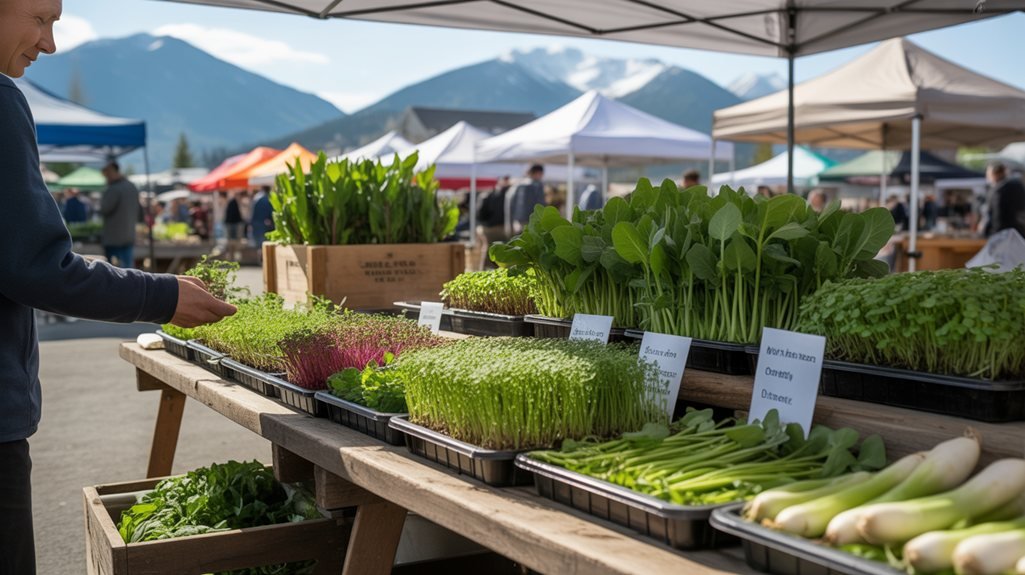
Montana hosts approximately 91 USDA-listed farmers markets, with primary activity concentrated in Missoula, Billings, and Bozeman between June and September. You’ll need to align your seeding schedule, application submissions, and booth logistics before the season opens, as compressed growing windows leave little margin for late planning. Each market attracts distinct buyer profiles—Missoula skews health-conscious, Bozeman trends premium, and Billings rewards volume consistency—making market selection a strategic decision that shapes your sales velocity, and what follows covers exactly that.
Key Takeaways
- Montana has approximately 91 USDA-listed farmers markets, with major microgreens opportunities concentrated in Missoula, Bozeman, and Billings.
- Most Montana markets operate June through September, requiring precise production timing to align harvests with selling weeks.
- Missoula attracts health-conscious buyers, Bozeman skews premium, and Billings customers prioritize value and consistent product volume.
- Research vendor saturation before applying; markets with established microgreens vendors significantly reduce your acceptance chances and sales potential.
- The MGW Market Finder at markets.microgreensworld.com filters Montana markets by region and cross-references operating seasons efficiently.
Farmers Markets in Montana for Microgreens Vendors
Montana’s approximately 91 USDA-listed farmers markets represent a measurable, structured opportunity for microgreens vendors willing to work within a compressed seasonal window.
The state’s market activity concentrates heavily in Missoula, Billings, and Bozeman, where consistent foot traffic and relatively health-conscious buyer demographics create conditions that favor specialty produce.
You’ll need to plan your production calendar around a primarily summer season, which means your seeding schedule, table inventory, and vendor applications all converge within a narrow operational timeline.
Why Montana Markets Are Worth Your Attention
If you’re already growing microgreens and looking for your next viable sales channel, Montana’s farmers market network deserves serious consideration.
The USDA database lists approximately 91 markets operating across the state, giving you meaningful geographic coverage across urban centers and smaller communities alike.
A microgreens farmers market presence in a city like Missoula positions you directly within a health-conscious consumer base that actively seeks specialty produce.
The Missoula farmers market, among others, draws consistent foot traffic during peak summer season, which aligns well with high-volume production cycles.
Montana’s market calendar concentrates primarily in summer, so your planning window is defined and manageable.
For a grower ready to scale distribution, this network offers real structural opportunity worth evaluating carefully.
What the Montana Market Season Looks Like
Because Montana’s growing season is compressed by its northern latitude and mountain climate, the farmers market calendar follows a proportionally condensed arc, running primarily through summer with most markets operating between June and September. As a microgreens vendor in Montana, you’re working within a defined window, which demands precise timing in your production schedule.
Markets in Missoula, Billings, and Bozeman anchor the state’s vendor activity, drawing consistent foot traffic through peak summer weeks. Some markets open as early as May, while smaller rural venues may run only six to eight weeks total.
Understanding this compressed structure helps you plan booth applications, production cycles, and inventory volume. Farmers markets in Montana reward vendors who treat the short season as a strategic constraint rather than a limitation.
How to Find the Right Market in Montana
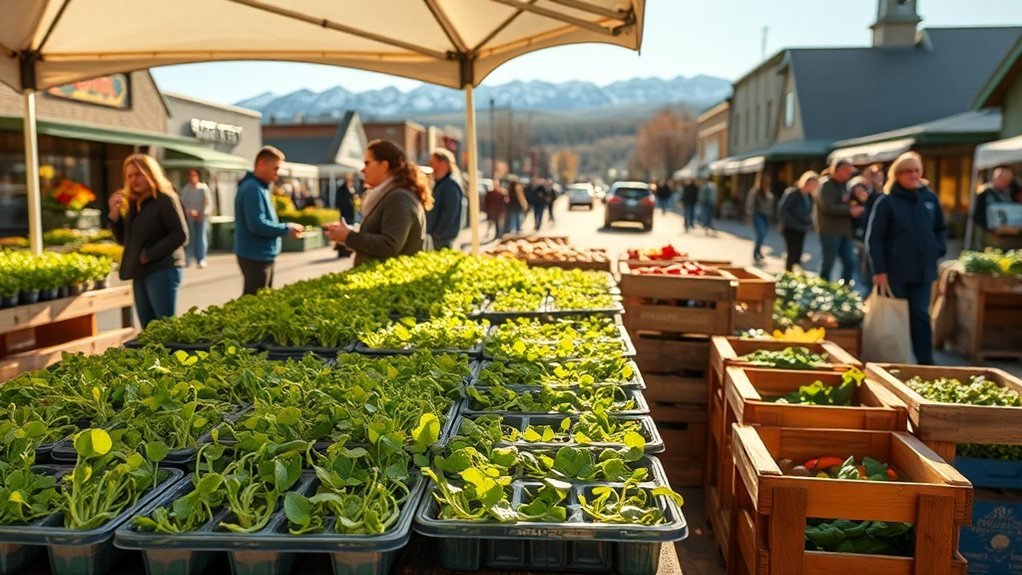
Before you apply to any market in Montana, you need to assess vendor density, customer foot traffic patterns, and whether the market’s existing produce vendors leave a viable opening for microgreens. Missoula’s Clark Fork Market and the Saturday Missoula Farmers Market both draw consistent crowds through the summer season, but their application processes are competitive and typically require early submission. Billings and Bozeman each support multiple market options, giving you a strategic advantage if one market reaches capacity or already carries a microgreens vendor.
What to Look for Before You Apply
Not every farmers market in Montana is going to be a good fit for what you’re growing, and walking into an application without doing some basic reconnaissance first is how vendors end up stuck at low-traffic markets that don’t move product. Before you submit anything as a farmers market vendor Montana, assess each market against concrete criteria.
| Factor | Why It Matters |
|---|---|
| Weekly foot traffic | Determines realistic sales volume |
| Vendor category saturation | Reveals microgreens booth farmers market competition |
| Market management responsiveness | Signals operational professionalism |
| Seasonal calendar length | Affects revenue continuity |
| Customer demographics | Indicates health-conscious buyer concentration |
Missoula and Bozeman markets, for instance, draw significantly different buyer profiles than smaller rural markets, which directly shapes how quickly your trays move.
Markets Near Missoula
Once you’ve identified the baseline criteria worth evaluating in any market, the next logical step is applying that framework to actual geography, starting with western Montana‘s most active urban cluster.
Missoula supports a notable concentration of market activity relative to the state’s overall population, making it a practical entry point for any microgreens grower Montana-based or relocating into the region.
The Missoula Farmers Market operates on a defined seasonal schedule, drawing consistent foot traffic from a demographic that skews toward health-conscious, locally-sourced purchasing behavior.
That’s a favorable alignment for what you’re growing.
You’ll want to confirm current vendor availability directly, since spots in higher-traffic Missoula locations fill quickly, particularly for specialty produce categories where microgreens sit prominently.
Markets Near Billings and Bozeman
| Factor | Billings | Bozeman |
|---|---|---|
| Customer Profile | Value-conscious, consistent | Premium, trend-aware |
| Competition Level | Moderate | Higher |
| Market Season | Summer-focused | Extended shoulder season |
Bozeman’s proximity to Montana State University shapes its vendor dynamics considerably, creating demand for differentiated products. Billings rewards reliability and volume consistency over novelty. Knowing which environment aligns with your current production capacity determines where your application carries the most weight.
What to Expect When You Get There
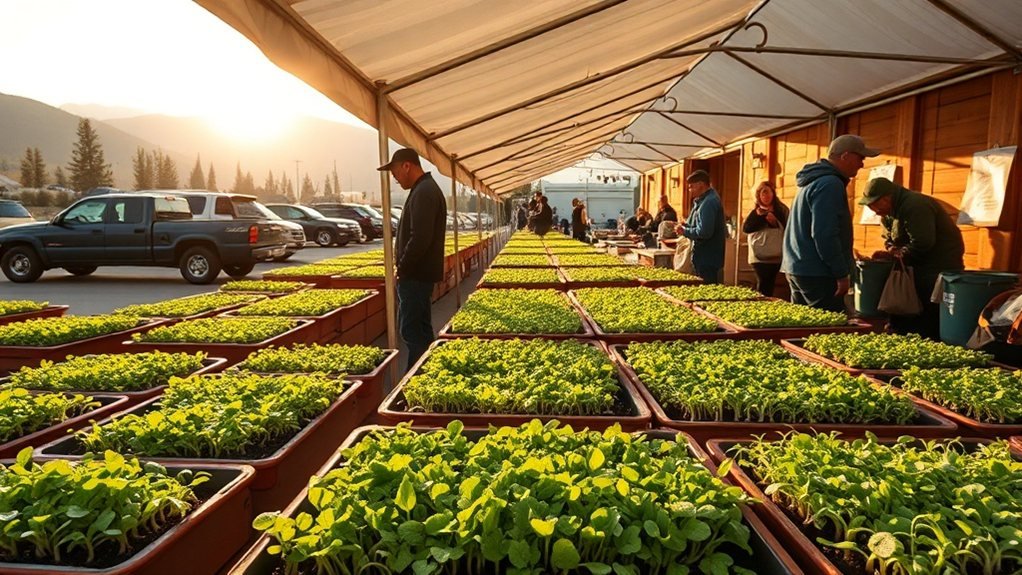
Once you’ve secured a spot, the operational realities of Montana markets become immediately concrete, beginning with booth fees that typically range from daily rates to seasonal contracts, depending on the market’s structure and location.
Setup logistics vary considerably across the state’s approximately 91 listed markets, so confirming load-in windows, table dimensions, and canopy requirements with each market manager before your first day prevents costly missteps.
What moves consistently in Montana’s summer-season markets tends toward functional, differentiated products, and microgreens occupy a compelling position precisely because most vendors aren’t growing them.
Booth Fees and Setup Basics
Booth fees at Montana farmers markets vary considerably, and understanding the fee structures before you apply will save you from budget surprises that can undermine your first season. Daily rates typically range from $15 to $50, while seasonal contracts can run $200 to $800 depending on market size and location. When you’re ready to sell microgreens at a farmers market, reviewing the farmers market vendor application carefully reveals what’s included in that fee.
| Fee Type | Typical Range |
|---|---|
| Daily booth | $15 to $50 |
| Seasonal contract | $200 to $800 |
| Corner placement | $10 to $25 premium |
| Electricity access | $5 to $15 added |
| Late registration | $20 to $40 penalty |
Most markets require a six-foot table, canopy, and weights.
What Moves at Montana Markets
Selling microgreens at a Montana farmers market means walking into a customer base that’s already conditioned to value fresh, locally grown produce, but that familiarity doesn’t automatically translate into immediate sales without some field observation on your part.
Before committing to a booth, walk the market as a visitor. Note which vendors draw consistent foot traffic, how shoppers find their way through the layout, and which price points generate visible hesitation versus immediate purchase.
Sunflower and pea shoots tend to perform reliably across Montana markets because shoppers recognize them. Radish and broccoli microgreens typically appeal to buyers already familiar with nutritional density.
Understanding how to sell microgreens at farmers markets montana vendors frequent requires matching your variety selection to demonstrated local demand, not personal preference.
Getting Your Application Ready
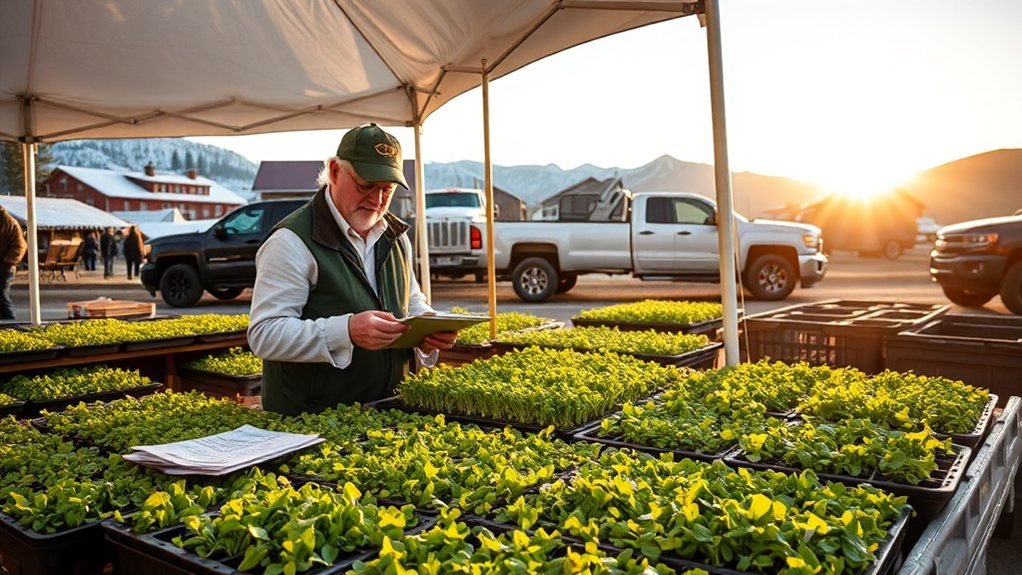
Your application is the first tangible signal a market manager receives about your operation, and it functions less as a formality than as a screening mechanism designed to filter out vendors who aren’t prepared to commit.
Most Montana market managers, particularly those running established programs in Missoula or Bozeman, are evaluating your documentation for consistency, proof of compliance, and evidence that you understand their specific vendor requirements.
Submitting incomplete paperwork, missing your food handler certification, or failing to list your product categories accurately are the kinds of errors that move your application to the bottom of the stack before you’ve had any real consideration.
What Market Managers Want to See
Once you decide to pursue a vendor spot at one of Montana’s roughly 91 listed markets, the application itself becomes the first real test of whether a market manager takes you seriously. They’re evaluating whether you’re prepared to operate professionally, not just whether you have microgreens for sale in Montana.
| What They Ask | What They’re Actually Assessing |
|---|---|
| Business license or cottage food cert | Legal compliance readiness |
| Product photos or descriptions | Presentation and booth professionalism |
| Prior market experience | Reliability and vendor maturity |
Knowing how to get a farmers market booth means understanding that managers select vendors who reduce their administrative burden. Submit complete documentation, reference your production capacity accurately, and demonstrate that you’ve researched their specific market’s customer base before applying.
Common Mistakes to Avoid
Even experienced growers who produce a consistent, high-quality product can undermine their own applications by making avoidable procedural errors before they ever interact with a market manager.
Submitting incomplete documentation is the most common failure, particularly missing cottage food permits or proof of liability insurance, both of which signal operational unpreparedness to managers reviewing your microgreens business for the first time.
Applying without researching vendor saturation is similarly damaging, since selling microgreens locally becomes significantly harder when a market already carries two established microgreens vendors.
You should also avoid generic product descriptions that fail to distinguish your varieties, your growing methods, or your harvest-to-market timeline.
Managers reviewing dozens of applications will skip past vague submissions without a second consideration.
Use the Market Finder to Shortcut Your Search

Tracking down viable farmers markets in Montana doesn’t have to mean hours of phone calls, dead-end web searches, or driving through Missoula on a Saturday morning just to see who’s operating. The MGW Market Finder at markets.microgreensworld.com pulls from USDA data to surface Montana’s approximately 91 listed markets in a single searchable interface.
If you’re building a local microgreens montana presence or scouting the right location for your microgreens market stand, that tool compresses what would otherwise be weeks of fragmented research into a focused, actionable process. You filter by region, cross-reference operating seasons, and identify markets that align with your production schedule. Start there before you contact a single market manager or load your first tray into a vehicle.
Frequently Asked Questions
Can I Sell Microgreens at Montana Farmers Markets Without a Business License?
You can often sell without a business license at Montana farmers markets, but you’ll still need a food handler’s permit and to comply with cottage food rules. Check each market’s vendor requirements individually.
Do Montana Markets Require Vendors to Grow Everything They Sell?
Most Montana markets don’t require you to grow everything you sell, but many prioritize producer-only vendors. You’ll want to confirm each market’s vendor policy before applying, since rules vary significantly by market.
How Early Should I Arrive to Set up My Market Booth?
Arrive at least 90 minutes before gates open. Montana markets move fast at setup, and you’ll want time to arrange your display, troubleshoot any issues, and be fully ready before the first customer walks in.
Can I Vend at Multiple Montana Markets on the Same Weekend?
Yes, you can, but Montana’s distances make it tough. Many vendors pick a Saturday anchor market and add a Sunday market nearby. Test the drive time before committing to both.
What Happens if My Microgreens Don’t Sell Out at Market?
If your microgreens don’t sell out, you’ve got options. Refrigerate what’s left and bring it next market day, donate it locally, or fold it into a compost system so nothing’s truly wasted.
Wrap-up
Montana’s farmers market landscape presents a viable, if seasonally constrained, distribution channel for microgreens vendors willing to approach it strategically. You’ve got concentrated demand in Missoula, Billings, and Bozeman, and that’s where your early efforts should focus. Align your production schedule with the compressed summer season, submit applications early, and present your product professionally. If you’re systematic about market selection and preparation, you can build consistent revenue within a single selling season.
Leave a Reply