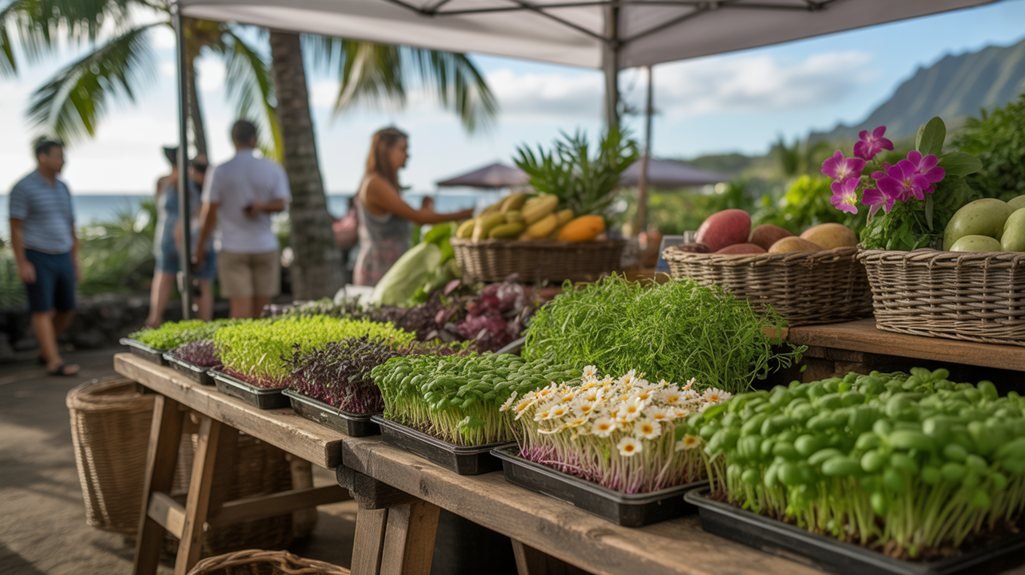
Hawaii’s roughly 71 USDA-listed farmers markets operate year-round across multiple islands, giving microgreens vendors consistent weekly selling opportunities without the seasonal gaps that constrain mainland production cycles. You’ll find strong demand in venues like KCC and Honolulu Farmers Market, where health-conscious buyers and restaurants actively seek sunflower, pea shoots, and radish varieties. Booth fees range from $25 to $150+, depending on venue traffic. What follows breaks down exactly how to evaluate, apply for, and succeed at these markets.
Key Takeaways
- Hawaii has approximately 71 USDA-listed farmers markets across multiple islands, operating year-round without seasonal dormancy common on the mainland.
- Sunflower, pea shoots, and radish are the fastest-moving microgreens at high-traffic Hawaii markets, attracting both restaurant and household buyers.
- Popular Honolulu venues include KCC Farmers Market, Ward Village, Kapiolani Community Market, Blaisdell Center, and Manoa Valley markets.
- Booth fees range from roughly $25 at smaller markets to $150+ at high-traffic Honolulu venues, with varying flat or percentage-based structures.
- Applications require proof of production setup, food handler certifications, general excise tax license, and precise product descriptions to avoid disqualification.
Farmers Markets in Hawaii for Microgreens Vendors
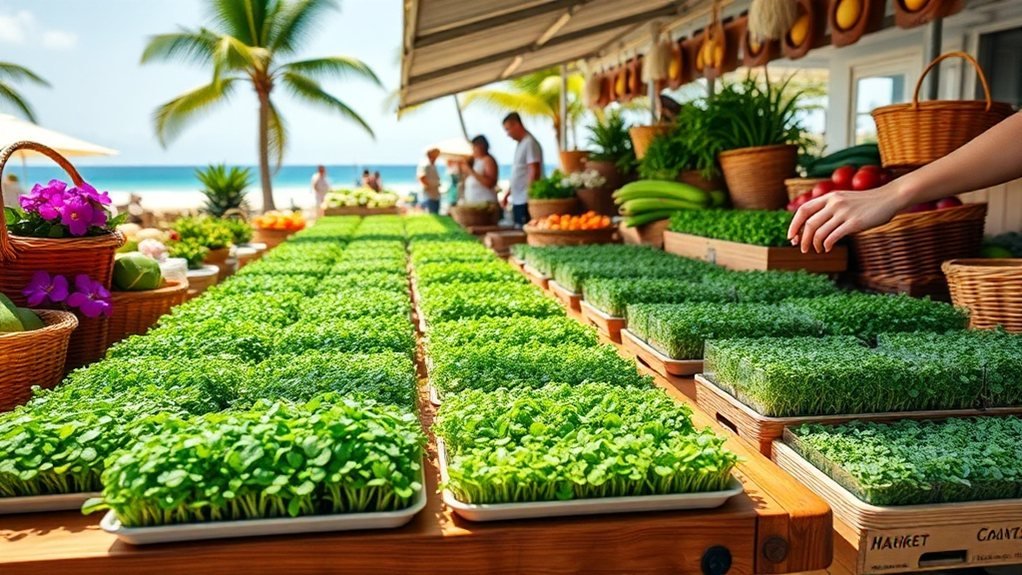
Hawaii’s farmers market landscape offers microgreens vendors a genuinely uncommon operating environment, one where seasonal dormancy is largely absent and consistent weekly foot traffic sustains vendor revenue across all twelve months.
The state’s approximately 71 USDA-listed markets are distributed across multiple islands, with Honolulu, Kailua, and Hilo representing the densest concentrations of established, year-round venues.
If you’re already producing and looking to place your trays somewhere reliable, Hawaii’s calendar structure removes the stop-start planning that complicates vendor strategy on the mainland.
Why Hawaii Markets Are Worth Your Attention
When you factor in the climate, the consumer base, and the sheer density of year-round markets, Hawaii stands out as a genuinely viable territory for microgreens vendors. With approximately 71 hawaii farmers markets listed in the USDA database, the state offers consistent selling opportunities that most mainland vendors simply don’t have access to year-round. Honolulu, Kailua, and Hilo carry the heaviest market concentrations, giving you multiple venue options within manageable distance.
The climate eliminates the seasonal dropout problem that forces mainland growers off the circuit for months at a time. At a microgreens farmers market in Hawaii, your product competes against a backdrop of high health-consciousness and strong local-food demand, which creates a customer base already predisposed to what you’re selling.
What the Hawaii Market Season Looks Like
Unlike most growing regions on the mainland, Hawaii operates on a market calendar that doesn’t compress into a narrow seasonal window, which fundamentally changes how you plan your production schedule and vendor commitments. Year-round market activity means your microgreens for sale Hawaii can move consistently across all twelve months, without the forced production surges that mainland growers manage every spring.
Farmers markets Hawaii operates roughly 71 active markets, distributed across Oahu, the Big Island, and Maui, with the heaviest concentration in Honolulu, Kailua, and Hilo. Because demand doesn’t seasonally collapse, you’re building a sustained production rhythm rather than cycling through peaks and gaps. That consistency rewards growers who treat vendor commitments seriously and maintain reliable supply week after week.
How to Find the Right Market in Hawaii
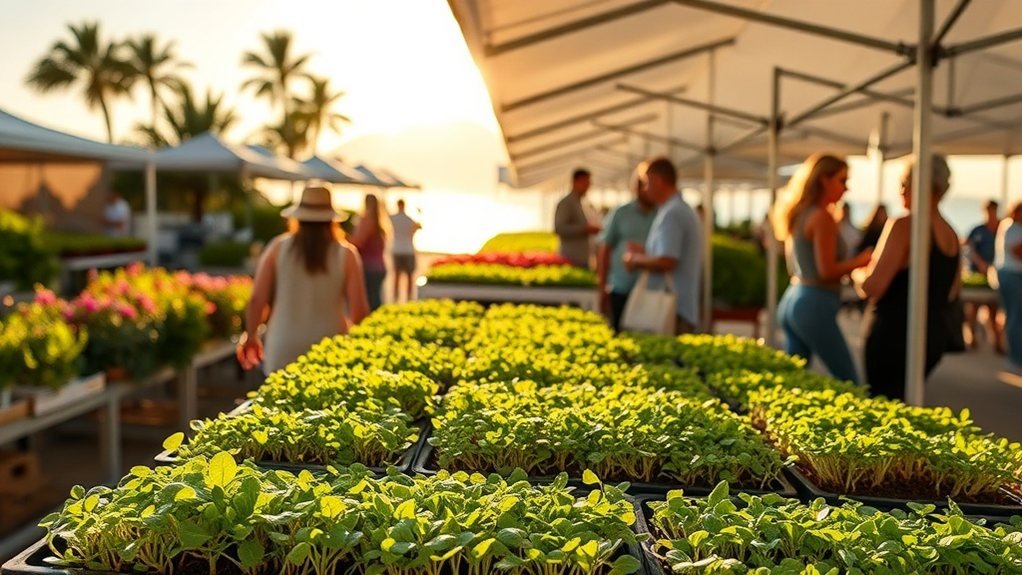
Before you apply to any market in Hawaii, you need to evaluate foot traffic patterns, vendor density, and whether the existing product mix leaves room for microgreens.
Honolulu concentrates the highest volume of market activity on Oahu, with established venues like the KCC Farmers Market drawing consistent weekly attendance, making it a logical starting point for vendors assessing competitive conditions.
Kailua and Hilo offer relatively smaller markets where vendor rosters tend to be less saturated, which can work in your favor if you’re entering without an existing customer base.
What to Look for Before You Apply
Choosing the right market matters as much as the quality of what you’re growing, and in Hawaii, that decision carries geographic and logistical weight that mainland growers rarely deal with.
As a microgreens vendor in Hawaii, you’re operating within island-specific constraints: ferry logistics, inter-island shipping costs, and humidity levels that affect shelf life before you even reach the booth.
Before you apply anywhere, evaluate vendor saturation, foot traffic data, and whether the market permits perishable specialty crops without excessive handling requirements.
A farmers market vendor in Hawaii also needs to confirm whether the market operates year-round, since Hawaii’s calendar largely supports continuous operation, making consistency more achievable than in seasonal mainland markets.
Audit each market’s application timeline, fee structure, and proximity to your production site before committing.
Markets Near Honolulu
Once you’ve assessed the logistical and regulatory variables that determine market fit, geography becomes your next filter, and in Hawaii, Honolulu presents the densest concentration of vendor opportunities on the islands. Operating a microgreens booth farmers market presence here means accessing high foot traffic, a culturally diverse customer base, and year-round scheduling stability.
| Market Name | Location | Schedule |
|---|---|---|
| KCC Farmers Market | Diamond Head | Saturday |
| Honolulu Farmers Market | Ward Village | Wednesday |
| Kapiolani Community Market | Kapiolani Park | Sunday |
| Blaisdell Farmers Market | Blaisdell Center | Wednesday |
| Manoa Farmers Market | Manoa Valley | Thursday |
Each honolulu farmers market operates under distinct vendor requirements, so confirming application windows and product category restrictions before committing protects your time and resources.
Markets Near Kailua and Hilo
Across the windward side of Oahu and the Big Island, Kailua and Hilo represent two distinctly different market environments that reward vendors who study them before applying.
The Kailua farmers market draws a health-conscious, higher-income demographic that responds well to specialty crops, including microgreens, particularly when you communicate growing methods clearly.
Hilo operates differently. The Hilo farmers market reflects a community deeply rooted in local agriculture, where relationships with regulars and consistent product quality carry more weight than branding.
You’re entering a market culture there, not just a transaction space. Both locations run year-round, which works in your favor as a microgreens grower maintaining continuous production cycles.
Research each market’s vendor requirements, application windows, and booth fees before committing your first tray.
What to Expect When You Get There
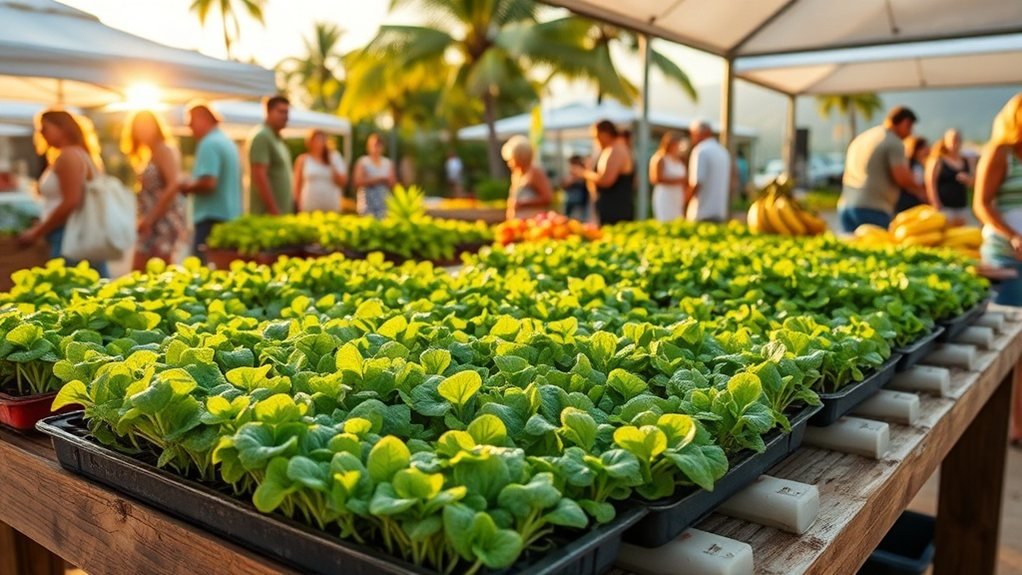
Once you secure a spot at a Hawaii farmers market, the operational realities of booth fees and product selection demand immediate, practical attention.
Booth fees across Hawaii’s markets vary considerably, ranging from modest daily rates at community markets to higher weekly fees at established Honolulu venues, and your margin math must account for this cost before you commit to a schedule.
Understanding which microgreens varieties move consistently at Hawaii markets, where health-conscious, year-round shoppers actively seek fresh, locally grown produce, shapes your production planning as directly as any growing decision you’ll make.
Booth Fees and Setup Basics
Before you commit to a market, you need to understand what booth fees actually look like in Hawaii, because the numbers vary more than most new vendors expect.
Weekly fees at farmers markets Hawaii microgreens vendors typically encounter range from $25 at smaller neighborhood markets to $150 or more at high-traffic Honolulu locations.
Knowing how to get a farmers market booth means budgeting accurately before you apply, not after.
Most markets charge a flat weekly rate, though some employ percentage-based models tied to reported sales.
Your setup requirements will likely include a canopy rated for wind and UV exposure, given Hawaii’s conditions.
Weighted anchors are non-negotiable at coastal sites, where gusts can compromise an unsecured structure within minutes of opening.
What Moves at Hawaii Markets
Microgreens consistently outperform other specialty crops at Hawaii farmers markets when vendors position them correctly, largely because the local culinary culture prioritizes fresh, hyperlocal ingredients with identifiable origins. Farmers market Hawaii vendors report that sunflower, pea shoots, and radish move fastest at high-traffic locations. Local microgreens Hawaii buyers skew toward restaurant buyers and health-conscious households, both of whom purchase repeatedly when quality holds.
| Variety | Primary Buyer | Reorder Rate |
|---|---|---|
| Sunflower | Restaurants | High |
| Pea Shoots | Households | High |
| Radish | Both segments | Moderate |
| Spicy Mix | Restaurants | Moderate |
Understanding which varieties align with your specific market’s demographics determines your inventory decisions before you ever unpack a tray.
Getting Your Application Ready
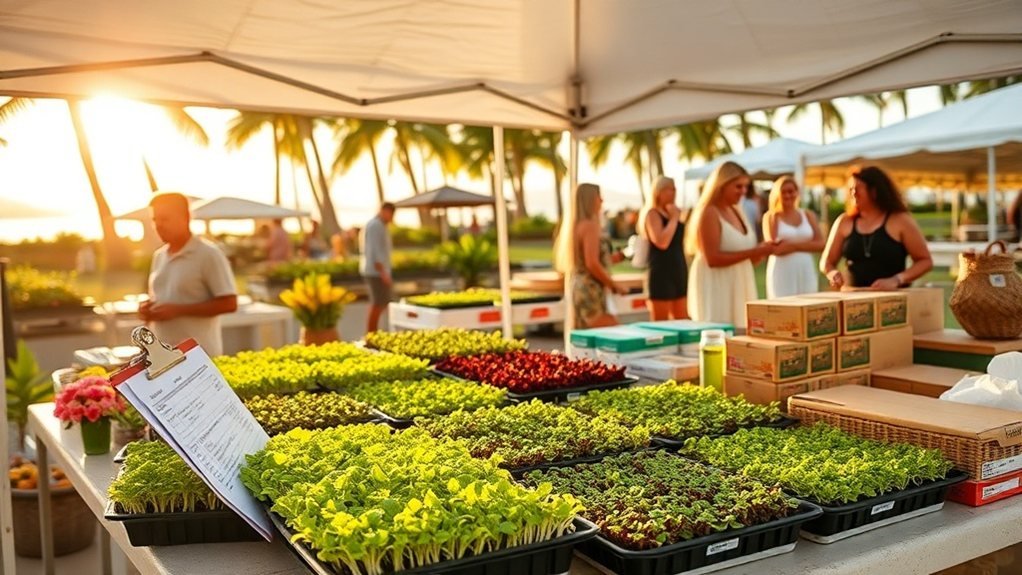
Your application is the first substantive data point a market manager employs to assess whether you fit their vendor mix, so the quality of that document carries real weight before you’ve exchanged a single word.
Most managers in Hawaii want to see proof of your production setup, a clear product description specifying varieties and formats, and documentation such as a general excise tax license and any applicable cottage food or commercial kitchen permits.
Vendors who submit incomplete paperwork, vague product descriptions, or photos that fail to represent actual sellable product consistently find their applications deprioritized, regardless of how strong their microgreens actually are.
What Market Managers Want to See
Getting accepted into a Hawaii farmers market often comes down to how well your application reflects an understanding of what that specific market is actually trying to accomplish. Market managers aren’t reviewing your farmers market vendor application to fill space; they’re curating a vendor mix that serves their specific community and revenue model. When you want to sell microgreens at farmers market venues in Hawaii, your application needs to demonstrate product consistency, food safety compliance, and genuine alignment with that market’s mission.
A Honolulu market prioritizing local agriculture reads your application differently than a Hilo community market emphasizing accessibility. Research each market’s stated values before submitting, then mirror that language precisely, showing managers you’ve done your homework rather than submitting a generic packet everywhere.
Common Mistakes to Avoid
Even experienced producers make avoidable errors when assembling their first farmers market application, and in Hawaii’s competitive market landscape, those errors tend to carry real consequences.
When you’re focused on selling microgreens locally, incomplete documentation is the most common disqualifier, particularly missing food handler certifications or vague product descriptions that leave managers guessing.
Submitting generic photos rather than Hawaii-specific booth setups signals inexperience immediately.
If you’re serious about learning how to sell microgreens at established markets, you need to treat each application as market-specific, not transferable copy-paste material.
Managers across Honolulu, Kailua, and Hilo review dozens of vendor submissions, and applications lacking precise details about your growing medium, harvest protocols, or packaging standards typically receive no follow-up.
Use the Market Finder to Shortcut Your Search
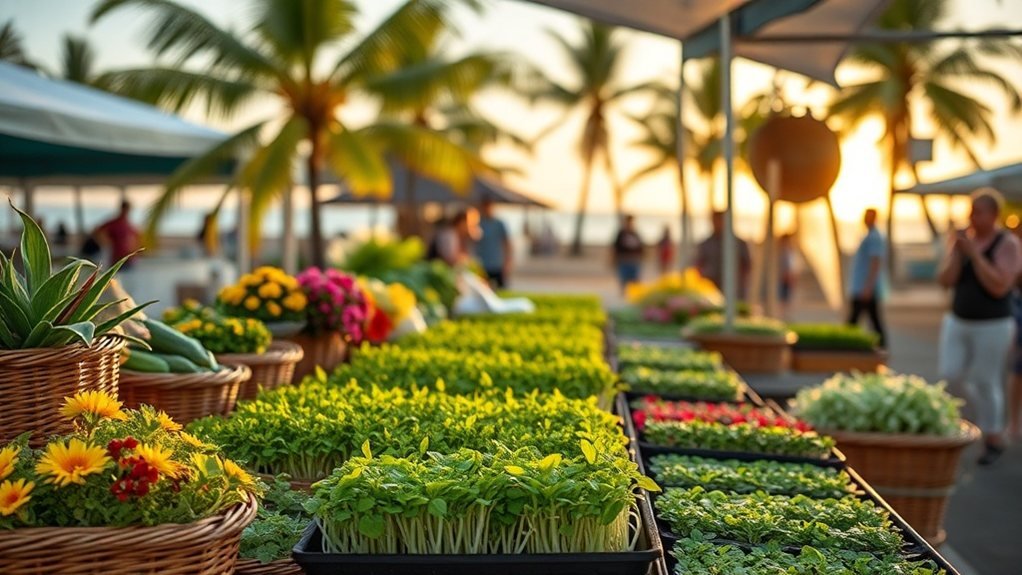
Tracking down viable vendor spots across Hawaii’s 71 listed markets takes time you could spend on trays, so the MGW Market Finder at markets.microgreensworld.com pulls USDA data into a searchable format built specifically for growers at your stage.
As a microgreens grower Hawaii, you can filter by island, city, or frequency rather than manually cross-referencing scattered directories.
A grower establishing a microgreens market stand in Honolulu, for instance, can identify year-round markets within a specific district, then approach management directly with availability and product focus already confirmed.
This removes the speculative groundwork that wastes weeks before you make a single contact.
The tool doesn’t replace your outreach, but it compresses the research phase significantly. Start your search at markets.microgreensworld.com before you make your first call.
Frequently Asked Questions
Do Hawaii Farmers Markets Require a State Seller’s Permit for Microgreens?
Hawaii doesn’t require a general seller’s permit, but you’ll need a General Excise Tax license from the Department of Taxation before you collect any money at a farmers market.
Can I Sell Microgreens at Multiple Hawaii Markets on the Same Day?
Yes, you can work multiple Hawaii markets on the same day, but you’ll need enough product, staff, or a trusted helper to run each booth while you’re away handling another one.
How Do Hawaii’s Humidity Levels Affect Microgreens Display and Shelf Life?
Hawaii’s humidity accelerates wilting and shortens shelf life fast. You’ll want breathable containers, minimal misting before display, and a cooler nearby to keep your trays crisp through the market day.
Are There Co-Op or Shared Vendor Spots Available at Hawaii Markets?
Some Hawaii markets do offer shared or co-op vendor spots, though availability varies by market. You’ll want to contact market managers directly to ask, since these arrangements aren’t always advertised publicly.
Do Hawaii Markets Close During Major Local Festivals or Holidays?
Most Hawaii markets stay open during holidays and festivals — they often see higher foot traffic on those days. Confirm directly with each market manager, since schedules vary by location and season.
Wrap-up
Hawaii’s farmers market landscape rewards growers who research strategically rather than apply broadly. You’ve got 71 markets across the islands, year-round operating schedules, and a consumer base that consistently prioritizes locally grown produce. Identify which clusters align with your location, prepare documentation in advance, and employ available market-finder tools to narrow your options efficiently. The infrastructure’s already there; your job is matching your production capacity to the right venue.
Leave a Reply