
Missouri’s approximately 156 USDA-listed farmers markets give microgreens vendors a dense statewide network with meaningful entry points across urban and rural corridors. Major hubs like Kansas City, St. Louis, and Columbia each carry distinct buyer demographics, vendor competition levels, and application timelines you’ll need to assess before committing. Peak season runs April through October, though several urban markets operate year-round. Selecting the right market requires evaluating booth fees, existing vendor mix, and production capacity — factors that directly determine your sell-through potential, all of which become clearer ahead.
Key Takeaways
- Missouri has approximately 156 USDA-listed farmers markets, with major hubs in Kansas City, St. Louis, and Columbia offering strong microgreens opportunities.
- Peak selling season runs April through October, but select Kansas City and St. Louis markets operate year-round.
- Sunflower and pea shoot microgreens generate the strongest repeat customer engagement across Missouri markets.
- Avoid applying to markets already saturated with greens vendors, regardless of your product quality.
- Use the MGW Market Finder at markets.microgreensworld.com to efficiently identify and filter viable Missouri market options.
Farmers Markets in Missouri for Microgreens Vendors
Missouri’s approximately 156 USDA-listed farmers markets represent a substantial distribution network for microgreens vendors seeking consistent, repeat-customer sales channels.
The state’s market activity concentrates heavily in Kansas City, St. Louis, and Columbia, giving you multiple metropolitan entry points where consumer foot traffic and vendor competition both run high.
The primary selling season stretches spring through fall, which aligns well with microgreens production cycles and gives you enough consecutive market weeks to build a recognizable booth presence.
Why Missouri Markets Are Worth Your Attention
With roughly 156 farmers markets operating across the state, Missouri gives microgreens vendors a meaningful volume of placement opportunities that many neighboring states simply can’t match. That density matters when you’re building a sustainable sales route, because redundancy in your market portfolio protects your revenue when one market underperforms.
| Market Factor | Missouri Context |
|---|---|
| Total Markets | ~156 statewide |
| Peak Season | Spring through fall |
| Major Hubs | Kansas City, St. Louis, Columbia |
| Vendor Competition | Varies significantly by market size |
Missouri farmers markets skew heavily toward urban corridors, which means your microgreens farmers market strategy should prioritize those hubs first. Buyers in those zones already understand specialty produce, reducing the educational barrier you’d otherwise face at smaller rural markets.
What the Missouri Market Season Looks Like
Seasonality in Missouri generally follows a compressed arc, with the bulk of farmers market activity clustering between April and October, though a handful of urban markets in Kansas City and St. Louis operate year-round. As a microgreens vendor Missouri presents a meaningful strategic variable: your production schedule must align with market availability, not the other way around.
Columbia’s mid-week markets tend to open later in spring, while weekend markets in Kansas City activate earlier, reflecting stronger cold-season consumer demand. Farmers markets Missouri operates on a tiered calendar, meaning application windows open well before the first market date. If you’re targeting a spring debut, you should be submitting applications by February, since competitive spots fill quickly at higher-traffic venues.
How to Find the Right Market in Missouri
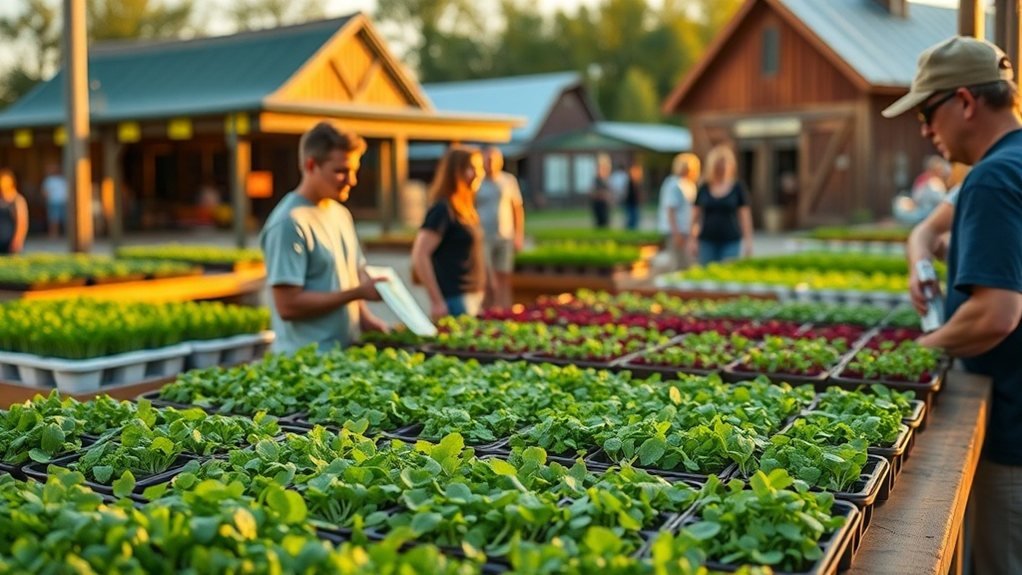
Before you submit a single application, you need to evaluate each market against your production capacity, your price point, and the existing vendor mix, because a market already saturated with greens vendors will absorb you poorly regardless of your product quality.
Kansas City’s network of established markets, including those operating in the metro’s denser residential corridors, tends to reward vendors who can commit to weekly attendance and volume consistency.
St. Louis and Columbia present structurally different opportunities, where Columbia’s proximity to a university population creates demand patterns that differ measurably from the suburban St. Louis markets drawing a more traditional weekend-shopper demographic.
What to Look for Before You Apply
Choosing the right farmers market in Missouri isn’t simply a matter of proximity or convenience, because the structural characteristics of a given market will largely determine whether your microgreens move consistently or sit untouched. Before you pursue how to get a farmers market booth, evaluate each market against criteria that directly affect sell-through rate.
| Factor | Strong Signal | Weak Signal |
|---|---|---|
| Vendor tenure | High turnover | Waitlisted spots |
| Customer traffic | Steady foot traffic | Sparse weekday crowds |
| Product overlap | Few microgreens vendors | Saturated with greens |
Farmers markets Missouri microgreens vendors should prioritize markets with established attendance patterns. A Columbia Saturday market drawing consistent crowds outperforms a newer market regardless of lower booth fees.
Markets Near Kansas City
Within the Kansas City metro area, Missouri microgreens vendors encounter one of the state’s most commercially active market ecosystems, where established venues like the Overland Park Farmers Market and the City Market in the River Market district draw consistent foot traffic across extended seasonal windows.
As a microgreens farmer in Missouri, you’re working within a competitive but accessible landscape. The kansas city farmers market circuit spans both Missouri and Kansas sides of the metro, which effectively doubles your application pool. Vendors who map this geography carefully identify gaps in specialty produce coverage before submitting applications.
City Market operates year-round, making it structurally different from seasonal alternatives. Understanding that distinction shapes which venues align with your current production volume and harvest scheduling capacity.
Markets Near St. Louis and Columbia
Shifting east from Kansas City, the St. Louis farmers market ecosystem offers considerably more density, with multiple established venues operating across the metro. You’ll find both nonprofit-managed markets and privately operated markets competing for quality vendors, which actually works in your favor when negotiating a microgreens booth farmers market placement. The Tower Grove Farmers Market and Soulard Market represent two distinct operational models worth studying before you apply.
Columbia sits roughly midway between both metros and runs a tighter vendor community, meaning relationships matter more and turnover is slower. Getting into a St. Louis farmers market often requires documented production capacity, so bring your grow records when you apply.
Missouri’s USDA-listed markets number around 156 statewide, and browsing them systematically saves considerable time. Employ the free Market Finder at markets.microgreensworld.com to map your options.
What to Expect When You Get There
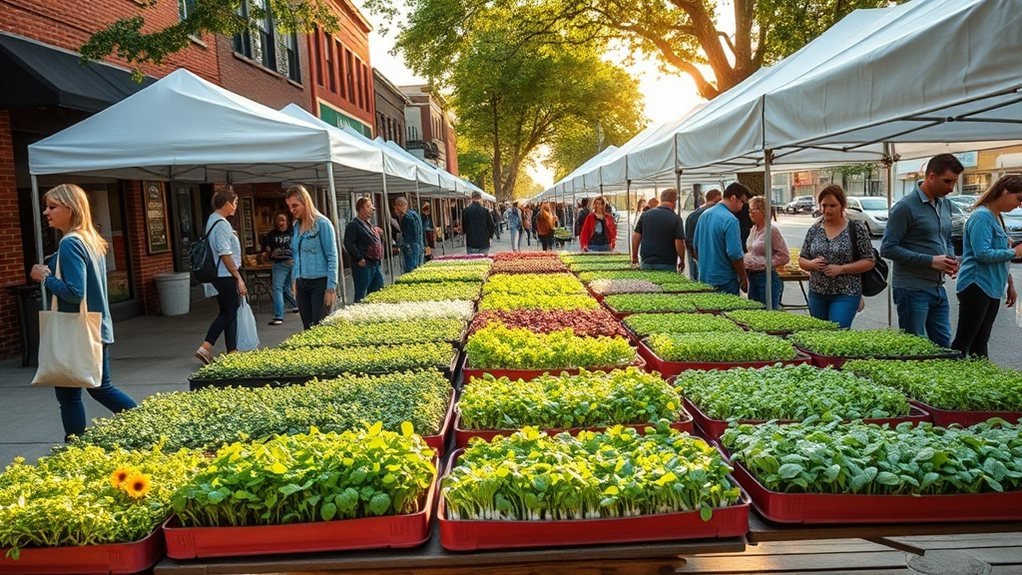
Once you’ve identified a market and secured a spot, the operational realities of vending become your immediate focus, spanning booth fees, physical setup requirements, and product positioning strategies specific to Missouri’s market culture.
Booth fees across Missouri markets vary considerably, ranging from modest weekly rates at smaller rural markets to higher seasonal commitments at established urban venues in Kansas City or St. Louis, so you’ll need to factor those costs into your pricing structure before your first setup day.
What moves consistently at Missouri markets tends to skew toward familiar varieties like sunflower and pea shoots, though that can shift depending on whether you’re working a Columbia neighborhood market with an adventurous customer base or a mid-Missouri community market where buyers want something they already recognize.
Booth Fees and Setup Basics
Before you commit to a market, you need a clear-eyed picture of what booth fees actually look like in Missouri, because the range is wider than most new vendors expect. As a farmers market vendor Missouri, you’ll encounter significant variation based on market size, location, and frequency.
| Market Type | Typical Weekly Fee | Season Length |
|---|---|---|
| Neighborhood/Rural | $15 – $30 | 12-20 weeks |
| Mid-Size City | $30 – $60 | 20-28 weeks |
| Kansas City/St. Louis | $50 – $120 | 24-32 weeks |
| Indoor Winter Markets | $25 – $75 | Variable |
| Specialty/Niche Markets | $20 – $50 | 8-16 weeks |
Booth fees and setup basics also include tent permits, insurance requirements, and weight anchoring standards. Budget accordingly before your first application.
What Moves at Missouri Markets
Knowing what actually sells before you set up your first table saves you from guessing games that cost both time and product.
Among missouri farmers market vendors, sunflower and pea shoot varieties consistently draw the strongest repeat customer engagement, largely because their flavor profiles are immediately recognizable to buyers unfamiliar with specialty greens.
Radish and broccoli microgreens for sale missouri vendors typically position as culinary accent products, which appeals to the restaurant-adjacent consumer demographic common in Columbia and St. Louis markets.
Smaller, competitively priced clamshells move faster than bulk offerings at entry-level markets, where customers are still building purchase habits.
Kansas City markets, particularly those with established vendor ecosystems, tend to reward vendors who maintain consistent weekly presence over those rotating product selection without clear category focus.
Getting Your Application Ready
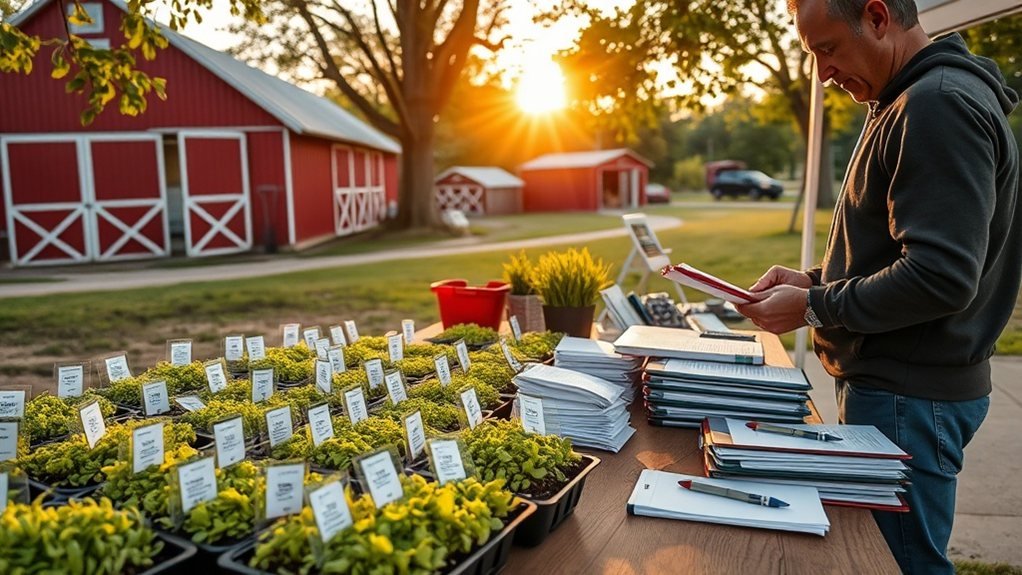
Your application is the market manager‘s first substantive assessment of you as a vendor, so it needs to reflect operational competence, not just enthusiasm.
Most Missouri market managers are evaluating whether your product fits their vendor mix, whether you understand food safety requirements, and whether you can reliably hold a weekly spot through the full season.
A Missouri grower who submits an application with vague product descriptions, no mention of production scale, or missing cottage food documentation is likely to get passed over in favor of someone whose paperwork signals they’ve already thought through the logistics.
What Market Managers Want to See
Market managers in Missouri are, more often than not, evaluating vendor applications through a specific lens: does this grower understand what a market needs, not just what they want to sell?
At a Columbia farmers market, for instance, managers prioritize product variety, consistent supply, and professional presentation over novelty alone.
When you apply to any microgreens farmers market, your application should demonstrate that you’ve researched their existing vendor mix, identified a genuine gap, and can fill it reliably week after week.
Managers want documented food safety practices, proof of consistent production capacity, and clarity about which varieties you’ll carry.
Vague answers signal inexperience. Specific answers, like citing your weekly harvest yield or your growing system’s output, signal that you’ve done the operational work before showing up.
Common Mistakes to Avoid
Most vendors who get rejected from Missouri farmers markets don’t fail because their microgreens are poor quality; they fail because their application signals operational unpreparedness before a manager ever evaluates the product itself.
Farmers market Missouri vendors consistently undermine strong products through avoidable application errors.
| Mistake | Why It Hurts You | What to Do Instead |
|---|---|---|
| Vague product descriptions | Signals inexperience to managers | List specific varieties and weights |
| Missing liability insurance | Immediate disqualification | Secure coverage before applying |
| No defined setup footprint | Creates logistical uncertainty | Specify exact canopy dimensions |
| Generic vendor statement | Indistinguishable from competition | Address market’s specific customer base |
| Applying off-season | Wastes relationship capital | Target spring application windows |
When you sell microgreens at farmers market venues, precision in your application communicates the same professionalism your booth eventually will.
Use the Market Finder to Shortcut Your Search

Searching for open vendor spots across Missouri’s 156 USDA-listed markets one by one is the kind of inefficient process that burns time you’d rather spend in the grow room.
The MGW Market Finder at markets.microgreensworld.com consolidates that data, allowing you, as a microgreens grower Missouri-based or otherwise, to filter by location and identify viable microgreens farmers market opportunities without the manual legwork.
The MGW Market Finder consolidates Missouri’s scattered market data so you can filter, identify, and move forward faster.
You enter your region, review what’s available, and move directly toward applications.
The tool doesn’t replace your judgment about fit, foot traffic, or competition, but it eliminates the search friction that stalls most vendors before they ever submit a single form.
Employ it to compress your prospecting timeline and redirect your energy toward actually getting to market.
Frequently Asked Questions
Can I Sell Microgreens at Missouri Farmers Markets Without a License?
You can sell microgreens at Missouri farmers markets without a license in many cases, but you’ll need to verify each market’s specific vendor requirements, since rules vary by location and market management.
How Early Should I Arrive to Set up My Microgreens Booth?
Arrive at least 90 minutes before opening. You’ll need time to unload, arrange your trays, set up signage, and handle anything unexpected. Most experienced vendors show up even earlier than that.
Do Missouri Farmers Markets Allow Shared Vendor Spaces for Microgreens Sellers?
Some Missouri markets allow shared vendor spaces, but you’ll need to ask each market manager directly. Policies vary widely, and many markets restrict booth sharing to prevent product conflicts with established vendors.
What Happens if My Application Gets Rejected by a Missouri Market?
Don’t take it personally. Ask the market manager for specific feedback, fix what you can, and reapply next season. Meanwhile, utilize markets.microgreensworld.com to find other Missouri markets accepting vendors now.
Should I Sell Microgreens at Indoor Winter Markets in Missouri?
Yes, do it. Missouri’s indoor winter markets keep your name in front of buyers when competitors disappear. You’ll hold shelf space heading into spring before anyone else even reapplies.
Wrap-up
Missouri’s farmers market landscape offers microgreens vendors a structured, viable entry point into direct retail sales. You’ve got 156 listed markets spanning urban centers like Kansas City and St. Louis to smaller regional venues, each carrying distinct vendor requirements, seasonal windows, and competitive dynamics. Start your applications early, particularly for high-traffic markets where spots close quickly. When you’re ready to identify specific locations, filter by proximity, season, and market size using the MGW Market Finder.
Leave a Reply