
Washington’s approximately 274 USDA-listed farmers markets offer microgreens vendors a broad but competitive distribution network, spanning seasonal windows from April through October in Seattle, Bellingham, and Olympia, with shorter May-through-September windows in Spokane and the Tri-Cities. You’ll find booth fees ranging from $20 at rural venues to over $100 daily at high-traffic Seattle markets. Selecting the right market — evaluating foot traffic, vendor saturation, and application requirements — matters far more than proximity, and what follows covers each factor systematically.
Key Takeaways
- Washington has approximately 274 USDA-listed farmers markets, with Seattle, Spokane, and Bellingham offering the highest vendor density and opportunity.
- Seattle, Bellingham, and Olympia markets run April through October; Spokane and Tri-Cities operate shorter May–September windows.
- Booth fees range from $20 at rural markets to over $100 daily at high-traffic Seattle venues, affecting profitability calculations.
- Sunflower and pea shoots sell fastest in urban markets, while Seattle buyers favor specialty crops like amaranth and sorrel.
- Confirm no existing microgreens vendor, review application fees, and verify market accepts specialty produce before applying.
Farmers Markets in Washington for Microgreens Vendors
Washington’s approximately 274 USDA-listed farmers markets represent a substantial commercial infrastructure for microgreens vendors seeking consistent, repeat-customer sales channels.
The state’s market calendar follows a predictable spring-through-fall arc, concentrating vendor opportunity in the warmer months when foot traffic and discretionary spending on specialty produce peak simultaneously.
Seattle, Spokane, and Bellingham anchor the market density, giving you geographically distributed entry points depending on your production location and distribution range.
Why Washington Markets Are Worth Your Attention
If you’re growing microgreens and weighing where to sell, Washington is a state that rewards the effort of showing up. The USDA database lists approximately 274 markets across Washington, giving you genuine geographic options whether you’re positioned near Seattle, Spokane, or Bellingham.
A Seattle farmers market draws consumers who actively seek specialty produce, making it a practical entry point for a microgreens farmers market vendor building a consistent customer base. Washington’s spring-through-fall calendar gives you a defined selling window to plan production cycles against real demand.
The market density here means you’re not locked into one venue if a particular market isn’t the right fit. You have room to find where your product lands best.
What the Washington Market Season Looks Like
The Washington market season generally runs from spring through fall, though the precise window varies considerably by region and venue. As a microgreens vendor washington, understanding these regional timing differences shapes your entire production calendar.
| Region | Season Window | Market Frequency |
|---|---|---|
| Seattle | April through October | Weekly |
| Spokane | May through September | Weekly |
| Bellingham | April through October | Weekly |
| Tri-Cities | May through September | Bi-weekly |
| Olympia | April through October | Weekly |
When you’re targeting farmers market washington opportunities, Puget Sound markets open earlier and close later than eastern counterparts. This split rewards growers who plan production schedules around both climates simultaneously, essentially giving you two distinct selling environments within one state, each demanding calibrated timing.
How to Find the Right Market in Washington

Finding the right market in Washington starts with evaluating foot traffic, vendor density, and seasonal timing before you submit a single application. Seattle’s concentrated urban markets, particularly those operating in Capitol Hill and the University District, attract consistent buyer volume, while Spokane and Bellingham offer less competitive entry points where a microgreens table can establish visibility more quickly. You need to assess each market’s existing produce vendors, since a market already saturated with greens and specialty crops will compress your opportunity regardless of how strong your product is.
What to Look for Before You Apply
Before you submit a single application, it’s worth treating market selection as its own research phase, because the wrong market costs you time, inventory, and momentum.
As a farmers market vendor in Washington, you’re evaluating foot traffic patterns, customer demographics, and existing vendor composition before committing. A microgreens booth at a farmers market positioned near other produce vendors performs differently than one anchored beside prepared food stalls, where impulse buyers dominate.
Check whether the market already has a microgreens vendor, because saturated categories get split attention. Confirm the market’s operating season aligns with your production capacity, particularly across Washington’s spring-to-fall window.
Review application fees, booth size requirements, and sales volume expectations against your current output before you ever fill out the form.
Markets Near Seattle
Once you’ve narrowed your evaluation criteria, geography becomes the next filter, and Washington’s density around Seattle makes that metro corridor both competitive and operationally viable for a grower with consistent weekly volume.
The region hosts multiple established farmers markets washington vendors rely on year-round, including high-traffic options in Capitol Hill, Ballard, and the University District. Each draws a distinct buyer profile, which matters when you’re positioning microgreens for sale washington consumers are already conditioned to spend on.
Proximity between markets also allows you to stack two stops into a single distribution run, reducing per-unit overhead without sacrificing coverage. Knowing which markets accept specialty produce vendors, and when their application windows open, determines whether you actually get a booth.
Markets Near Spokane and Bellingham
Whether you’re based east of the Cascades or anchored in the northwest corner of the state, Spokane and Bellingham represent two structurally different market environments that reward vendors who understand their distinct buyer demographics and seasonal patterns.
The Spokane farmers market draws a pragmatic, value-oriented customer base, where competitive pricing and volume consistency matter considerably. Bellingham farmers market culture skews toward environmentally conscious buyers who prioritize production transparency, making your growing methods a genuine selling point.
Spokane’s inland climate compresses your viable selling window, while Bellingham’s proximity to the coast extends shoulder-season opportunities. Understanding these structural differences before you apply prevents misaligned expectations and wasted application fees.
Employ the free MGW Market Finder at markets.microgreensworld.com to locate verified Washington markets matching your specific regional position.
What to Expect When You Get There
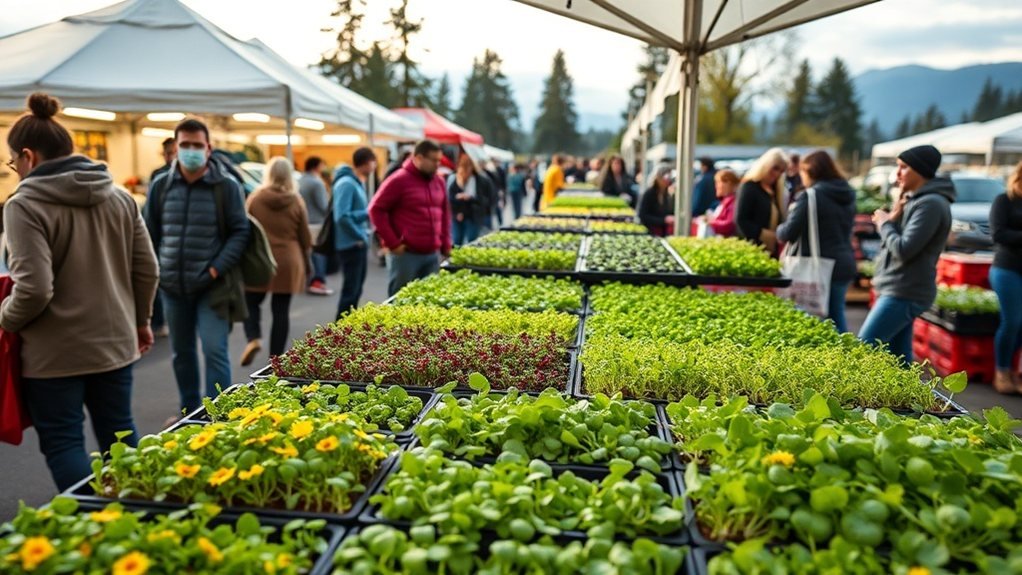
Once you’ve secured a spot, the operational realities of Washington markets come into focus quickly, and two factors shape your early experience more than any others: what it costs to hold that space and what products actually move.
Booth fees across Washington’s approximately 274 USDA-listed markets vary considerably, from roughly $20 at smaller rural markets to well over $100 per day at high-traffic Seattle venues, with some markets also charging a percentage of sales or requiring a seasonal commitment upfront. Understanding those cost structures alongside which microgreens varieties Washington shoppers consistently purchase gives you the foundation to assess whether a given market is worth your time before you load the van.
Booth Fees and Setup Basics
Before you commit to a market, you need a clear picture of what booth fees actually look like in Washington, because the range is wider than most new vendors expect.
When you sell microgreens at farmers markets across the state, daily booth fees typically run between $25 and $75, though established Seattle markets can exceed $100 per day. Farmers markets in Washington microgreens vendors frequent often charge percentage-based fees instead, commonly 8 to 12 percent of gross sales, which shifts financial risk onto higher-volume weeks.
Setup requirements vary considerably: most markets mandate a canopy, a weighted anchor system rated for wind, and a display surface at a consistent height. Confirm these specifications before purchasing equipment, since non-compliant setups result in immediate exclusion from the selling floor.
What Moves at Washington Markets
Knowing your booth costs is only part of the equation, because what you actually sell matters just as much as what you pay to be there. Farmers market Washington vendors consistently report that sunflower and pea shoot varieties move fastest, particularly in urban markets where buyers already understand raw greens.
Selling microgreens locally demands that you study each market’s demographic before committing your grow schedule to a specific variety mix. Seattle buyers, for instance, skew toward specialty crops like amaranth and sorrel, while Spokane markets tend to favor familiar, accessible options.
Your production calendar should respond to observed demand patterns, not assumptions. Track what sells out, what sits, and adjust your next grow cycle accordingly.
Getting Your Application Ready
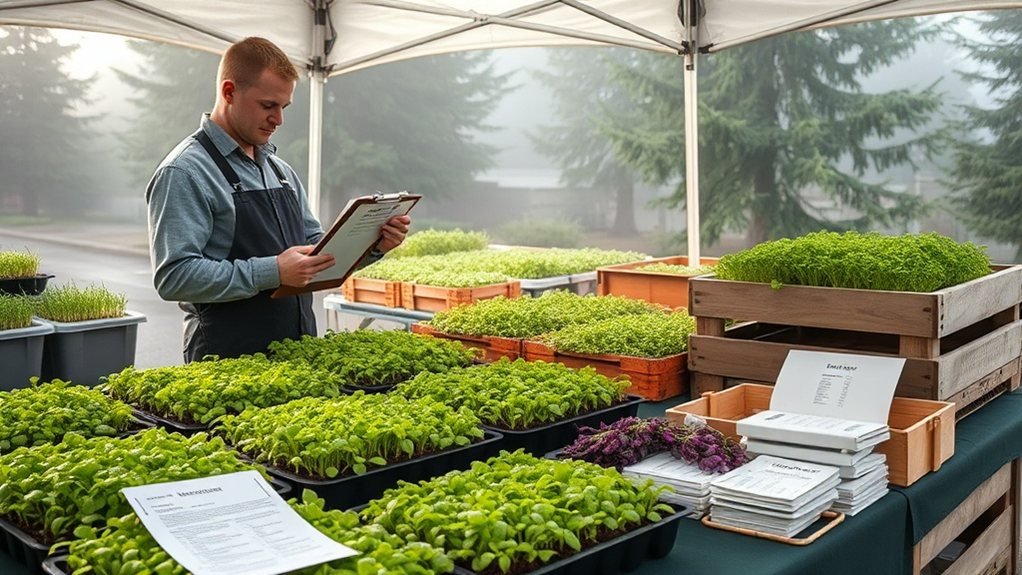
Your application is the market manager‘s first substantive assessment of you as a vendor, and a poorly constructed submission, regardless of your product’s quality, can disqualify you before you’ve set up a single table.
Most Washington market managers are evaluating whether you’re compliant with state cottage food or commercial kitchen requirements, whether your product category fills a genuine gap in their vendor roster, and whether you can demonstrate operational reliability through documentation like a business license or liability insurance certificate.
The most common mistake growers make is submitting incomplete paperwork or generic product descriptions that give the manager no clear picture of what you’re actually bringing to market.
What Market Managers Want to See
Market managers in Washington receive a high volume of vendor applications each season, and the growers who move through the process quickly tend to arrive prepared with specific documentation before they even submit the form. As a microgreens grower Washington markets evaluate, you’ll want your business license, proof of production location, and any applicable cottage food or commercial kitchen documentation ready before touching a farmers market vendor application.
Seattle-area markets, particularly those under the Neighborhood Farmers Market Alliance, scrutinize growing practices closely. Bellingham markets frequently prioritize local sourcing verification. Having your seed sourcing records and a basic production summary on hand signals operational maturity, and managers respond to that credibility. Preparation communicates seriousness before you ever speak with anyone.
Find your next Washington market at [markets.microgreensworld.com](https://markets.microgreensworld.com).
Common Mistakes to Avoid
Arriving prepared with documentation is only half the equation, because even well-organized growers routinely undermine their own applications through avoidable procedural errors.
Applying to a market without first confirming they accept specialty produce like local microgreens washington vendors offer is a common, costly oversight.
Many applicants submit incomplete booth setup descriptions, leaving managers uncertain whether the vendor understands how to get a farmers market booth configured to meet site-specific requirements.
Missing application windows by even one day eliminates your candidacy entirely, since most Washington markets close waitlists without exception.
Submitting generic product descriptions rather than specifying varieties, harvest windows, and pricing signals inexperience.
Reviewing each market’s vendor rules document before submitting, not after, separates candidates who advance from those who don’t.
Use the Market Finder to Shortcut Your Search

Narrowing down 274 farmers markets across Washington by hand is a task that compounds in difficulty the moment you factor in seasonal schedules, application windows, and geographic clustering.
The MGW Farmers Market Finder at markets.microgreensworld.com consolidates that USDA data into a searchable format, letting you filter by region before you’ve committed a single hour to cold outreach.
If you’re still figuring out how to sell microgreens systematically, starting with a filtered search by county puts the highest-density clusters, Seattle, Spokane, Bellingham, into immediate view.
A well-positioned microgreens market stand begins with selecting the right market, not just the nearest one. Employ the free Market Finder tool at markets.microgreensworld.com to identify your strongest candidate markets across Washington before you apply anywhere.
Frequently Asked Questions
Can I Sell at Multiple Washington Farmers Markets Simultaneously?
You can sell at multiple Washington farmers markets simultaneously, but you’ll need separate applications, market fees, and enough product to cover each location. Staff each booth or find a trusted person to run one while you run another.
Do Washington Markets Require Liability Insurance for Microgreens Vendors?
Most Washington farmers markets require liability insurance, typically $1 million per occurrence. You’ll need to name the market as an additional insured. Get your certificate before applying so you’re not scrambling at acceptance.
How Early Should I Arrive to Set up My Booth?
Arrive 90 minutes before gates open. You’ll need time to unload, orient your table, arrange product, and troubleshoot anything that’s off before customers walk in. Early setup also signals professionalism to market managers watching new vendors.
Are There Markets That Run Year-Round in Washington State?
Yes, a handful of Washington markets run year-round, mostly in Seattle and Spokane. Indoor winter markets keep you selling through the slow months, but you’ll need to confirm each market’s specific schedule at markets.microgreensworld.com.
What Happens if My Application Gets Rejected by a Market?
Don’t take it personally. Ask the manager for feedback, fix what you can, and reapply next season. Meanwhile, apply to other markets so you’re not waiting on one decision.
Wrap-up
You’ve got the landscape now, so put it to work. Washington’s 274 listed markets give you real selection, but the vendors securing consistent spots aren’t waiting for spring to feel urgent. They’re making calls in late winter, submitting clean applications, and showing up prepared. Start your search at markets.microgreensworld.com, identify your targets early, and move before the available tables disappear.
Leave a Reply