
Utah’s roughly 112 USDA-listed farmers markets offer microgreens vendors a structured entry into specialty produce sales, with the Salt Lake City, Provo, and Park City corridor representing the strongest concentration of viable opportunities. Salt Lake City buyers treat microgreens as a staple, Park City’s premium demographic supports higher price points, and Provo skews value-driven. You’ll need documentation, competitive scouting, and production schedules aligned to market calendars before applying. There’s considerably more to unpack across each stage of the process.
Key Takeaways
- Utah has approximately 112 USDA-listed farmers markets, with the highest density in Salt Lake City, Provo, and Park City.
- The primary selling season runs late April through October, with peak foot traffic from June through September.
- Salt Lake City treats microgreens as a staple, Park City favors premium varieties, and Provo skews toward value-oriented offerings.
- Top-selling microgreen varieties at Utah markets include sunflower, pea shoots, and radish, with placement driving purchases significantly.
- The MGW Market Finder lets vendors filter Utah markets by region, season, size, and current application availability.
Farmers Markets in Utah for Microgreens Vendors
Utah’s approximately 112 USDA-listed farmers markets represent a substantial commercial landscape for microgreens vendors, with market density concentrated in Salt Lake City, Provo, and Park City, where health-conscious consumer bases and established vendor ecosystems create predictable, recurring demand.
You’re working with a predominantly spring-through-fall seasonal calendar, which means your production schedule, variety selection, and booth logistics all need alignment with that window rather than a year-round model.
Understanding both the market count and the seasonal structure before you start making calls or submitting applications will save you considerable time and position you to enter the right market at the right point in the calendar.
Why Utah Markets Are Worth Your Attention
Across the western United States, Utah stands out as one of the more active states for farmers market activity, with roughly 112 markets listed in the USDA database. For a microgreens farmer market vendor, that volume represents genuine optionality, not just a broad landscape to get lost in.
Utah farmers markets concentrate heavily around Salt Lake City, Provo, and Park City, which means you can build a multi-market route without excessive travel. The season runs primarily spring through fall, giving you a defined window to plan production cycles around actual sell dates.
Understanding this structure before you approach a market manager puts you ahead of vendors who show up without knowing the competitive and logistical conditions already in place.
What the Utah Market Season Looks Like
The Utah farmers market season generally opens in late April or early May, depending on the region, and runs through October, with some markets extending into early November in warmer valleys. Salt Lake City venues tend to activate earlier than rural markets, giving you a longer selling window if you position yourself there first.
As a microgreens vendor in Utah, you’ll find that the peak window runs June through September, when foot traffic justifies consistent production scheduling. Park City markets operate on a compressed summer timeline due to elevation, while Provo-area farmers markets in Utah maintain steadier mid-season attendance. Plan your germination cycles around market start dates, not around when you feel ready, because the calendar won’t wait for your first harvest to align perfectly.
How to Find the Right Market in Utah

Before you apply anywhere, you need to evaluate each market on foot traffic, vendor competition, and whether the customer base actually buys specialty produce.
Salt Lake City’s urban corridor, anchored by markets in Sugar House and the Downtown area, draws health-conscious shoppers who already understand microgreens, which shortens your education curve considerably.
Provo and Park City serve different demographics entirely, with Park City skewing toward high-income seasonal residents who expect premium pricing, while Provo’s markets tend toward value-driven buyers near a large university population.
What to Look for Before You Apply
Finding the right market before you submit a single application will save you time, money, and the frustration of landing a vendor spot that doesn’t move product.
Scout each microgreens farmers market Utah location in person before committing, noting foot traffic patterns, customer demographics, and whether existing vendors already sell specialty produce. A market saturated with salad greens will compress your margins before you unpack your first tray.
Understanding how to get a farmers market booth starts with reading each market’s vendor rules carefully, because some Utah markets restrict certain crop categories or require proof of production acreage. Attendance frequency, booth fees, and seasonal duration all determine whether a given market justifies your investment of time and growing capacity.
Markets Near Salt Lake City
Salt Lake City and its surrounding communities represent one of the densest concentrations of farmers market activity in Utah, giving microgreens vendors a realistic range of options across varying customer demographics, booth fee structures, and seasonal schedules.
When you sell microgreens at a farmers market in this region, you’re working within a competitive but high-traffic environment where educated buyers actively seek specialty produce. The Downtown SLC Farmers Market draws substantial foot traffic, while suburban markets in Sandy, Murray, and Millcreek offer lower entry barriers with comparably engaged customer bases.
Understanding which salt lake city farmers market aligns with your current production volume helps you avoid overcommitting inventory before you’ve established consistent weekly yields across your growing operation.
Markets Near Provo and Park City
Provo and Park City occupy distinct market ecosystems within Utah’s broader vendor landscape, and understanding those distinctions shapes how you position your microgreens operation before you ever submit an application.
The Provo farmers market draws a price-conscious, community-oriented buyer base, meaning your booth presentation and pricing structure need to reflect that demographic’s expectations. Park City operates differently. The Park City farmers market attracts higher disposable income, tourism-adjacent foot traffic, and buyers accustomed to premium specialty produce. Your packaging choices and variety selection should shift accordingly between these two contexts.
Utah’s USDA database lists approximately 112 markets statewide, giving you genuine options across both corridors. Employ the free Market Finder at markets.microgreensworld.com to identify which specific markets in the Provo and Park City areas currently have vendor opportunities.
What to Expect When You Get There

Once you’ve secured a spot, your immediate priorities shift to understanding the operational and commercial mechanics of the market itself. Booth fees at Utah farmers markets typically range from modest daily rates to seasonal contracts, and knowing which structure a market employs affects how you calculate your break-even volume before you load the van.
What sells well in Utah markets, particularly in Salt Lake City and Park City, tends to skew toward culinary varieties like sunflower, pea shoots, and radish, reflecting a customer base that cooks with intention and responds to clear, confident product communication from the vendor.
Booth Fees and Setup Basics
Booth fees across Utah’s farmers markets vary more than most new vendors expect, and understanding that variance before you apply saves you from budget surprises mid-season. Daily fees typically range from $15 to $75, depending on market size, foot traffic, and location prestige. Seasonal contracts often reduce your per-day cost significantly.
| Market Type | Typical Daily Fee | Seasonal Option |
|---|---|---|
| Neighborhood/small | $15–$25 | Rarely available |
| Mid-size city market | $30–$50 | Sometimes offered |
| Salt Lake City anchor | $50–$75 | Common |
| Park City premium | $60–$90 | Competitive waitlist |
| Provo university-adjacent | $25–$45 | Available mid-season |
For your farmers markets utah microgreens setup, budget a six-foot table, canopy, and weights. Your microgreens booth farmers market footprint should project professionalism from day one.
What Moves at Utah Markets
Selling microgreens at Utah markets will test your assumptions about what customers actually reach for, and the variety that moves fastest often surprises first-time vendors. Sunflower shoots consistently perform well across multiple Utah locations, particularly in Salt Lake City, where health-conscious buyers treat them as a staple rather than a novelty. Radish microgreens, with their sharp, recognizable flavor, attract customers who already cook with intention.
Pea shoots move steadily when positioned near prepared food vendors, because proximity influences impulse purchasing. As farmers market Utah vendors hone their tables, they learn that presentation and placement drive decisions more than variety count alone. When you microgreens sell at farmers market events repeatedly, seasonal patterns become readable, and you stock accordingly rather than guessing.
Getting Your Application Ready
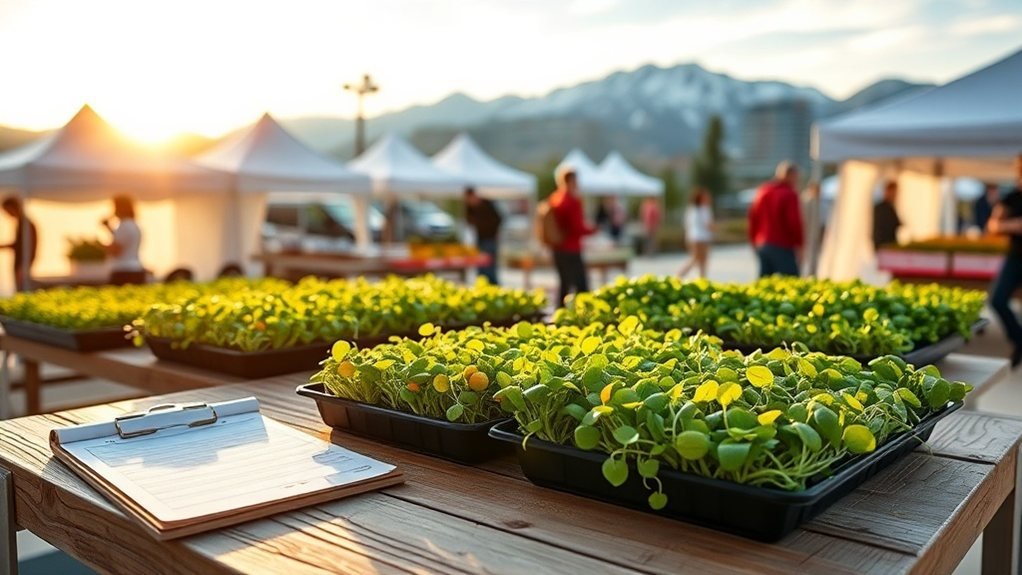
Your application is the first data point a market manager employs to assess whether you’re a productive fit for their vendor lineup, so precision and completeness matter more than enthusiasm.
Most Utah market managers evaluate product category, production scale, and compliance documentation simultaneously, meaning an incomplete submission signals operational immaturity before you’ve said a word.
Understand what each market prioritizes, whether that’s locally-sourced growing inputs, organic certification, or product diversity, and tailor your submitted materials to reflect those criteria explicitly.
What Market Managers Want to See
Getting accepted into a Utah farmers market starts well before you fill out an application, because market managers are evaluating your operation as a whole, not just your product. As a microgreens grower Utah markets will scrutinize your food handler certifications, production documentation, and liability insurance before anything else.
Most Utah market managers want confirmation that your growing environment meets basic health code standards, particularly regarding water source and sanitation. Your display setup matters too, since managers visualize how your booth will function within their overall vendor mix.
As a farmers market vendor Utah coordinators will ask whether you can commit to consistent weekly attendance throughout the season. Demonstrating operational reliability through your application materials signals professionalism that distinguishes serious growers from those simply testing the waters.
Common Mistakes to Avoid
Most application rejections from Utah farmers markets aren’t about product quality at all, but rather about avoidable procedural oversights that signal operational immaturity to market managers.
Submitting incomplete paperwork, particularly missing food handler certifications or proof of liability insurance, immediately disqualifies vendors hoping to sell microgreens at farmers market venues across Salt Lake City or Provo.
Many applicants offering microgreens for sale utah overlook booth dimension requirements, which creates logistical conflicts managers can’t accommodate mid-season.
You should also verify that your application addresses product labeling compliance, since Utah’s cottage food regulations contain specific requirements that market managers actively scrutinize.
Submitting generic product descriptions rather than specific varietal offerings further signals that you haven’t researched the market’s existing vendor composition.
Use the Market Finder to Shortcut Your Search

Searching through 112 farmers markets one by one is a slow, inefficient process, and the MGW Market Finder at markets.microgreensworld.com consolidates that USDA data into a single, searchable interface built specifically for vendors like you.
Rather than manually cross-referencing schedules and locations, you can filter by region, season, and market size to identify where local microgreens Utah demand actually concentrates. Salt Lake City, Provo, and Park City each carry distinct vendor dynamics, and knowing which markets accept new applications saves you from pursuing dead ends.
The farmers market vendor application process moves faster when you’ve already vetted each opportunity before making contact. Employ the free Market Finder at markets.microgreensworld.com to narrow your list and approach the right markets with precision.
Frequently Asked Questions
Can I Sell Microgreens at Utah Farmers Markets Without a Business License?
You can often sell without a business license at smaller Utah markets, but many require a cottage food registration or basic vendor permit. Check each market’s application requirements before assuming you’re covered.
How Do Utah Cottage Food Laws Affect Microgreens Sales at Markets?
Utah’s cottage food laws don’t cover microgreens since they’re a fresh produce item, not a processed food. You’ll sell under agricultural exemptions instead, which actually gives you a simpler path to market.
Do Utah Markets Require Vendors to Grow Everything They Sell?
Utah doesn’t have a statewide grow-your-own rule, but individual markets set their own sourcing policies. Check each market’s vendor agreement carefully before you apply, since requirements vary widely.
What Insurance Do Utah Farmers Market Vendors Typically Need to Carry?
Most Utah markets require you to carry general liability insurance, typically $1 million per occurrence. You’ll often need to list the market as an additional insured on your policy before your first selling day.
Can I Vend at Multiple Utah Markets on the Same Weekend?
Yes, you can vend at multiple Utah markets on the same weekend, but you’ll need separate applications, fees, and enough product to stock each booth fully without running short.
Wrap-up
You’ve got the framework now, so it’s time to put it to work. Utah’s 112 markets give you real options across Salt Lake City, Provo, and Park City, but none of those opportunities convert without deliberate research, a polished application, and production timing that matches your target market days. Utilize the market finder to compress your research phase, identify vendor openings that align with your capacity, and position your microgreens operation for a productive market season.
Leave a Reply